

McDonald's McCrescent
McDonald's had a great idea for a new sandwich, they just chose the wrong time to sell it.

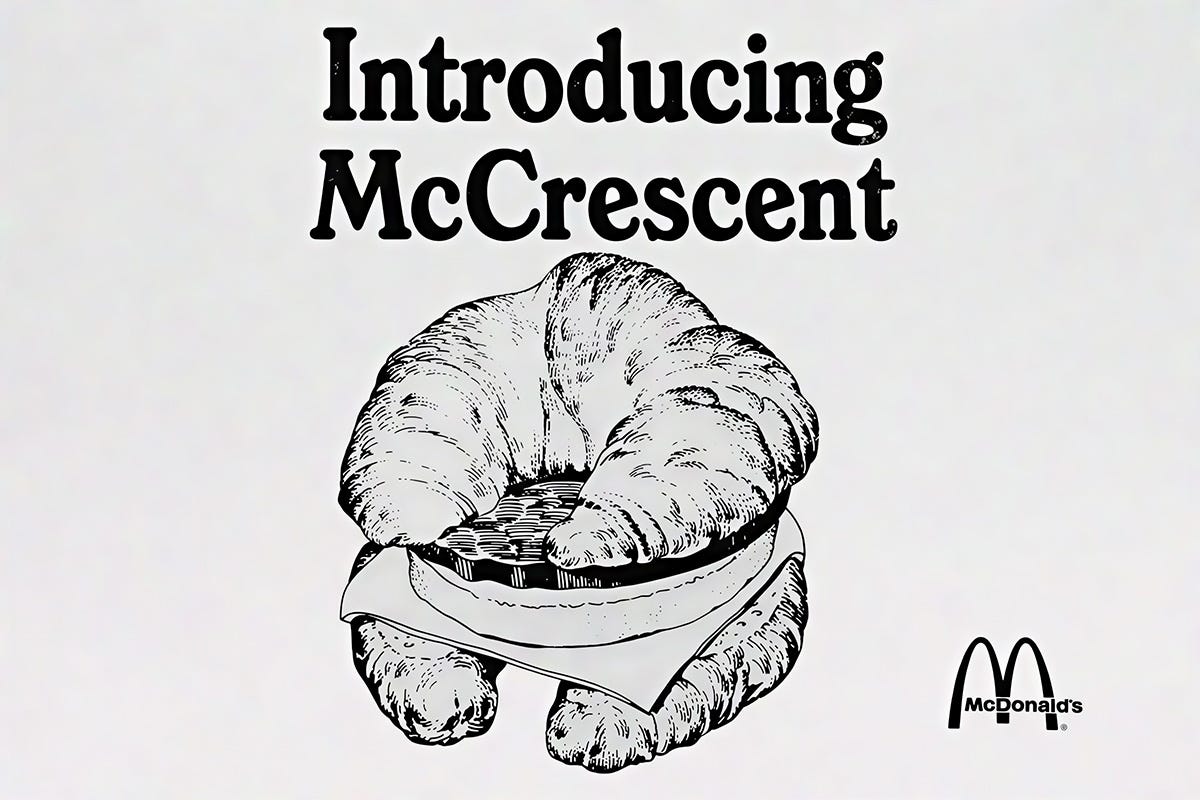
Most people have never eaten a McDonald’s McCrescent. That includes me. The sandwich only existed in Rockford, Illinois, for about three months in 1983, and it never expanded anywhere else. It was a food ideas, as others would demonstrate, but it sat on McDonald’s lunch menu instead of breakfast, and that turned out to be a big mistake.
By the early 1980s, McDonald’s was already a company running constant small experiments. Some worked out. A chicken product first spotted testing in the Midwest in the mid 1970s eventually became Chicken McNuggets and turned into one of the biggest hits in company history. Others disappeared almost as soon as they arrived. The McCrescent belongs to the second group, but its short life offers an unusually clear look at how a single decision, made somewhere far from the test kitchen, can sink an otherwise reasonable idea.
The sandwich arrived just as croissants were becoming a real fast food trend. Sara Lee had introduced its national line of frozen croissants five months earlier, and by the fall of 1983 the pastry was turning up everywhere a fast food chain or brand could put it. Terry Moran, then a spokesperson for Sara Lee, told the Fort Lauderdale News at the time that “what was a staple of Paris, France is now available in Paris, Illinois.” I am sure the French were thrilled to see this trend.
McDonald’s wasn’t alone in jumping on the croissant bandwagon in 1983. Burger King was already testing its own version around the same time, filling croissants with ham, egg, and cheese under the name Croissandwich (not Croissan’wich, yet) in test markets like South Florida, Savannah, and Hartford. Even the much smaller seafood chain, Boston Sea Party, ran ads for something it also called a Croissandwich.
McDonald’s version showed up in Rockford that same year, a croissant filled with egg, Canadian bacon, and American cheese. Frank Patton, who had opened the first McDonald’s in the Rockford area more than 20 years earlier, said the company considered the region a good place to test new products, and that the sandwich would stay limited to the area’s 16 restaurants for now. The company turned the launch into a real event, running a public contest called “You Name It” that pulled in more than 10,000 entries. The winner was Mary Hannawell, a Rockford freelance artist whose entry combined the shape of the new sandwich with the first syllable of McDonald’s own name. She won a trip for two to Paris and a $1,000 bonus.
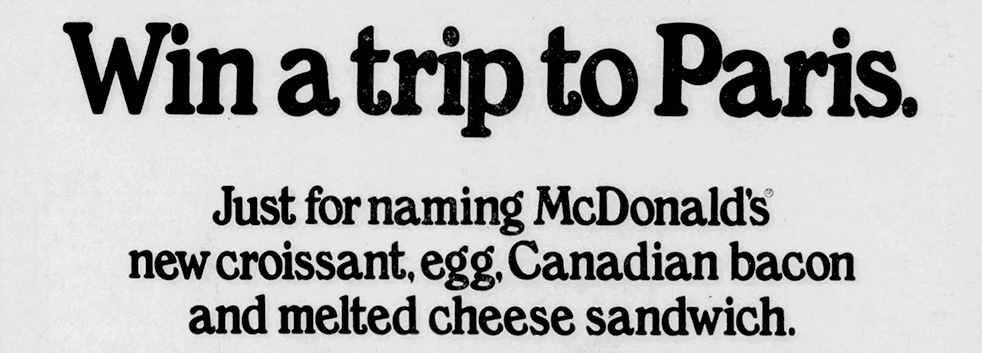
Why McCrescent and not McCroissant? The Crescent Roll name was popularized by Pillsbury when they released a product under that name in 1965. Even thought the products are different, they looks similar and some Americans would even use them interchangeably. Part of me wonders if McDonald’s preferred the name because it was just a bit easier for most people to spell. Although maybe we were just seeing how much they like to reference the moon.
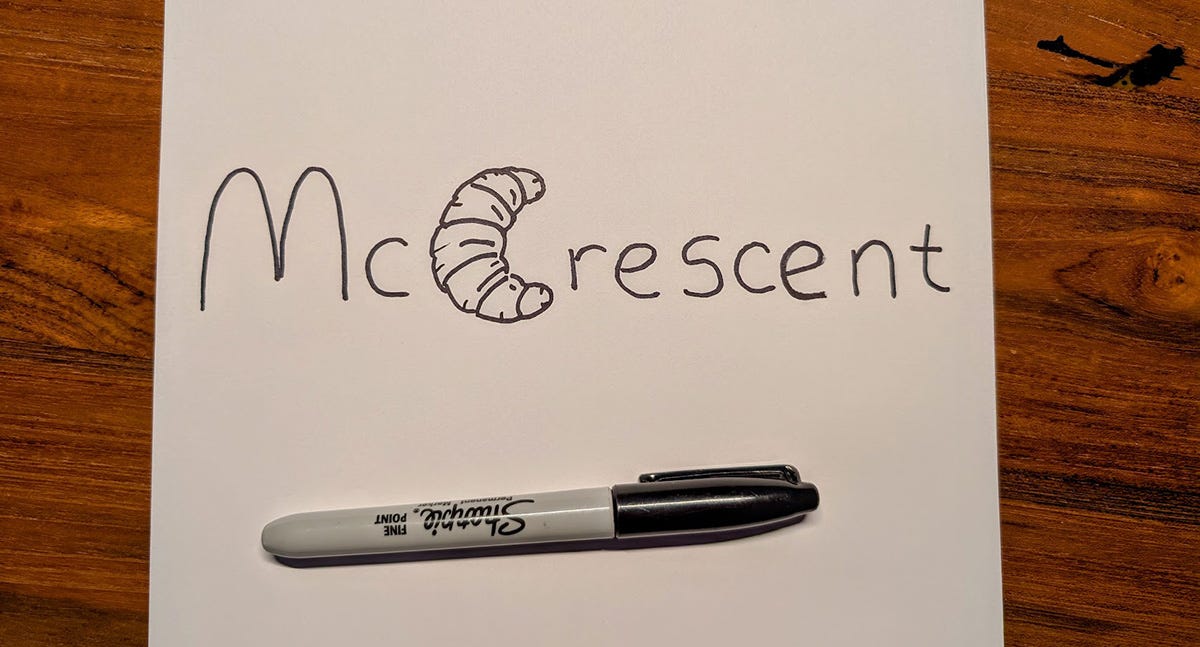
Now I cannot find any examples of what a logo or promo would have looked like, but I can guess. So I decided to draw my own. First I did the McCrescent with the C replaced with a croissant. I could also see this done with many croissant letters.
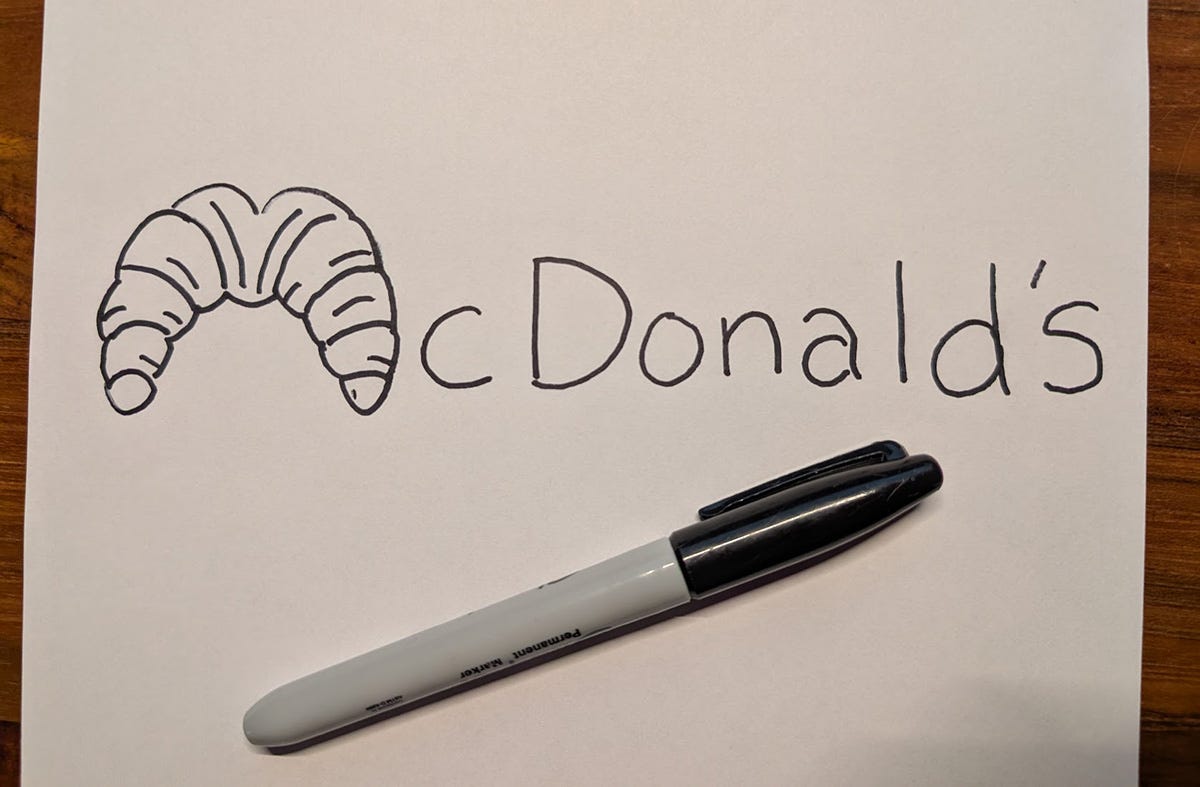
I also thought to do a general McDonald’s logo. I originally tried it with the C as a sideways croissant as well, but it looked too busy.
Fewer than two weeks after Hannawell’s win, McDonald’s pulled the sandwich. Eric Miller, the company’s operations manager for the Rockford area, announced on October 11 that the McCrescent, on the market for about three months by then, would come off the menu and go back to the kitchen for more testing. “It did not have the acceptance we expected,” he said. He added that it had only been sold after 11 in the morning, which meant competing directly with lunch sandwiches instead of other breakfast items. The company had pulled other Rockford test products before, he said, including a steak sandwich and an earlier quarter pound burger called the McFeast.
Hannawell, interviewed again for the story, said she thought the sandwich would have sold better as a breakfast item, since it had to compete with lunch food instead of other morning options. She told the paper she preferred it to the Egg McMuffin because of the softer roll, and that McDonald’s had simply picked the wrong part of the day to sell it.
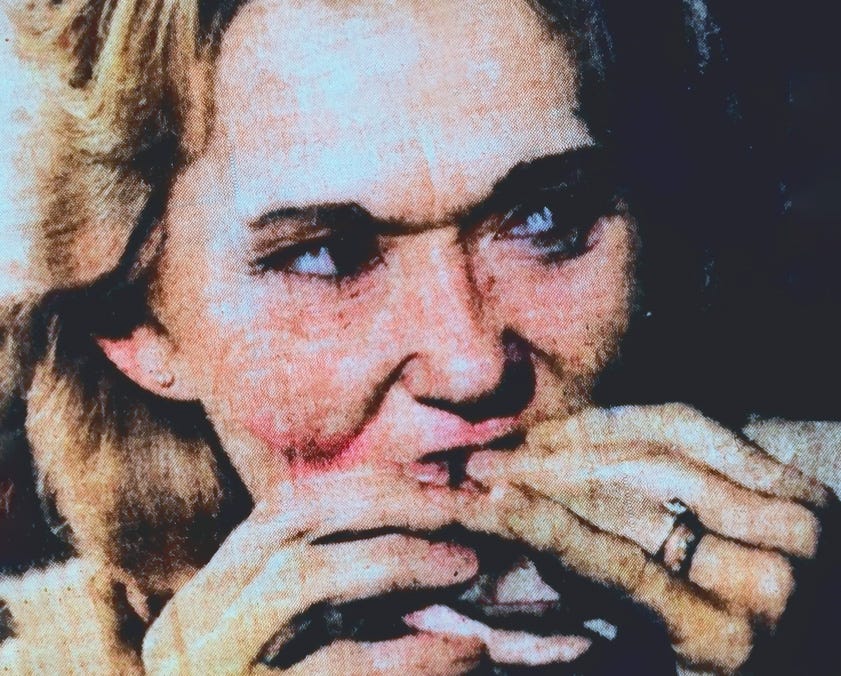
An editorial two days later mocked the decision, noting that “sophisticated market research costing untold sums” had somehow missed what one customer had figured out for free. The piece nicknamed the sandwich the McFlop and suggested that if it were ever revived successfully, Hannawell should get another trip to Paris out of it.
She never got one. The McCrescent did not return to Rockford, or anywhere else. In the years since, according to the company’s own history of its breakfast menu, McDonald’s added biscuit sandwiches in 1986 and breakfast burritos in 1991, but never returned to the croissant format the McCrescent briefly occupied. Maybe that is because their big rival at the time already staked a big claim on the format.
Burger King’s own croissant sandwich followed a very different path. It launched in test markets that same year under the eventual name Croissan’wich, and by that November had gotten the green light to expand company wide, according to a wire service report picked up by USA Today. Newspaper ads for it kept spreading through 1984, including a big discount push with coupons in papers for lower prices and free sandwiches with the purchase of another, across its ham, sausage, and bacon versions. It spread quickly and by July 1984 it had reached Alaska, priced at $1.49 and already Burger King’s second breakfast menu change of the year, according to the Anchorage Times. Soon newspapers were running taste tests pitting the Croissan’wich against McDonald’s Egg McMuffin, and customers were picking sides in the same debate.
One of those comparisons came from Rockford itself. In May 1984, a Register Star columnist named Pat Cunningham noticed a Burger King commercial on television and wondered whether the company had borrowed its idea from the very contest that had produced the McCrescent the year before. He then laid out, without much sympathy, why McDonald’s version had failed while Burger King’s was thriving. McDonald’s, he pointed out, had been selling essentially the same sandwich, just at the wrong meal time.
It was a big mistake. Burger King’s Croissan’wich is still on its breakfast menu more than 40 years later, having survived a wider breakfast overhaul in 1985 that added French toast sticks to the lineup, a plant based version introduced in 2020, and a “Fully Loaded” upgrade that now stacks ham, bacon, and sausage into one sandwich. The McCrescent lasted three months in one Illinois city, sold at the one time of day almost guaranteed to bury it, and never got the second chance at the right mealtime that Hannawell always thought it deserved.
"...what was a staple of Paris, France is now available in Paris, Illinois.”
Though not in Paris, Ontario...