

McDonald's McFeast
The short American life and long international afterlife of a forgotten burger

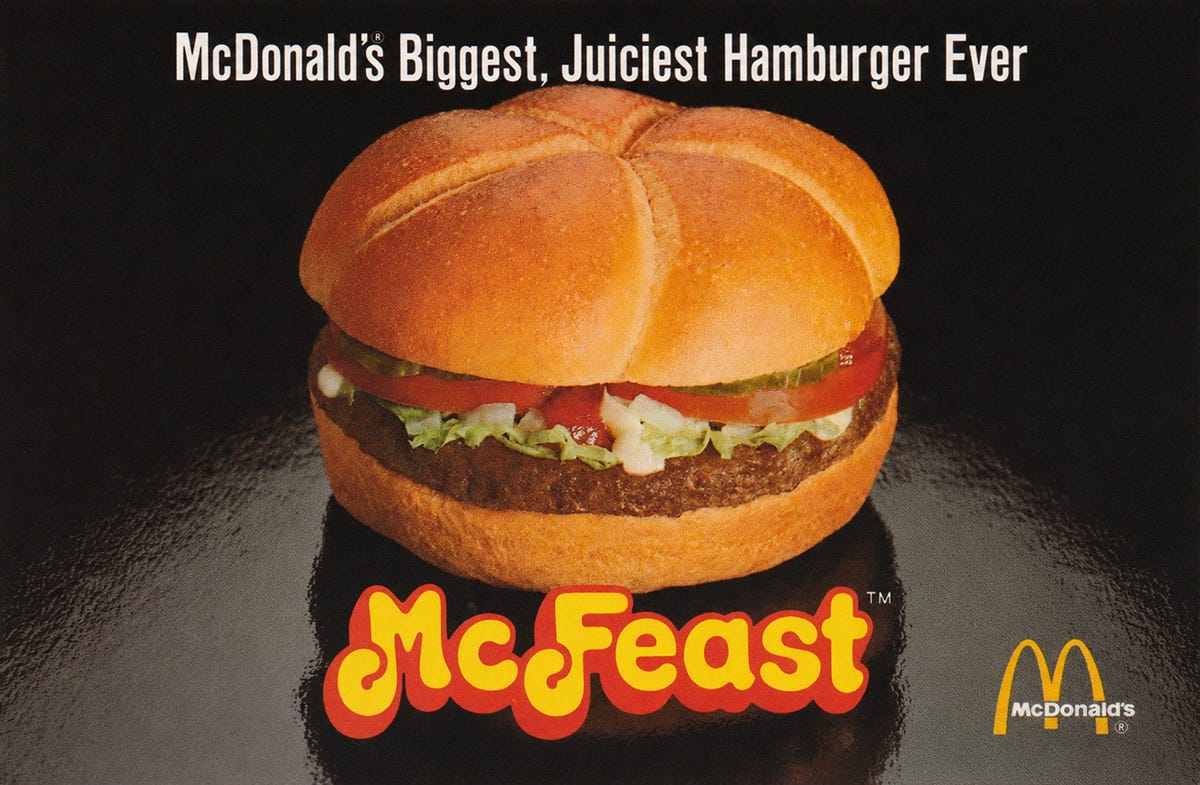
My mom loved tell me about food that didn’t exist anymore. I was a fast food kid from a fast food family, so I always wanted the details. What was it. Where did she have it. Why did it go away. The McFeast came up more than once in these talks, and for a long time it was mysterious since my mom was light on the details. All I know is that it was a sandwich from before I was born that some people remembered fondly, but didn’t catch on.
It turns out the McFeast had a longer and stranger life than I expected. The sandwich started as a quiet experiment in Montana, became a genuine weapon in the burger wars of the late 1970s, and lingered in pockets of Texas into the 1980s before more or less vanishing from the United States. Except it never actually disappeared. The McFeast moved to the other side of the world, where it has been showing up and getting pulled off menus again for almost forty years.
In November of 1975, the Billings Gazette ran a short piece under the headline “McDonalds test sandwich here.” Billings, Montana was one of the spots chosen to try out a new “giant sized McFeast,” a deluxe hamburger with mayonnaise and tomatoes packed into a yellow styrofoam box. According to Milo Richards, a company supervisor overseeing the local franchises, the sandwich was sold nowhere else in the world but the three Billings locations. The article noted that twenty two owner operators from McDonald’s restaurants in New York had flown out on a private company jet just to see how the McFeast was doing. One local owner put it bluntly. “They want it, but they aren’t going to get it,” he said, explaining that new products got tested for years before they made it onto national menus.
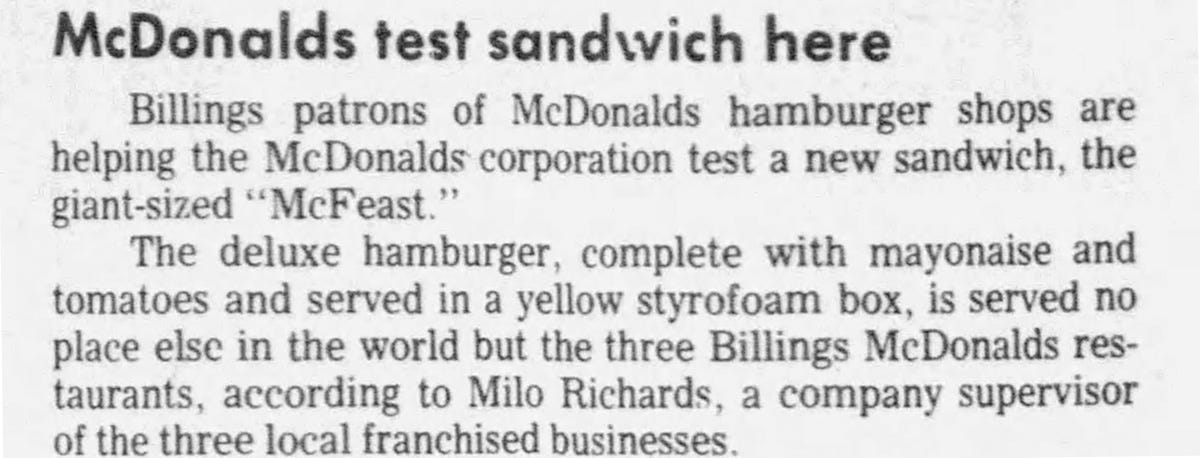
That same article mentioned something else being tested in the Midwest at the time, a new item called McDonald’s chicken. It would be years before that became Chicken McNuggets, but it is a reminder that McDonald’s was running a lot of these little experiments at once, and most people only ever heard about the ones that worked.
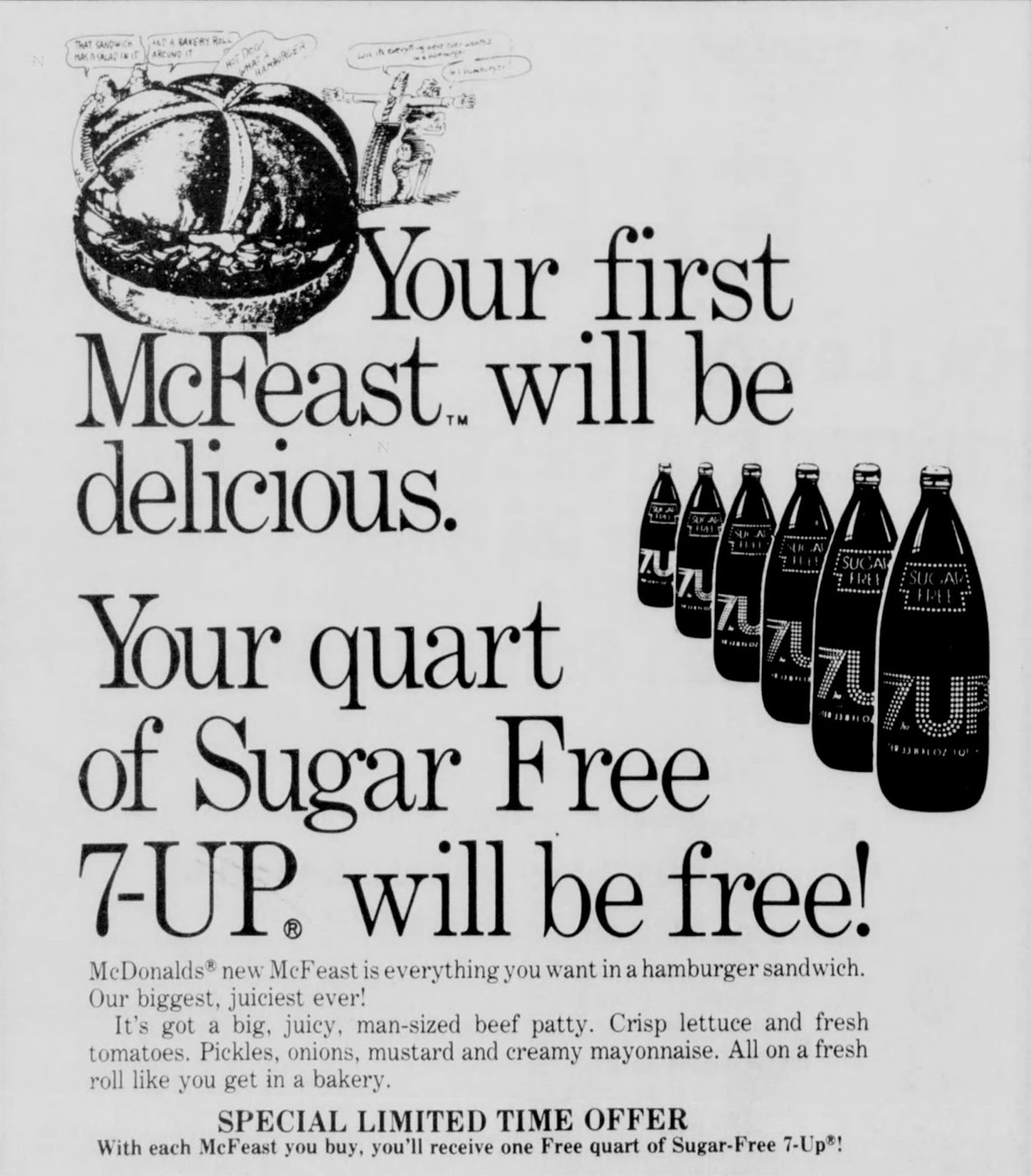
The McFeast kept moving through test markets over the next year. By the spring of 1976, it had reached Irving, Texas. An ad in the Irving Daily News from April of that year promised that your first McFeast will be delicious, paired with a free quart of sugar free 7 Up. The copy described it as everything you want in a hamburger sandwich, with a big juicy man sized beef patty, crisp lettuce, fresh tomatoes, pickles, onions, mustard, and creamy mayonnaise, all on a fresh roll like you get in a bakery. The offer only ran for two days at two specific Irving locations.
People who worked at McDonald’s around this time remember it well. Former employees from Minneapolis, San Diego, and the Bakersfield area have described a quarter pound patty served on a kaiser roll, loaded with mayonnaise, lettuce, tomato, and pickles, and one person who tried it as a kid in the late 1970s nicknamed it the McMess because of how much fell out of the sandwich with every bite. Reflecting on it years later, that same person said it seemed like McDonald’s was testing out their version of the Whopper to compete with Burger King. A Minneapolis worker from the 1976 to 1977 school year remembered it the same way, calling it “essentially a Whopper, but the Kaiser roll made it better.”
That comparison was not just a customer’s guess. By January of 1978, McDonald’s locations in Eau Claire, Wisconsin were running newspaper ads with a guy in a hard hat holding the sandwich like a trophy, under the line you’re gonna love our new McFeast a lot. The tagline that ran through this whole era was simple. McFeast. It’s a lot to love. By the fall of that year, the comparison to Burger King’s flagship sandwich became official. The Star Tribune in Minneapolis ran a Wall Street Journal piece in April of 1978 with the headline Burger King declares war to head off Big Mac attack. Buried in that story was the detail that McDonald’s counterattack was already being mapped out. To complement its Big Mac, the company was testing in more than 400 stores a Whopperlike sandwich called the McFeast, loaded with lettuce and tomato slices and nicknamed the Whopper Stopper inside the company.
The nickname traveled. A Toronto Star feature from July of 1978 profiled George Cohon, the head of McDonald’s restaurants in Canada, and used the same phrase. The article described a lettuce and tomato concoction being tried in test markets, called the McFeast, and noted that at what the piece called Hamburger Central, it was known as the Whopper Stopper. Cohon would not say much about it directly, though he did admit the company was experimenting with onion rings around the same time, as if the McFeast was just one of several things being thrown at the wall to see what stuck.
McDonald’s would return to some of this same territory in the 1990s with the Arch Deluxe, another quarter pound burger with lettuce, tomato, a different bun, and its own sauce. But the Arch Deluxe was trying to be the grown up McDonald’s burger. The McFeast seems more straightforward, like McDonald’s taking a swing at the Whopper with the pieces it already knew how to use
Back in the United States, the McFeast was still rolling out city by city. A reader question in the Abilene Reporter News from September of 1978 explained why a new arrival in town had not been able to find a McFeast at the local McDonald’s. The paper’s answer was that the sandwich was still in the experimental stages, approved for only three test markets, and that the reader happened to have moved from one of them. To get a McFeast at that point, the answer said, you had to go to the Dallas Fort Worth area. The same answer described the McFeast as a little bigger than a Quarter Pounder, with lettuce, tomatoes, mustard, mayonnaise, and onions.
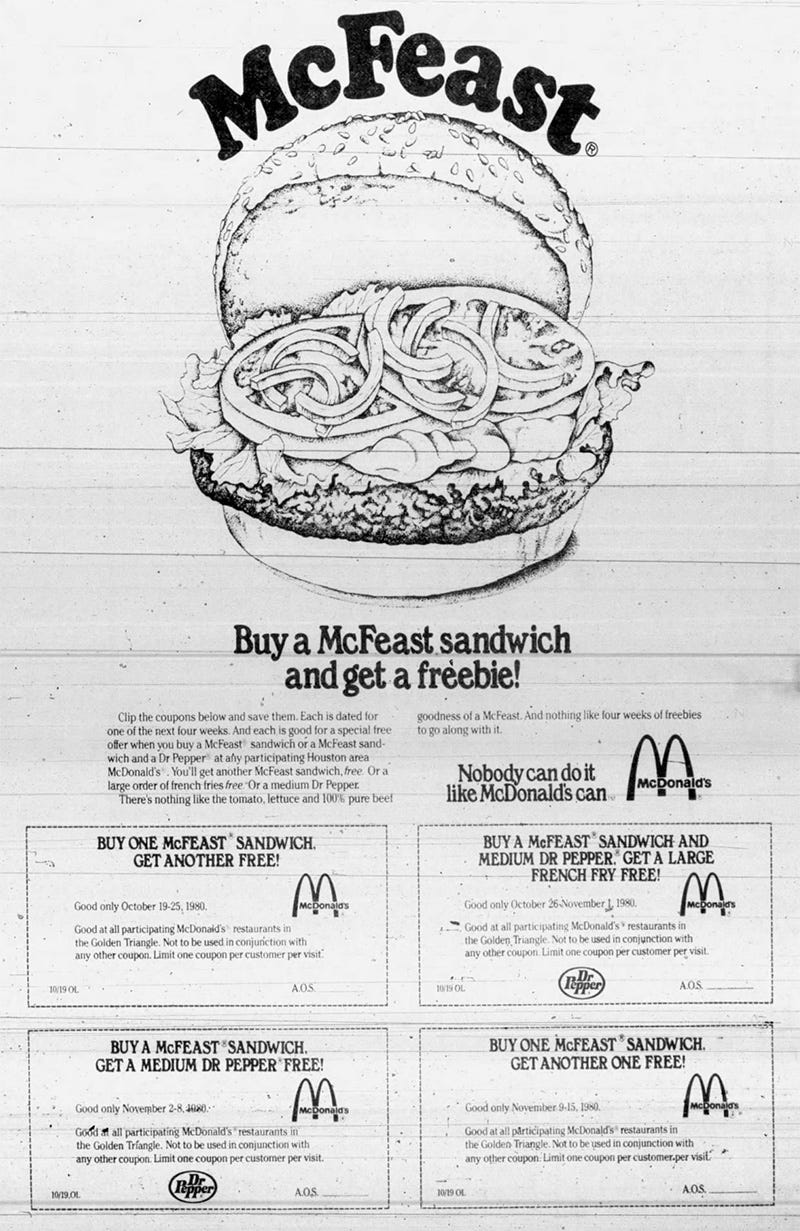
By 1980, the McFeast was still hanging on in parts of Texas, even as it was fading elsewhere. The Orange Leader ran a full page ad in October of that year showing an enormous illustrated McFeast and offering a month of weekly coupon deals at McDonald’s locations across the Golden Triangle area near the Louisiana border. Buy one McFeast and get another free, or get a large fry or a Dr Pepper thrown in, depending on the week. The ad called it nothing like the goodness of a McFeast, with tomato, lettuce, and one hundred percent pure beef.
And yet, somewhere in this same stretch of years, McDonald’s corporate had quietly decided the experiment had not worked. The clearest evidence comes from October of 1983, in the Rockford Register Star. The story was actually about a different failed product, a breakfast product called the McCrescent (coming soon) that was being pulled from test markets around Rockford, Illinois. In the course of explaining that decision, the local operations manager for McDonald’s, Eric Miller, ran down a short list of other items the company had tried and dropped in that area, including a steak sandwich and, before that, the McFeast, which he described as a quarter pounder on a sesame seed bun with lettuce and tomatoes. Miller also pointed out that this kind of pullback was not unusual, since McDonald’s tested plenty of products regionally before deciding whether they were worth keeping. In the same breath, he mentioned that Chicken McNuggets, the descendant of that mysterious McDonald’s chicken from the 1975 Billings article, had become one of the company’s most successful products.
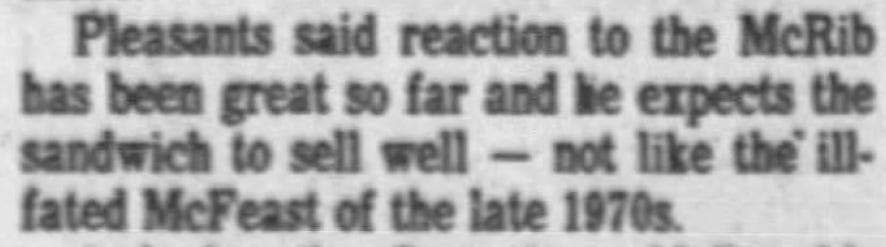
A year before that, in May of 1982, an Atlanta Constitution piece about the launch of the McRib made the McFeast’s fate even more explicit, if a little unkind. The story quoted a local McDonald’s franchise group president expressing confidence that the McRib would sell well, unlike what the article called the doomed McFeast of the late 1970s. By the time high schoolers in Archdale, North Carolina ran a burger preference survey for their school paper in January of 1985, the McFeast was still familiar enough as a name to include as one of the options, alongside the Whopper, Wendy’s Triple, and Burger King’s Big Deluxe, even though it was gone from menus by then. That is often how these things go. The name outlives the product by a few years in the public memory before it fades for good.
So that is roughly the McFeast’s North American story. It started as a quiet test in Montana in 1975, then crawled through Texas, Minnesota, California, Wisconsin, and Canada over the next several years. For a while it had a starring role in the burger wars of the late 1970s as McDonald’s answer to the Whopper. Then it died a fairly ordinary corporate death by the early 1980s, confirmed almost as an afterthought in a newspaper story about a completely different sandwich.
But the McFeast was not done. It just moved.
By the early 1980s, the McFeast had landed in Australia, where it would go on to have a much longer and more complicated career than it ever had in the United States. A Sydney Morning Herald restaurant column from November of 1982 described ordering a McFeast at a McDonald’s near Central Station in Sydney. The reviewer called it the nearest thing to a traditional Australian hamburger, since it contained tomato, though they found it bland and not hot enough. For the record, it contained a slice of tomato, two pickles, tomato sauce, lettuce, a meat patty, and cheese, all stacked between two pieces of a toasted sesame seed bun.
From there, the Australian version took on a life of its own, eventually becoming known as the McFeast Deluxe, with a sauce blend built around mustard, ketchup, and the chain’s McChicken sauce. According to a 2024 retrospective from the food site Mashed, this version stuck around through the 1980s and 1990s before being discontinued. It returned in a slightly revised form in 2009, vanished again, came back in 2011 for another limited run, and was pulled in 2021. As of May 2023, the McFeast was on the menu once more, although still only for a limited time. That 2023 return was covered by delicious.com.au, which framed it as the resurrection of a cult favorite. The writer described the McFeast as having been quietly removed from the menu in 2021 without warning, leaving what she called a hamburger shaped hole, and noted that McDonald’s marked the comeback with a lunch deal pairing the McFeast with small fries and a small soft drink for $5.95, available daily between half past eleven in the morning and half past two in the afternoon.
Australia also flirted with a homegrown variation called the McOz, built around the distinctly Australian addition of beetroot, alongside lettuce, tomato, onion, cheddar, ketchup, and mustard. According to the food history site Australian Food Timeline, the McOz was discontinued in 2008, briefly reintroduced in 2011, and then revived again in 2018 as part of a five dollar lunch deal, but it never became a permanent fixture and was eventually replaced on the regular menu by the McFeast.
The McFeast name became enough of a fixture in Australian pop culture that a television personality borrowed it. The comedian Libbi Gorr created a character called Elle McFeast for the ABC series Live and Sweaty in the early 1990s, later hosting her own talk show under the same name. It is a strange kind of immortality for a hamburger, getting turned into a parody of a brash Australian celebrity persona, but it suggests the McFeast had genuinely worked its way into the culture there in a way it never managed in the United States.
The McFeast also crossed into South Africa, though in a different form (so more in name). The South African version, as described by Mashed, uses two beef patties instead of one, includes onions but not pickles, and is topped with McChicken sauce alongside something called braai sauce, a tomato based condiment flavored with brown sugar, mustard, Tabasco, Worcestershire sauce, and peach chutney. Braai is the Afrikaans word for barbecue, and the sauce is apparently common enough in South Africa that the McDonald’s menu there does not bother explaining what it is.
Versions of this same sandwich, sometimes built on slightly different recipes, have also turned up under other names entirely. In Sweden, a McFeast has reportedly been on the menu since the middle of the 1980s, built around a quarter pound patty, lettuce, a modified mayonnaise, onion, and tomato, without ketchup. Much of continental Europe got a similar burger under the name Big Tasty. In Canada it became the Big Xtra, or the McXtra in Quebec. Mexico and Latin America got something called the McNifica. New Zealand had its own version for a while called the Mega Feast. It is the same basic idea, a bigger beef patty dressed up with lettuce, tomato, and a distinctive sauce, repackaged under a different name for each market, the way a touring band might play the same set under a different name in every country.
Which brings us back to my mom, and to the question of why any of this matters. The McFeast was never the Big Mac. It never got its own jingle that stuck around for decades, and most Americans under fifty have probably never heard of it. But for a few years in the late 1970s, it was McDonald’s best answer to a real competitive threat, tested carefully, advertised aggressively, and then quietly shelved when it did not catch on the way the company hoped. That alone would make it a forgotten footnote, the kind of thing that shows up in old newspaper ads, vintage commercials, and nowhere else.
Instead, the McFeast kept going, just somewhere else. It became a beloved, repeatedly resurrected fixture in Australia, the subject of online petitions and nostalgic articles every time it disappeared again. It became a quietly persistent menu item across parts of Europe, Africa, and Latin America under names most Americans would not recognize. The sandwich my mom remembered from somewhere in the 1970s never really went away. It just went international.
The more I read about fast food and experience it, the more I realize that your Mom was so right. So much of what was great about that experience when I was young...is now gone. Everything worth going there for has been eliminated by some franchisee complaint to HQ about kitchen complexity.
Wendy's amazing Works salad bar...gone. McDonaldland play areas...gone. Hot mustard sauce, fried apple pies and McRib...gone. Burger Chef's massive condiment bar and everything else...gone. KFC potato wedges and unbelievable buffet..gone. Taco Bell Quesarito...gone. Burger King cinnamon rolls...gone...but at least they kept those magical paper crowns.
None has been replaced by something better...just eliminated. Reduced. Simplified. Mechanized. All at the altar of efficiency.
My father has long said that we've actually forgotten what food tasted like then too. Fried in beef tallow he would say is remarkably better tasting. Vegetable oil is a poor substitute. He said that if we could go back to 1975, we would be shocked at how bland fast food is now...and how great everything tasted then.
A YouTuber confirmed it a few years back, finding a single outlet of a 70s fast food restaurant (can't remember which one) in Latin America that was still operating somehow... never changed...stuck in time...never heard they should wrap it up. Like those WWII soldiers from my youth you read about who never heard the War ended and just kept fighting. They just kept dropping that fry basket.
His first reaction? How much better it tasted...mind blowing. It served dozens, not billions and you could just taste the commitment.
It's funny, that as a kid in the 70s everyone looked to the future, confident that everything would be even better than the present. All futures would necessarily keep getting brighter. They had to...right? Science said so.
A false promise it turns out. Today, we constantly look to the past and realize what has been lost for little in exchange. My grandparents never did that...their past was decidedly not great. They preferred the present and future instead too.
Fast food is sadly no exception. It's now a vast wasteland of expensive sameness in identical rectangular taupe buildings. Like stumbling upon a familiar logo in the backrooms.
Thanks as always for the terrific history and perspectives here. Great work.
Have mercy…when a McDs burger could actually look like a rival to a Whopper in size. Even the Big Mac frowns and quivers in the presence of the Feast. [I think some woman named the Big Mac and got a raise for that, according to The Foods That Made America. But, the Feast actually looks like a Big Mac instead of a thin duplex.]