

Atmosfear
The story of Nightmare, how it became The Harbingers, and the Gatekeeper who somehow made a VCR feel like it was personally disappointed in you

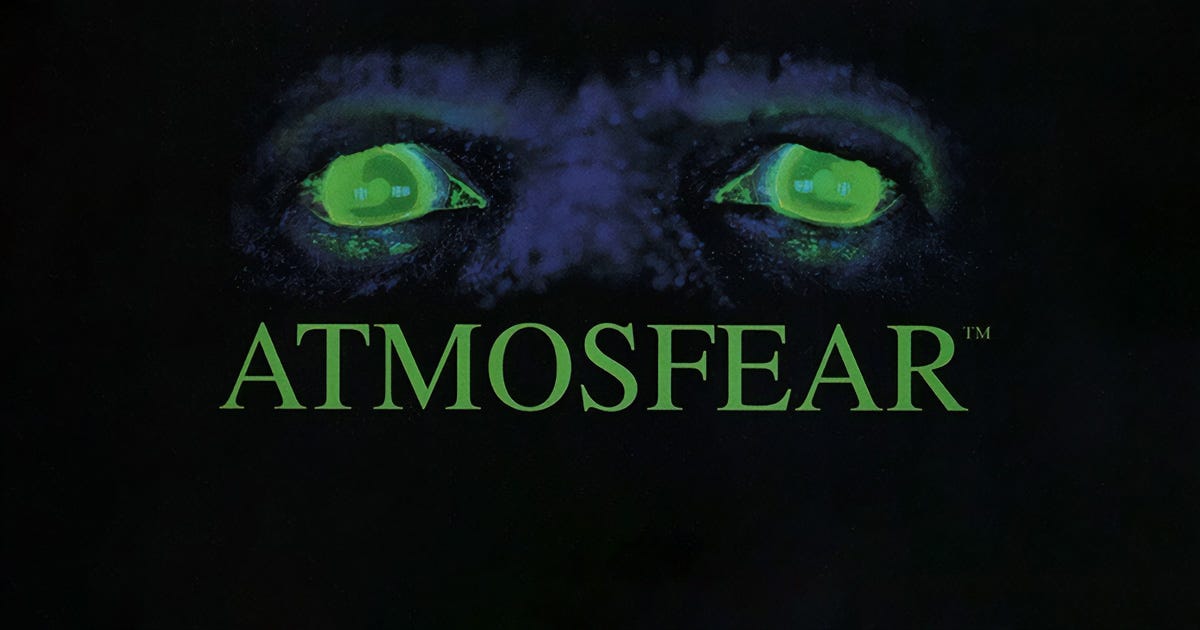
I only played Atmosfear once, at a friend’s house, and I liked it while but also felt like I had arrived a little late. I was old enough to issues with the game, but not so old that I could ignore what the game was trying to do. The Gatekeeper shouting from the television, the clock running, everyone getting a little louder as the tape kept going, it was a great setup. If I had played it at twelve, that would have been perfect. I would have been nervous, excited, and completely sold on it.
Atmosfear had its roots in a game called Nightmare, released in Australia in September 1991 by a production company called A Couple ‘A Cowboys. The company was founded in 1983 by two television producers, Brett Clements and Phillip Tanner, who had met the previous year. They spent two years developing and testing Nightmare before taking a pilot to Village Roadshow, Australia’s largest video distributor at the time. Village Roadshow signed a marketing and distribution agreement within 24 hours and soon the game launched with advertising on television and movie theaters.
The VCR board game was not a new idea in 1991. Parker Brothers had released the Clue VCR Mystery Game in 1985, which sold nearly 500,000 copies and briefly landed on the Billboard videocassette charts, becoming the fourth best-selling video title of that year in the United States. Over the next decade, board game companies would release a variety of VCR games that included adaptations of existing games as well as games original to the format. Most of them used the tape passively, as a kind of theatrical backdrop. Nightmare used it differently. The tape ran continuously during play, counting down from sixty minutes, and an on-screen character would interrupt the game at irregular intervals to punish, reward, or mock the players. The tape wasn’t just there for atmosphere, but it did add a lot. That was mainly because of this guy.
That character was the Gatekeeper, played by Wenanty Nosul. Nosul was born in 1949 in the Byelorussian SSR and came to Poland as a child. He spent 1979 to 1995 in Australia, where he studied acting at the Sydney Acting School. The Gatekeeper’s character, as Brett Clements conceived him, was based on the cemetery gatekeepers of the 17th and 18th centuries, people who literally guarded graveyards from grave robbers. What Nosul brought to that concept was a controlled malice, a performance that balanced genuine menace with just enough absurdity to keep the whole thing from curdling. He called you a maggot. He banished you to the Black Hole. He sighed, audibly, when he was forced to release a player he would rather keep trapped. If you played the game as a kid, this is what you remember about the game.
Nightmare sold two million copies by the Christmas period of 1993. Three expansion packs followed, each hosted by a different character from the game’s roster of monsters. Baron Samedi the zombie hosted Nightmare II in 1992. Anne de Chantraine the witch hosted Nightmare III in 1993. Countess Elizabeth Bathory the vampire hosted Nightmare IV in 1994. A fourth expansion, featuring Khufu the mummy, was announced and then cancelled. The reason was a problem with the format itself.
Because VHS is linear, the Gatekeeper’s interruptions were always identical. Every game of Nightmare played out the same sequence of events at the same times. Once you had played it a few times, you knew what was coming. The tension that made the first few sessions electric gradually flattened out. Sales began to decline, and Clements and Tanner went back to work on something larger.
What they built would be called Atmosfear: The Harbingers, which was released in 1995. The name change from Nightmare was already in use in Europe, where a trademark conflict with an existing product had forced the rename. The Harbingers was a complete redesign rather than an expansion. Clements and Tanner brought in J.W. Spear and Sons, the British game publisher that had distributed Nightmare and done extensive market research on its reception, as a development partner. Spear wanted input into how the new game was built, which they had not had with the original. By the time The Harbingers reached stores, development costs had reached approximately six million dollars.
The board itself was a significant upgrade. Six two-sided hexagonal provinces fit together around a central hub, and since the provinces could be assembled in any order, the physical layout of the game could change from session to session. Each province was ruled by one of six Harbingers: Gevaudan the werewolf, Hellin the poltergeist, Khufu the mummy, Baron Samedi the zombie, Anne de Chantraine the witch, and Elizabeth Bathory the vampire. All of them except Hellin were drawn from history or mythology. Hellin was the one character Brett Clements created entirely from scratch, conceived as a childlike figure whose fury escalated when she did not get her way.
Players started each game as Numb Skulls and had to land exactly on a Harbinger’s headstone to transform and begin collecting the six differently colored Keystones needed to win. If you failed to reach a headstone within the first ten minutes, you became a Soul Ranger instead, one of the skeletal scavengers who couldn’t collect Keystones by landing on them but could steal them from other players. Clements had originally designed the Soul Rangers as a punishment, something players would dread becoming. He found out quickly that many players preferred it.
Mattel launched The Harbingers with a marketing campaign that included spots on MTV, cross-promotions with soft drink brands, and a website, which was notably the first website any Mattel product had ever had. The game sold above industry predictions in Australia and reached the top ten best-selling games in both the United States and the United Kingdom within months of its release. The US retail price was $34.99. In Britain, copies went for £27.99 each. It was a genuine commercial hit on two continents.
Scary game for kids? You can guess what happened next. In November 1996, the Independent Television Commission in the United Kingdom received 21 complaints that a TV commercial for Atmosfear was too frightening to air during children’s programming. Eight of those complaints specifically mentioned that their children had been scared by it. The ITC ruled the commercial could no longer run in children’s time slots.
There was also a SNES game that almost happened. Beam Software, an Australian developer responsible for titles including Shadowrun and Radical Rex, developed a prototype of an Atmosfear game for the Super Nintendo. Rather than adapting the board game, they turned it into a platformer in which the Gatekeeper would randomly interrupt gameplay at the level, much as he did on the tape. The game was mentioned in magazines in late 1993 and in 1994 but was never formally previewed or reviewed. A prototype dated July 12, 1994 exists. The game was cancelled for reasons that have never been publicly explained.
The franchise shifted formats in 2004 when A Couple ‘A Cowboys released Atmosfear: The Gatekeeper on DVD. The DVD format solved the replayability problem that had eventually eroded Nightmare’s appeal. Unlike the linear storytelling format dictated by videotape, the larger size of DVD allowed for more than 300 storylines and responses from the Gatekeeper. So rarely does a game truly plays the same way twice.
The game sold 60,000 copies in its first six months and eventually reached 600,000 worldwide. A sequel, Khufu the Mummy, followed in 2006. The DVD Gatekeeper was played by David Whitney, and the general consensus among longtime fans was that the performance, whatever its merits, was not the same thing as Nosul. With a game driven by one featured performer, they make all the difference.
The DVD version also lost something physical. The original Harbingers board had bone-colored plastic pieces that matched the game’s aesthetic. The DVD edition updated them to a more boring plastic, and the board provinces were redesigned. People who had played the original found the revision noticeably flatter and cheaper seeming.
An app version launched in 2019, licensed by Creata IP and released first in Australia, Spain, and Portugal. It used a smartphone or tablet in place of the disc, with a new Gatekeeper played by Jacek Koman. In 2021, a 30th anniversary edition launched on Kickstarter, raising AU $491,581 from 3,884 backers against a goal of AU $90,000. That edition replaced the tape with streamed video, added new cards, redesigned the playing pieces, included a Baron Samedi expansion, and came with a graphic novel called The Lore of the Other Side, which explored the Gatekeeper’s origins. Rewards began shipping to backers in January 2023.
Nosul, who had returned to Poland after the Atmosfear productions concluded in the mid 1990s, went on to appear in European film and television productions including Anna Karenina and War and Peace. He is now in his mid seventies. In the context of his overall career, the Gatekeeper is a footnote. For a large number of people who grew up in Australia, the UK, and North America in the early 1990s, it is the role they know him for. A man on a tape, barking orders from a television, somehow became the part of the game that lasted longest.
Wow, not sure how knowledge of this escaped me all of these years. Very cool!
And don’t forget about VCR Quarterback! 😀
-"Village Roadshow, Australia’s largest video distributor at the time."
Is this any relation to Village Roadshow Pictures, which has released several motion pictures in North America via Warner Brothers?
-The only time I really encountered a VCR game in my life was with one my family had based on "The Honeymooners". At least that had the advantage of getting me interested in that show.