


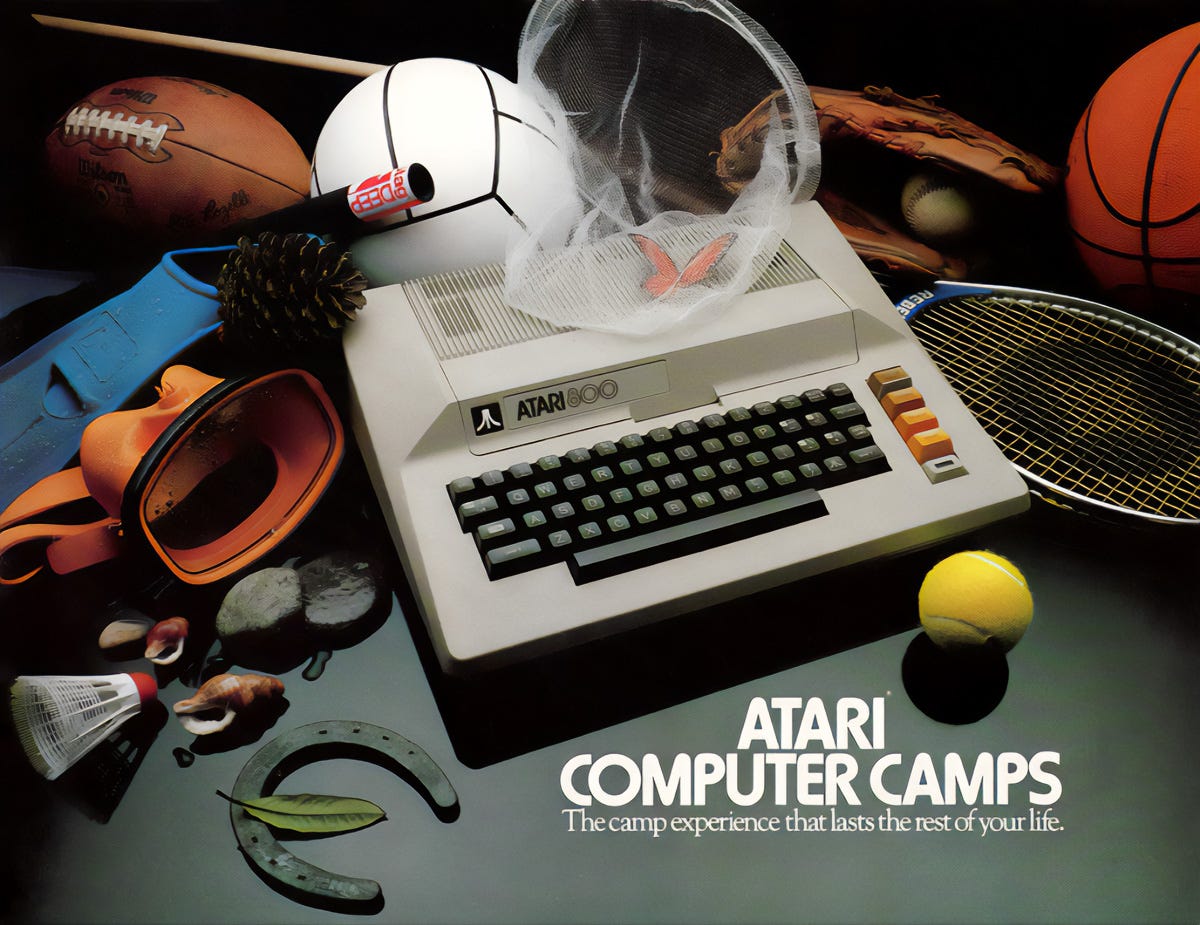
I was the right age for Atari Computer Camp. I had been reading about computers in every magazine I could get my hands on, playing games whenever I could get near a machine, and trying to understand a technology that felt like it was going to change everything. When the ads for the camps started showing up, something in them clicked. This was a place where you could actually learn how the machine worked. Not just play with them, but make them do something.
I pleaded with my mom to go and I couldn’t believe it when she actually called them to get information. The price came back and that was the end of that.
It was somewhere in the neighborhood of $1,600 for a month, which at that point in our household would have been better spent on too many other things. My mother also had reservations about sleep-away camps in general, which was its own separate obstacle. So we made a different call that summer, one that turned out fine. We got a Commodore 64. I spent that summer and several more sitting in front of it, learning things my own way, on my own schedule.
In retrospect there is something almost funny about it. I am the kind of person who gets loyal to things, and had I spent a summer immersed in Atari machines, who knows where that leads. Maybe I end up on a different path entirely, never making it from my VIC-20 to the Commodore 128, never becoming the person I turned out to be. I am genuinely fine with how things went. But I still think getting one of the camp t-shirts would have been incredible.
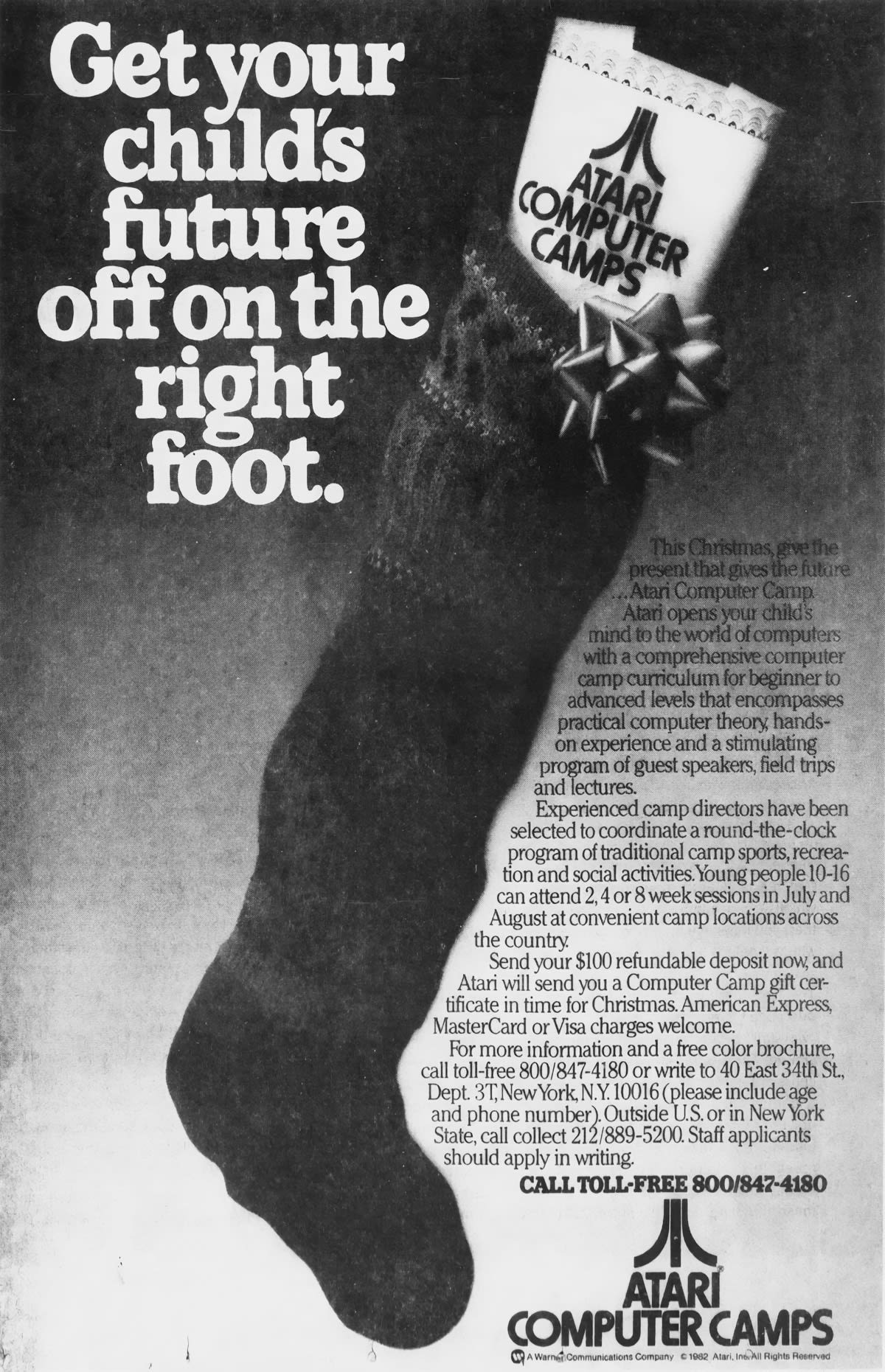
Despite my childhood want to go to one, I didn’t know too much about the camps themselves. What I learned was that they were ambitious, and for the kids who went, they appear to have been genuinely memorable.
The idea of a computer camp did not originate with Atari. In 1977, a physics and engineering professor at Fairfield University in Connecticut named Dr. Michael Zabinski did something no one had done before. He coined the phrase “computer camps” and founded National Computer Camps. It was the first of its kind in the country. Zabinski had been watching computers reshape how people worked and thought, and he believed children needed a structured place to engage with them beyond the arcade and the living room.
His first session was a day program for about fifty kids, run out of a junior high school in Orange, Connecticut. It worked well enough that he kept it going. Over the following decades, NCC would introduce thousands of students ages 8 to 18 to coding, robotics, and computer science. The High Point Enterprise reported in 1983 that Zabinski’s original inspiration came partly from summer institutes he conducted for the National Science Foundation, where he taught teachers how to bring computers into their classrooms. The camp format, he realized, was ideal for reaching students the same way.
Atari took that idea and scaled it up. In March of 1982, the company announced it would sponsor the first computer summer camp run by a major home computer manufacturer. Three locations opened that summer: East Stroudsburg State College in Pennsylvania’s Pocono Mountains, the Asheville School in North Carolina, and the University of California, San Diego. A fourth site at Lakeland College in Wisconsin was on the original plans but never came together.
The person who built the educational side of the program was Bob Kahn, Director of Special Projects at Atari from 1982 to 1984. Kahn developed the curriculum, hired the instructors, and assembled the equipment and software libraries that campers would use. He described his goal like this, Atari wanted students to have a romance with the computers. The overall program was overseen by Linda S. (Gordon) Brownstein, Atari’s Vice President of Special Projects. For the actual camp operations, Atari partnered with a company called Specialty Camps Corporation, and together they formed the subsidiary Atari Special Projects, Inc., operating out of 40 East 34th Street in New York (so close to where I was).
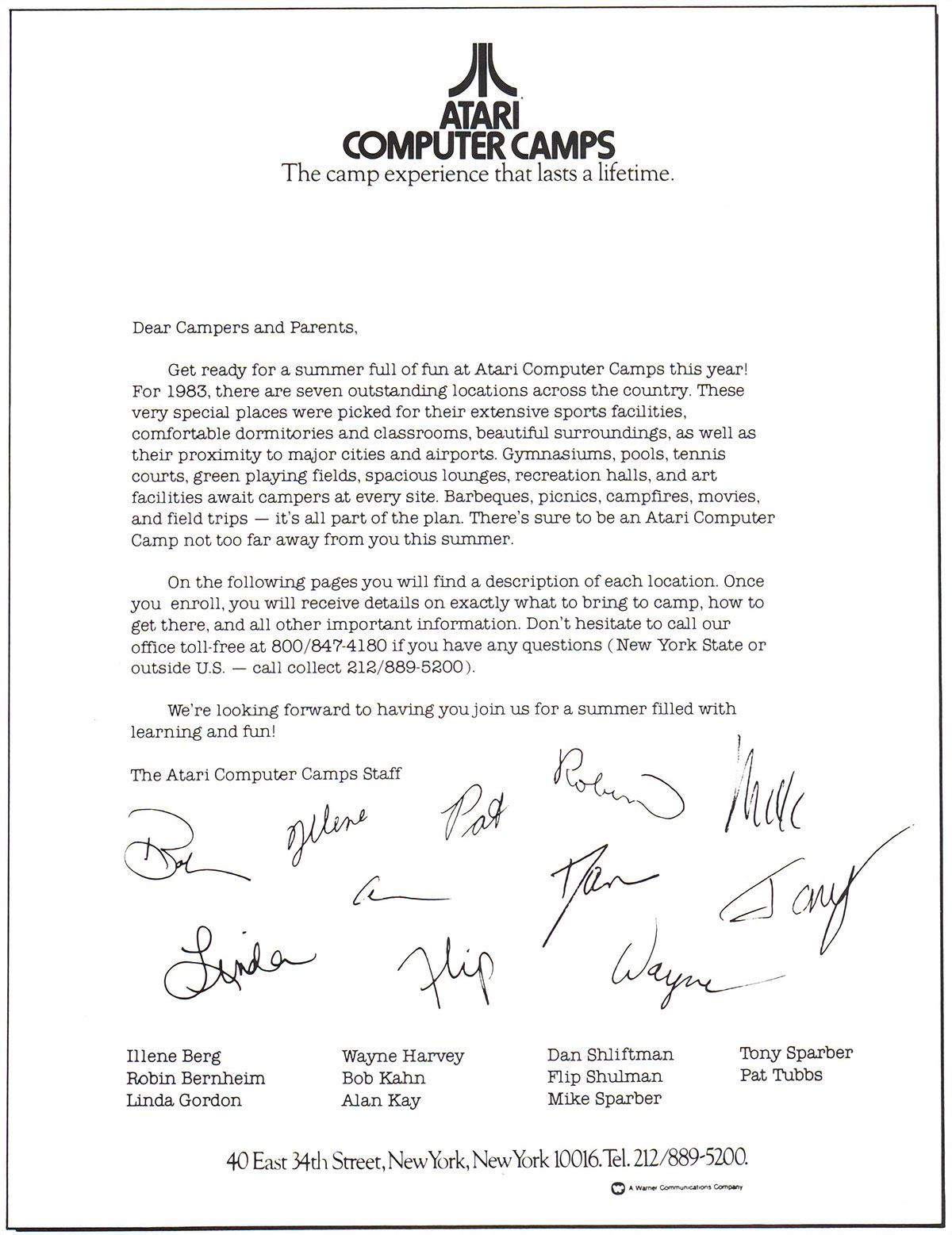
The first summer worked better than expected. By 1983 Atari had expanded to seven locations, adding New England at the Stoneleigh-Burnham School in Greenfield, Massachusetts; Chesapeake at Oldfields School in Glencoe, Maryland; Smokey Mountains at the University of North Carolina at Asheville; Midwest at the Shattuck School in Faribault, Minnesota; and Old West at the Athenian School in Danville, California. The Antic magazine reporter who visited Old West in August 1983 noted that demand at the Poconos site had doubled from one year to the next, with 160 kids seeking spots where 80 had come the year before. There were plans to add three more locations in 1984, bringing the total to ten.
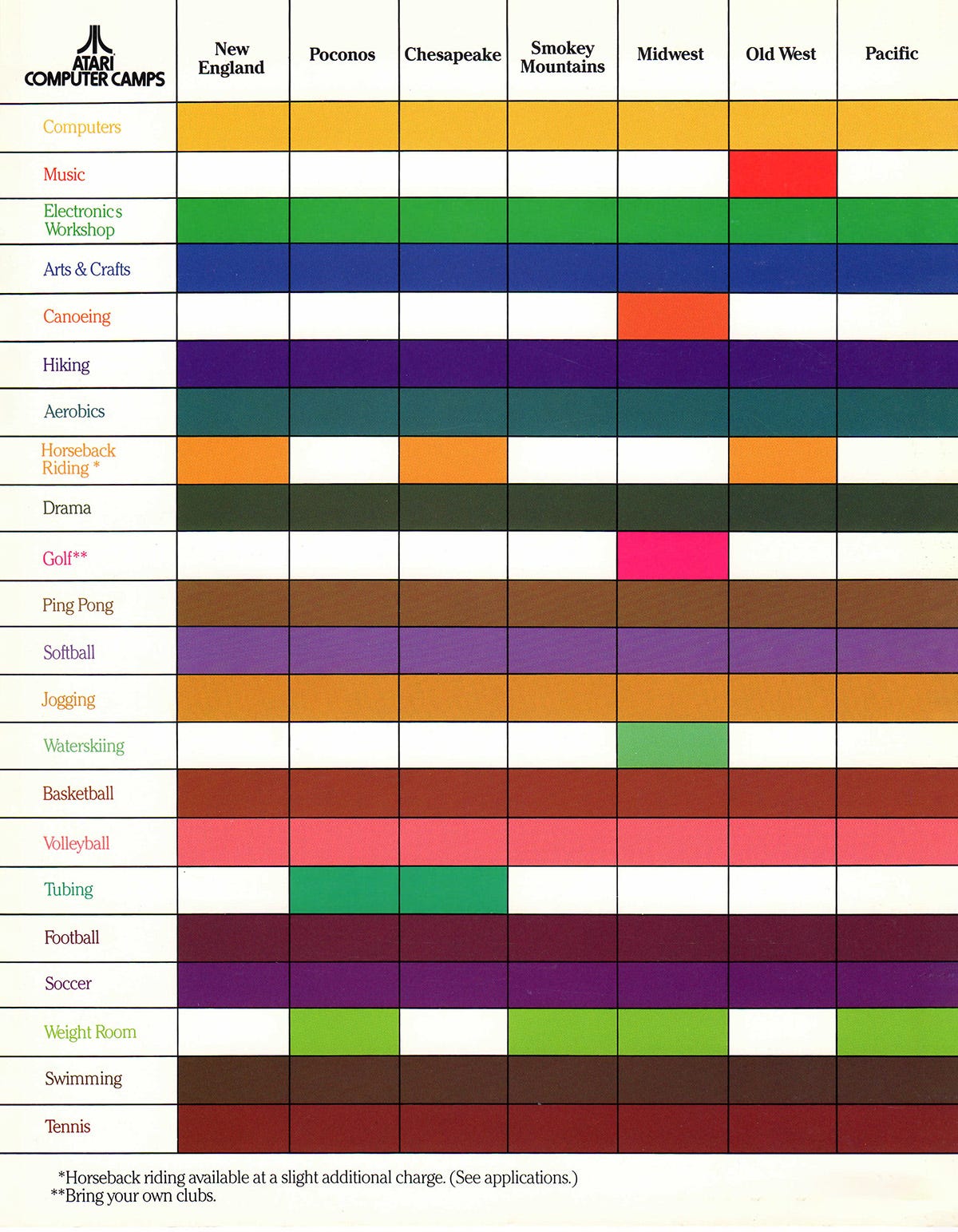
The camps were genuinely designed to feel like traditional summer camps. The 1983 brochure describes gymnasiums, pools, tennis courts, playing fields, arts and crafts facilities, campfires, barbecues, and guest speakers. The activity grid across all seven sites covered swimming, tennis, soccer, softball, volleyball, basketball, aerobics, drama, hiking, and electronics workshops. The Midwest camp at Shattuck had a private lakefront with water skiing and a nine-hole golf course. Old West sat adjacent to Mount Diablo State Park. New England offered horseback riding at a slight additional charge and had access to a pottery studio with a kiln. The Pacific camp at the University of San Diego promised field trips to Sea World, the San Diego Zoo, and Pacific Ocean beaches. These were not stripped-down computer labs parked on a college campus. Atari was selling the full camp experience, just with keyboards.
The computer instruction itself took up roughly four to four and a half hours of each day, split into two formal sessions with free time in the evenings when at least two of the three computer rooms stayed open. Students could use that time to play games or keep working on their programs. That Antic reporter visiting Old West observed that newer campers tended to spend their free time on games initially, but by the second week most of them had shifted toward programming. Instructor Jim Brown gave each new arrival a short questionnaire to gauge their level so classes could be matched to ability. Beginners started from scratch. Advanced students were handed spec sheets and deadlines the way a working programmer might receive them.
The machines in those classrooms were Atari 400s and 800s, and each site had three rooms equipped with twelve systems each. At maximum enrollment there were two students per computer. The curriculum covered BASIC, LOGO, and PILOT programming languages, along with modules in assembly language, machine architecture, word processing, graphics, and more. Guest speakers came once a week, usually game designers or programmers. The week before Antic visited Old West, Chris Crawford, who wrote Atari’s Eastern Front, had come to talk about his work. The day they arrived, the designer of Donkey Kong was scheduled. The campers also took a field trip to see Tron, which was fitting since some of the film’s sound effects had been created using an Atari 800.
In the summer of 1982, Atari commissioned a documentary film about the camps. They hired filmmakers Bob Elfstrom and Lucy Hilmer of Robert Elfstrom Productions to shoot it at the University of California, San Diego campus. Three versions were created: a 26-minute version, an 18-minute version, and a 3-minute trailer. The film was released in 1983 under the title The Magic Room. It is an unguarded and often moving portrait of kids at the beginning of something, learning to make machines do what they asked. One camper named Enrique put it this way on camera: “I tell the computer what to do, and that comes from me, from inside, I think it comes. What’s up on the screen, it’s me.”
Head instructor Richard Pugh offered a prediction at the end of the film that holds up: “I think that, if they look back upon this summer, 10, 20, 30 years from now, they’re not going to remember all the commands, perhaps. Maybe this is the last time they even see a computer. But I bet you they never forget what they programmed.”
The longer version of the film circulated for years online. The 18-minute version was a substantially different edit, featuring more intimate perspectives on certain campers and entire scenes not in the longer cut. It was unclear for years whether it still existed. In August 2021, it was released publicly for the first time after the original tape was discovered and digitized.
The camps made the papers constantly from 1982 through 1984, and most of those articles had the same two preoccupations. The first was the price.
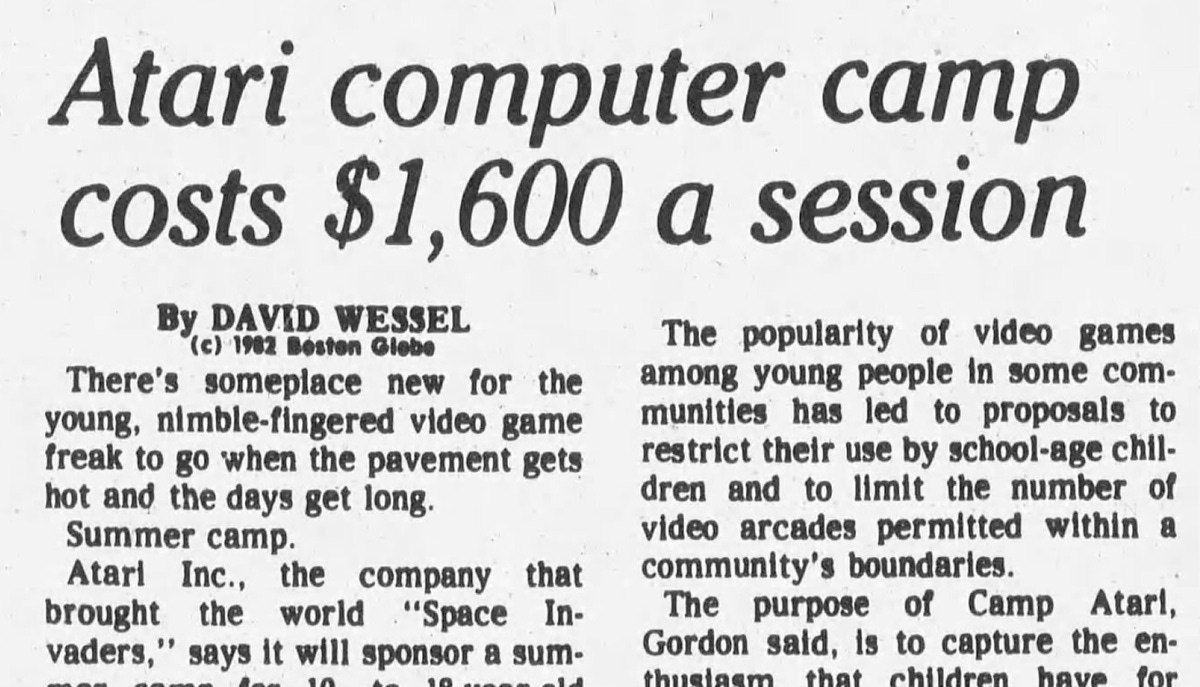
The original two-week session cost $890. Four weeks was $1,690. The full eight weeks came to $2,950 in 1982, rising slightly to around $2,990 by 1983 and 1984. The Morning Union out of Springfield, Massachusetts listed the 1984 New England prices as $990, $1,790, and $2,990. By any comparison, the number was hard to absorb. The Boston Globe noted that the monthly rate exceeded what a month at Harvard cost for tuition, room, and board. A local computer workshop in Elkhart, Indiana ran an ad in 1984 marketing itself as a four-week program similar to Atari Computer Camp but significantly cheaper. The camps had become the expensive benchmark that other programs positioned themselves against.
The second thing the press kept returning to was the girls at camp.
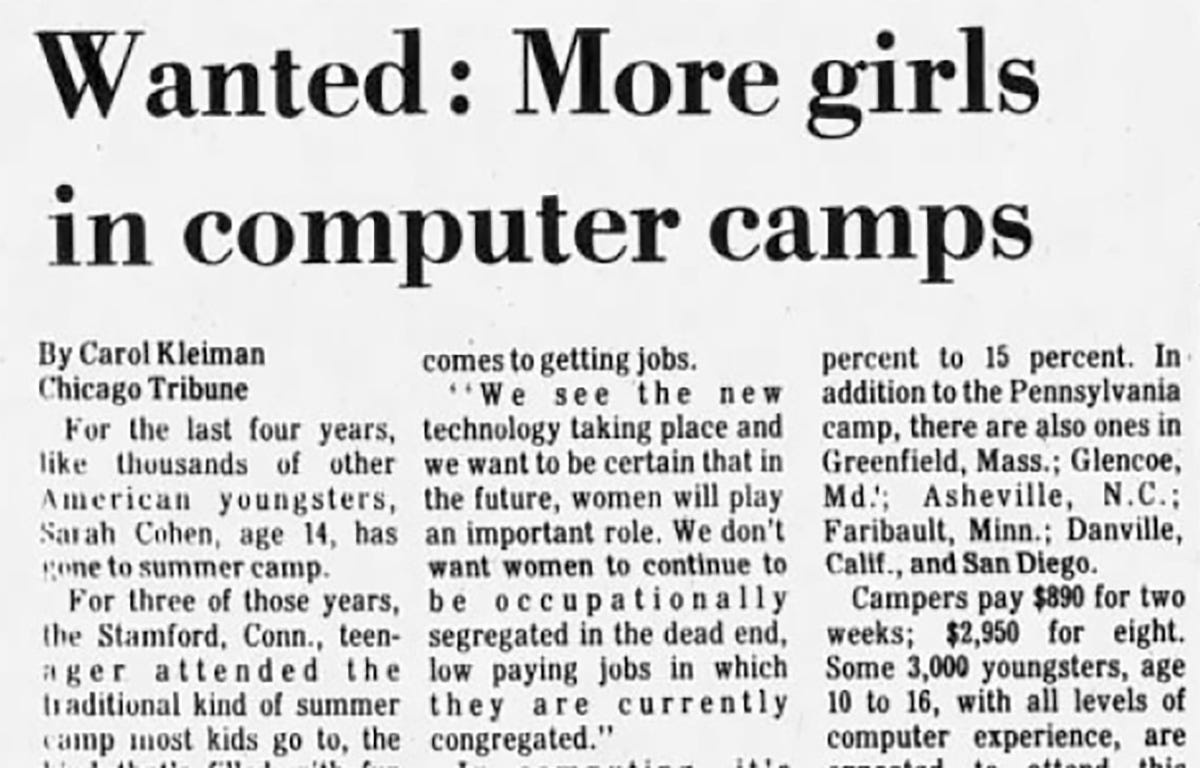
Atari made a deliberate effort to attract female campers and was very open about it. Linda Gordon told reporters that she visited girls schools regularly and found that when girls did not have to compete with boys, they were enthusiastic about computers. She called computer literacy the fourth R. She was also candid about her disappointment that more parents had not pushed their daughters toward computers the way they pushed their sons. The Chicago Tribune reported that girls had made up only about five percent of campers in 1982 but rose to fifteen percent by 1983. At the Asheville camp in its first summer, a visitor from the Winston-Salem Journal noted there were 37 boys and just 4 girls enrolled. The 1982 film features a female instructor, and Atari placed girls prominently in its advertising materials. The broader stereotype of the male computer whiz was already forming and proving hard to break. The percentage of women majoring in computer science peaked in 1984 and then dropped significantly.
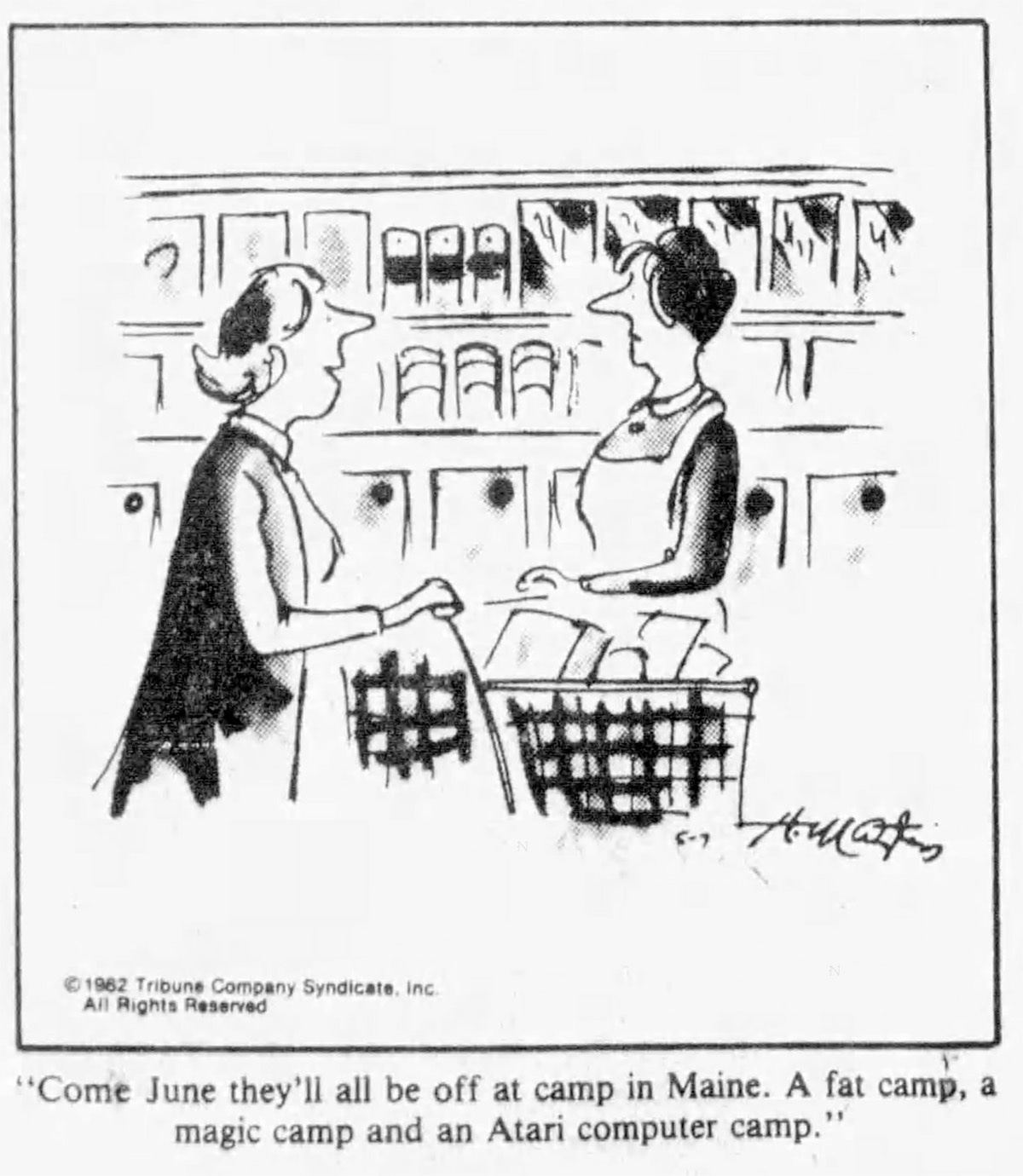
By May 1982, the camps had become culturally visible enough that they appeared in Henry Martin’s syndicated newspaper cartoon strip Good News, Bad News. The punchline had a mother mentioning that her kids were off to a fat camp, a magic camp, and an Atari computer camp. That sort of secondary mention shows just how much the camps had spread through society.
The camps ran through the summer of 1984. That same year, Atari was sold by its parent company Warner Communications to Jack Tramiel, the founder of Commodore International, as the company absorbed the full force of the video game industry collapse that had been building since 1982. Atari was one of the companies most affected by the crash. By mid-1983 the company had lost significant revenue, was forced to lay off a large portion of its workforce, and moved manufacturing overseas. The camps, which had been an ambitious educational project from a company in expansion mode, did not survive. The Strong National Museum of Play’s records confirms the camps ran from 1982 to 1984, and that the decline of the video game industry was a factor in their end.
The camps were not really about producing a new generation of programmers (although they did). They were about putting kids in a room with machines that most of the world still found intimidating and letting them discover that the machines would do what they asked. That was not a small thing in 1982, and it is easier to forget now because computers no longer seem mysterious.
For three summers, Atari gave kids a chance to spend real time with computers right at the moment those machines were starting to move from curiosity to necessity. Then the company collapsed, the camps ended, and what remains is mostly what people held onto, brochures, clippings, a little film, and the memories that still surface online from people who were lucky enough to go.
I never got there. I got a Commodore 64 instead and I turned out fine. But I have spent enough time looking through what survives to understand what I missed, and I think it was something worth missing properly.
I still think the t shirt would have been great.
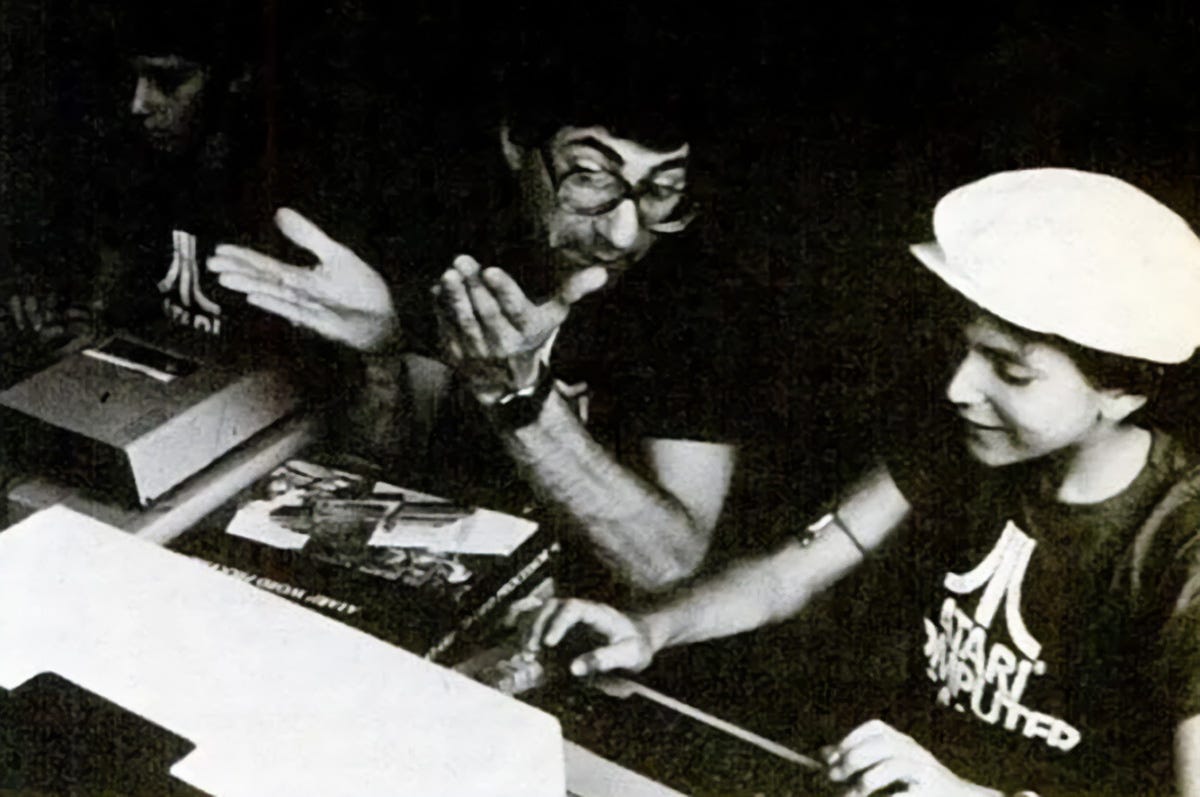
Found an Atari Summer Camp postcard I had in my stash. (No, I did not attend.)
I remember hearing about these and really wanted to attend, although none seemed to be near my home in Denver, Colorado. No matter - we'd never have spent that kind of money for a camp anyway. I ended up going to a week-long day camp that featured TI-99/4a computers. At the end of the week we had the chance to buy the machines, but at that point they were too expensive. I don't recall any programming - mostly just loading and running programs.