

When Club Med Met Atari
How Atari computers ended up under the palm trees at Club Med

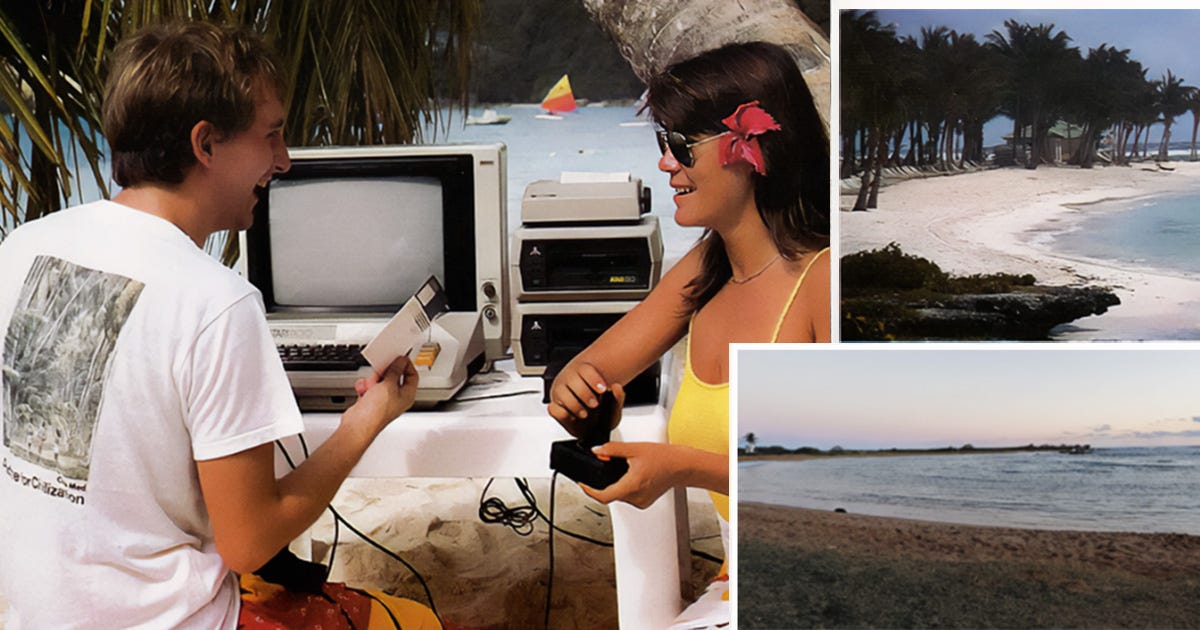
Club Med always sounded like a place for relaxation and adult activity (certainly that’s what commercials hinted at). Sunny, relaxed, a little European, and just far enough outside my world that I had to imagine most of it. The name made me think of beaches, drinks, people with good tans, and long afternoons where nobody seemed to be looking at a clock. It did not make me think of an Atari 800 sitting under a palm tree. But for a strange and interesting stretch in the early 1980s, that was part of the story too, and before getting to the computers, it helps to talk a little about what Club Med actually was.
It all started in 1950 with a Belgian water polo champion named Gérard Blitz, who was fresh out of the WWII French Resistance and looking for a way to help people shake off the weight of postwar Europe. His idea was simple. Let’s gather people together in a beautiful place, take away the usual pressures of money and status, and let them rediscover the pleasure of being alive. Blitz officially founded Club Méditerranée on April 27, 1950, bringing the first group of vacationers to the northern coast of Majorca in the Balearic Islands. They slept in tents. They cooked together. Nobody wore a tie. Groundbreaking vacation stuff for 1950.
A better entertainer than businessman, Blitz went bankrupt in 1953. His main creditor was his tent supplier Gilbert Trigano, known as the French “King of Camping,” who took control of the club. Trigano was a builder. Under his leadership, the tents gave way to straw huts, the straw huts gave way to actual rooms, and Club Med grew into something no one had quite seen before. Guests paid one price covering transportation, lodging, three meals a day, wine and beer with lunch and dinner, most sports and leisure activities with instruction, and evening entertainment. No tipping. No extra charges. No decisions about money once you arrived.
The staff were called G.O.s, short for Gentils Organisateurs, or “gracious organizers.” The guests were G.M.s, Gentils Membres. Everyone was on a first-name basis. The whole thing was designed to feel like the best version of a vacation you had ever taken with as little friction as possible. By the time the 1980s arrived, Club Med operated 92 villages across 26 countries. It was one of the most recognized vacation brands on the planet. Club Med was thriving and they were about to make an unexpected partnership with the computer company, Atari.
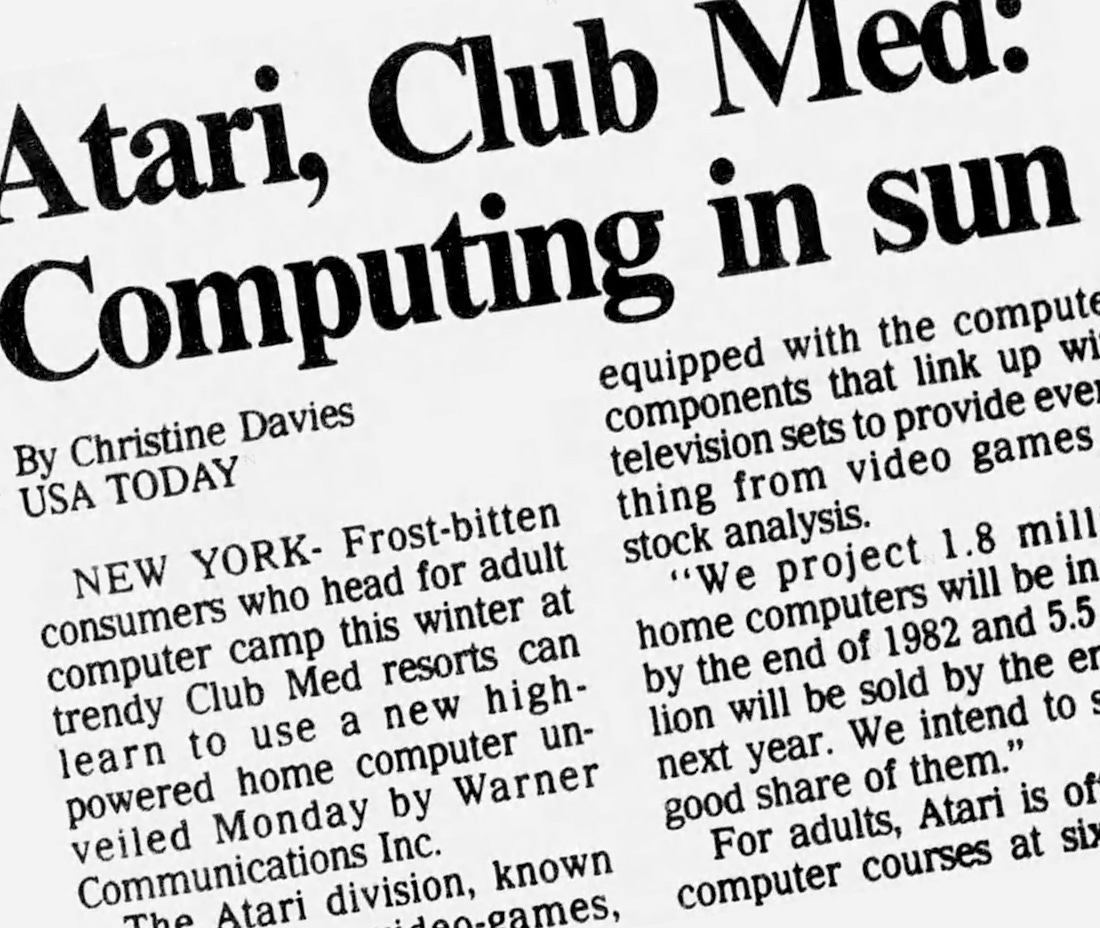
In 1982, the home computer was breaking through. Atari, then a division of Warner Communications, was one of the biggest names in the business. The company had built its reputation in arcades and living rooms with games, but it had also released the Atari 400 and 800 home computers, machines capable of real work like word processing, spreadsheets, programming and music composition. Atari wanted people to think of these machines as more than just game consoles with keyboards. The problem was that a lot of adults were genuinely afraid of computers. They had heard about the computer revolution and were not sure they wanted any part of it.
Club Med had noticed the same anxiety from a different angle. The resort reasoned that many people could overcome their fear of computers if instruction were offered in a non-threatening environment, without the intrusion of everyday urban life. The two companies found each other and discovered they were solving the same problem from opposite ends.
The partnership was announced publicly in late 1982. Serge Trigano, chairman and CEO of Club Med, Inc., said at the time that the home computer would become a major force in society, and that by offering workshops to members, the club would help demystify computers for its guests. Ray Kassar, chairman and CEO of Atari, added that Club Med villages offered a perfect setting for young people and adults to be introduced to microcomputers. The announcement came at a Warner Communications press event, and Atari projected at the time that 5.5 million home computers would be sold by the end of 1983 alone.
The idea was not invented from scratch. The first computer workshop had been held at Club Med’s Kamarina village in Sicily, using Honeywell, French PTT, Thomson, and IBM equipment, and it proved popular enough that Club Med expanded the concept to villages in the Caribbean. By the time the Atari deal was formalized, workshops were already running at Ixtapa in Mexico, Caravelle in Guadeloupe, and Eleuthera in the Bahamas. Atari secured the exclusive right to supply computers for all Club Med villages in the Western Hemisphere.
The early results from the Kamarina pilot were remarkable. During a ten-week period there, 12,000 vacationers participated in the computer program. Of those, 3,200 became proficient at using computers, and 1,500 went far enough to write their own programs. For a crowd that had rarely touched a keyboard before arriving at a beach resort, that was impressive.
The flagship of the whole operation would be Club Med’s Punta Cana village in the Dominican Republic. This was where the collaboration really got serious.
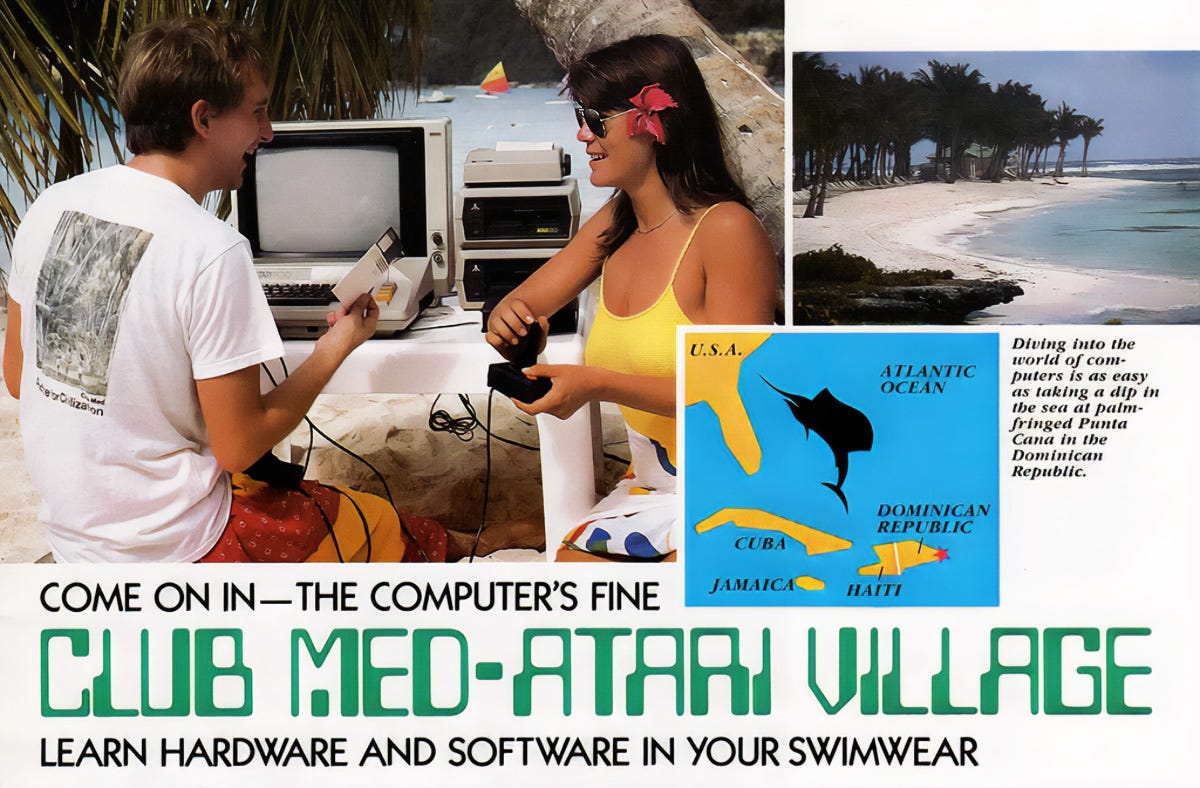
Starting June 11, 1983, and running thirteen weeks through September 10, Atari and Club Med launched what their brochure called a “21st century experiment.” The setup at Punta Cana was unlike anything else in computer education at the time. Atari installed 57 computers throughout the village, not locked away in a classroom but distributed across the resort, with a total of 83 computers and terminals in use when you counted every kiosk and station. Workshops ran from 11 in the morning until 5 in the afternoon, with free time built in at the end of each day for practice. Instructors were available to answer questions and help guests go further with anything covered in the sessions.
What did you do while there? Mini-workshop topics covered everything from an introduction to microcomputers to budgeting and planning with VisiCalc. In addition to computer staples like BASIC language programming, word processing, and games, Atari provided things like painting, music, astronomy, astrology, and weaving software. That weaving program was particularly inventive. In it guests could blend 256 colors on screen as they would yarn on a loom, and when the mix was right, a printout would show them how to actually weave the design into a headband, belt, or carrying strap.
Atari also developed a tennis tournament organizer that operated in English, Spanish, and French, so players of different nationalities could be matched and compete together. Snorkelers had access to an interactive computerized slide show that identified the marine life they were likely to see on the reefs. Sailors could brush up on their rigging and knot-tying at a terminal. A computer bulletin board, the first at any Club Med village, displayed daily events and special messages for all guests on screens around the resort.
The kids were not left out. Computer instructors were assigned to the Mini-Club for children ages four to seven, and to the Kid’s Club for ages eight to twelve. The whole program was folded into Club Med’s all-inclusive price. Nobody paid extra to sit down at an Atari 800 and learn to compose music or design graphics. It was just part of what you got.
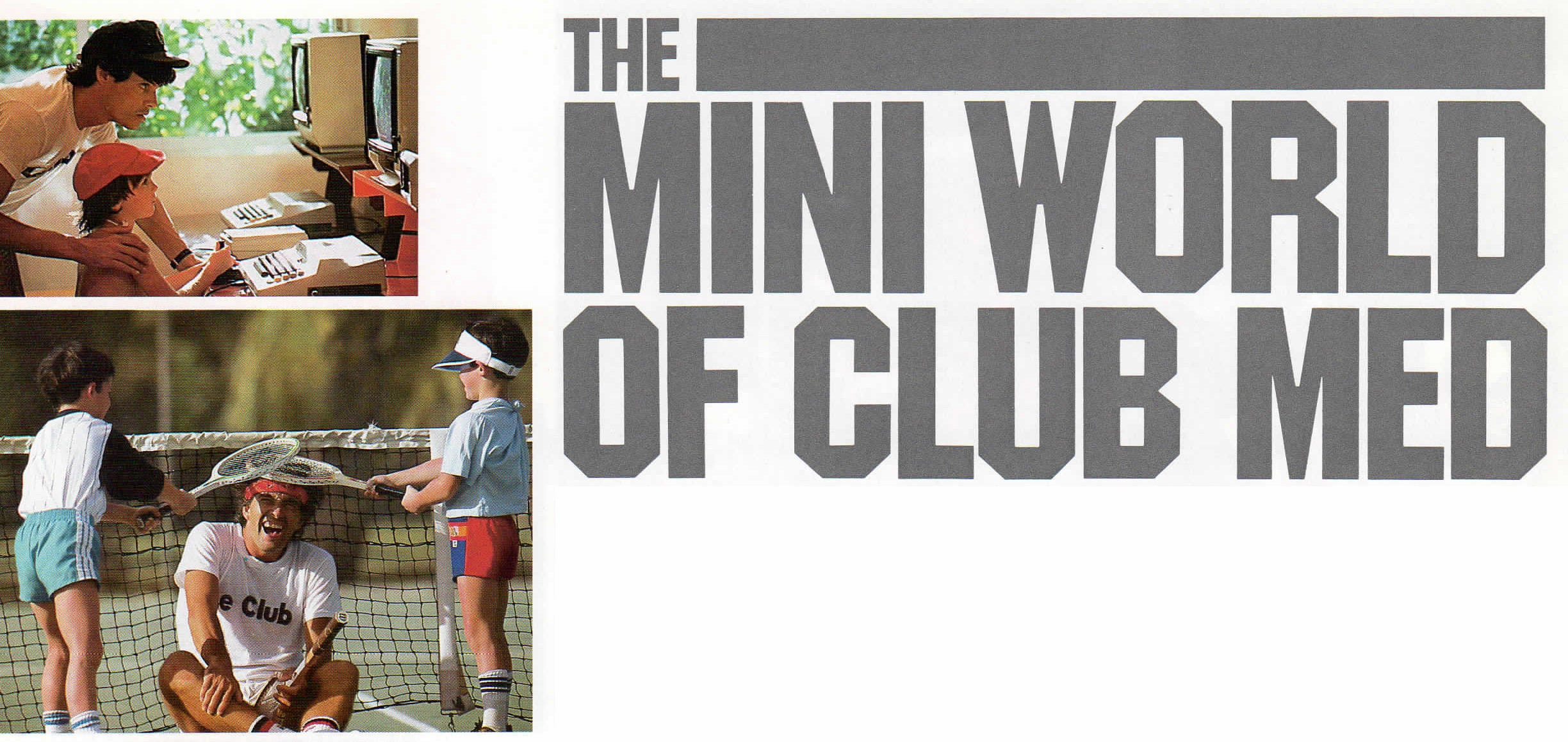
Bob Kahn, Director of Special Projects at Atari from 1982 to 1984, was responsible for the entire computer portion of the summer program, including curriculum, staffing, equipment, and materials. He had previously run the Atari Computer Camps that operated across the United States, and the Club Med collaboration was an extension of that educational mission into a very different setting.
Atari Computer Camps

I was the right age for Atari Computer Camp. I had been reading about computers in every magazine I could get my hands on, playing games whenever I could get near a machine, and trying to understand a technology that felt like it was going to change everything. When the ads for the camps started showing up, something in them clicked.
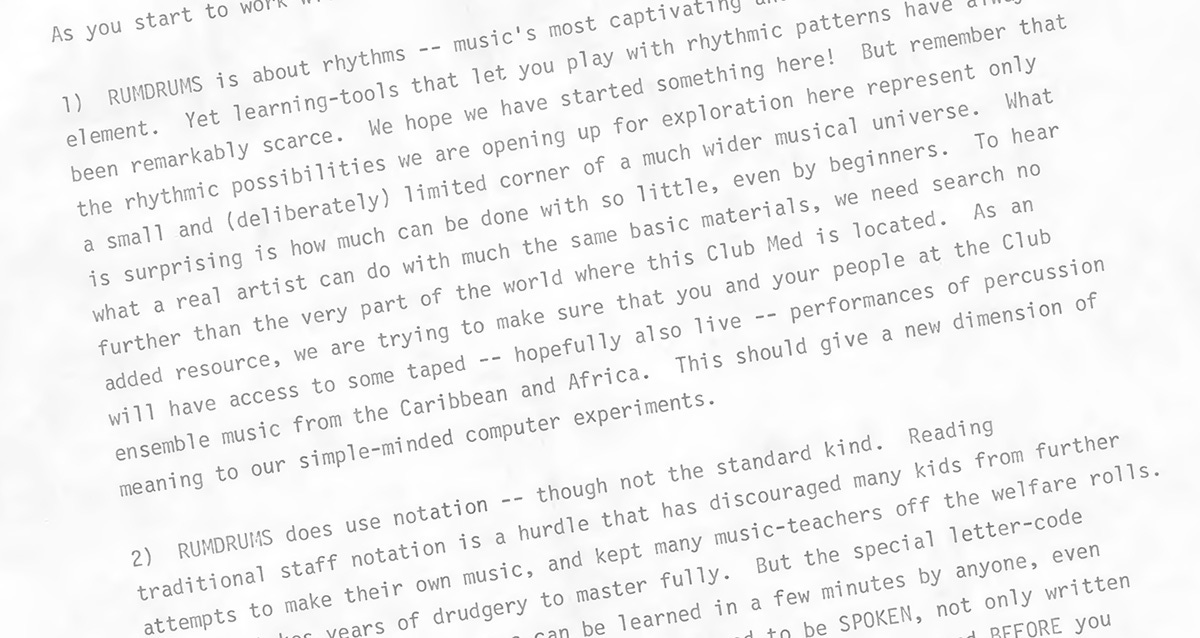
What makes the Punta Cana program so interesting in retrospect is how much original work went into it. Atari did not simply drop off a box of machines and walk away. For example, the music curriculum was developed by Sterling Beckwith, a music consultant who wrote to Kahn from his home in North Salem, New York, in the spring of 1983 describing his frustration at not being able to find existing software that did what he needed. There was nothing on the market that addressed rhythm in a way accessible to complete beginners. So he wrote something himself.
The result was a program called RUMDRUMS, built specifically for the Atari/Club Med project and written in Atari Logo. The curriculum materials described it as a rhythmic exercise for novice composers. Users could input rhythm patterns using a simple letter code, hear them played back, build sequences, and eventually have the computer generate a semi-random melody to layer over their rhythms. Beckwith’s letters to Kahn show a genuine creative collaboration, complete with bug reports, debugging notes, and a closing wish that Kahn had survived his trip into what Beckwith cheerfully called “the wilds of Hispaniola.”
The music workshop also included demonstrations using the Atari Music Composer cartridge, lesson plans by educator Carolyn Pugh covering composition forms like ternary and rondo, and a note from Battlezone creator Ed Rotberg, who sent over sound synthesis disks he had personally developed. It was a more ambitious educational effort than the vacation branding suggested.
Linda Gordon, Atari’s vice president of special projects, called the Club Med experience a milestone in human relations for both companies, observing that places where people need computers the least are probably the best places for them to discover the technology.
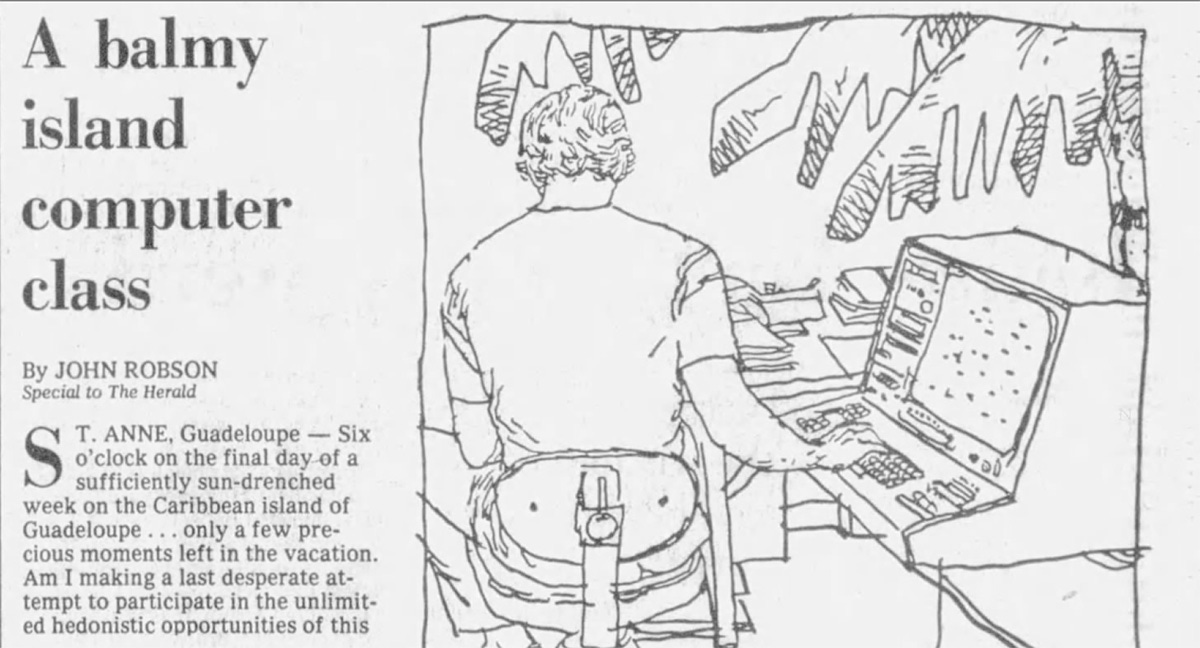
The Miami Herald sent writer John Robson to the Caravelle village in Guadeloupe in 1984 to find out what the experience was actually like. He arrived as a committed skeptic. Not really seeming to realize that a computer was different from a typewriter, he described himself as a poor typist who spent 40 percent of his time typing and 40 percent correcting errors. What he found surprised him.
Classes were small, typically eight people, meeting in front of Atari 800s for one hour a day. His group’s instructor that week was someone called B.J., a blond refugee from Gulf Oil, filling in for the regular computer guru “Aladdin.” The first day was devoted to demonstrating that the computer was not an all-knowing machine but a fairly limited tool, which was a key part of the demystification strategy both companies were aiming for. Day two moved into Basic programming. Day three opened up graphics, where Robson watched the basic structure of video game design unfold in minutes. By day four the group was working with the Atari as a filing and note-card system. The final day brought AtariWriter, the word processing program.
By the end, Robson found himself staying after class to write, his speed increasing, misspellings flagged automatically. He left Guadeloupe a reluctant convert. His article ran under the headline “A Balmy Island Computer Class.”
The regular guru “Aladdin” at Caravelle was a Frenchman who had stumbled into the job almost by accident. His initial visit to Club Med’s Paris headquarters was simply to accompany a friend applying for a position. Overhearing a conversation about computer education, he stepped in to correct some misconceptions and walked away with the job of developing the computer program for the Club’s American operations. That was 1982. By 1983, the program had spread to Eleuthera, Ixtapa, Caravelle, and Punta Cana, with Copper Mountain, Colorado also in the mix.
The chef de village at Punta Cana, Gerard Barouh, framed the whole project in terms of communication rather than technology. He pointed out that people who do not learn about computers may eventually find it impossible to speak to their own children. The tennis and sailing programs that ran in multiple languages reflected his broader vision: computers as a social tool, not just a vocational one. He described the whole setup as a buffet. You choose what you want.
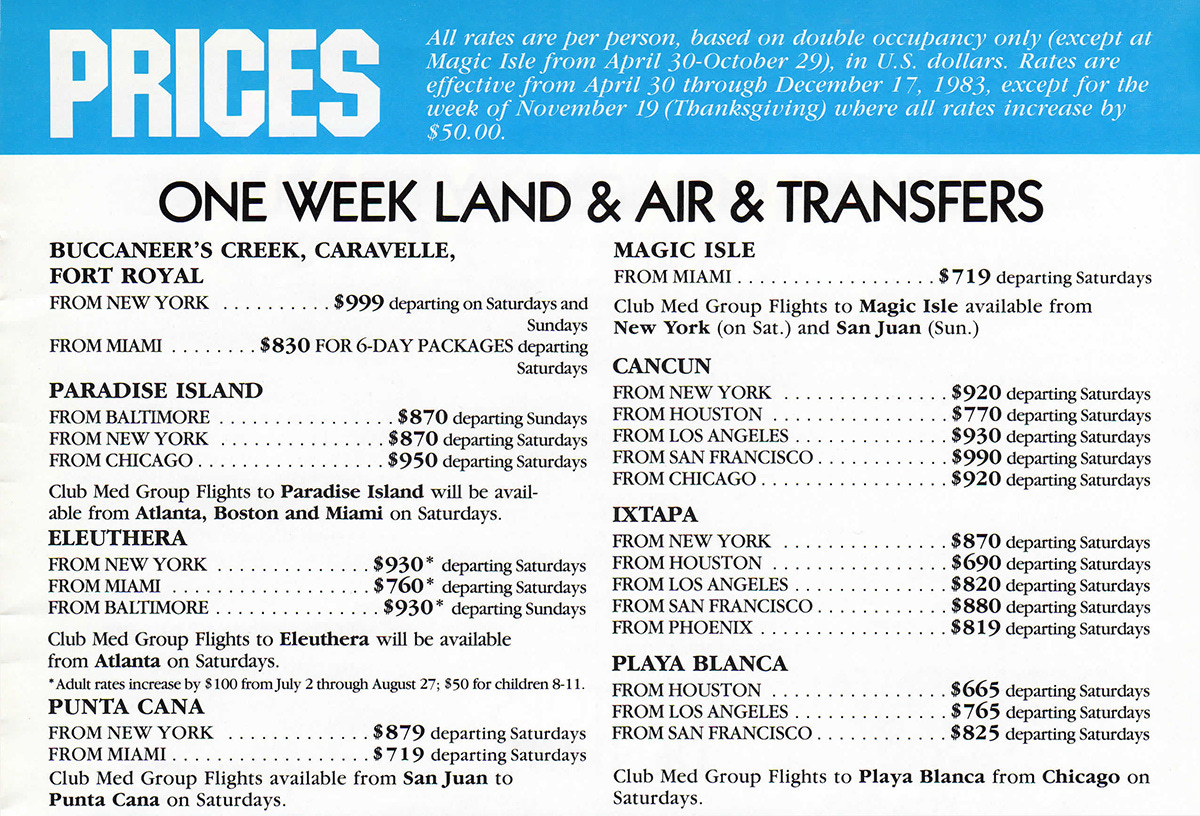
In 1983, a week at Punta Cana with computer instruction included cost $499 per person for the land portion, based on double occupancy. Children ages four to seven stayed free. Children eight to eleven paid half price. A full package from New York including air and transfers ran $879. From Miami, it was $719.
By 1984, a week at Caravelle in Guadeloupe with roundtrip Air France transportation came to $839. Land-only rates were $500 at Eleuthera, $530 at Punta Cana, and $490 at Ixtapa. Computer instruction was included in all of those prices, alongside meals, wine with dinner, sports, and evening entertainment. The Miami Herald noted that with the exception of excursions and bar drinks, everything, including computer instruction, was covered by the package price.
For context, an Atari 800 retailed for around $500 on its own in 1982. A week at one of the most celebrated vacation resorts in the world, with a dedicated instructor and a machine waiting for you on the beach, was not unreasonable.
The San Francisco Chronicle covered the Punta Cana program in August 1983, noting that while most Club Med villages had only a handful of computers, usually about 12, Atari had installed 57 at Punta Cana because the program there was serious about making computer training the major attraction. The ratio of instructors to computers made it possible to get as much training as you wanted.
The timing for the Club Med-Atari partnership was perfect. The home computer had arrived in living rooms and offices, but it still felt alien to most people. Making a mistake at a computer terminal at work had real consequences. Making one on a beach in the Dominican Republic, with a rum drink nearby and nothing on the schedule until dinner, felt like a completely different proposition. People find it easier to learn when they are relaxed, and Club Med had spent three decades building an environment engineered specifically for that. Atari brought the machines.
The program continued and expanded after 1983. By the time the Miami Herald article ran in the summer of 1984, computer workshops were operating at Punta Cana, Caravelle, Ixtapa, Eleuthera, and Copper Mountain. The Caravelle workshop had grown to 25 Atari computers. Club Med hoped to have computers in 45 villages within a couple of years. The Atari 400, with its easily cleaned membrane keyboard, was preferred for children. The 800 with its standard keyboard was used for adults. Instructors trained at Atari headquarters in California before arriving at their villages, and according to Serge Trigano, they were selected by computer.
Atari’s own fortunes shifted dramatically in the years that followed. Warner Communications sold the consumer division in 1984, the same year Atari’s losses nearly brought the company down. Even if the company itself lingered, the Club Med partnership did not. Which makes this product of a very specific window in Atari’s history, one in which the company had both the resources and the vision to pursue something this genuinely unusual.
Still, the partnership proved something that seems obvious in retrospect but wasn’t in 1982. People learn better when they are comfortable, and comfort is not incompatible with education.
Club Med eventually moved upmarket and away from experiments like this one. Atari eventually became something else entirely. But for thirteen weeks in the summer of 1983, on a beach in the Dominican Republic, you could sit down at an Atari 800 between windsurfing sessions and learn to program in BASIC, compose a piece of music, or weave a headband from a design you made yourself on a computer with 256 colors to choose from. Nobody made you. It was just there if you wanted it, which is very Club Med.
I'd heard of the Atari Computer Camps for kids but was completely unaware of this Club Med venture. Revolutionary for the time!
Fascinating! Thanks. I was an avid membrane-keyboard A400 user as a kid.