

The Reggie Bar
A History of Baseball’s Most Famous Candy Bar

Growing up, the Yankees were not exactly welcome in my family's house, even though we lived so close to New York City. My family had been New York Giants fans, and when the team moved to San Francisco they shifted their loyalty to the Mets. Rooting for the Yankees was viewed as a personal failing and said something suspect about your character. Like maybe you thought you were better than everyone else.
And yet, sometime in the early 1980s, I found myself genuinely excited about something with Yankee Reggie Jackson’s name on it. The Reggie Bar slipped past my carefully maintained anti Yankee defenses, and I didn’t even feel guilty. There was something about the hype, the nerve of naming a candy bar after yourself, and the fact that it was actually good, that made it hard to resist. Even for a kid who was supposed to be rooting against everything that wrapper represented.
The origin story for the bar is great. Reggie Jackson, then still with the Oakland Athletics, once remarked to reporters, “If I played in New York, they’d name a candy bar after me.” It was the kind of thing only someone with a high opinion of their own greatness (and media savvy) would say out loud. Jackson signed with the Yankees after the 1976 season for 2.96 million dollars over five years, and the candy wheels started spinning almost immediately. Curtiss Candy Company, a division of Standard Brands and the maker of Baby Ruth and Butterfinger reached out and suggested they do exactly that.
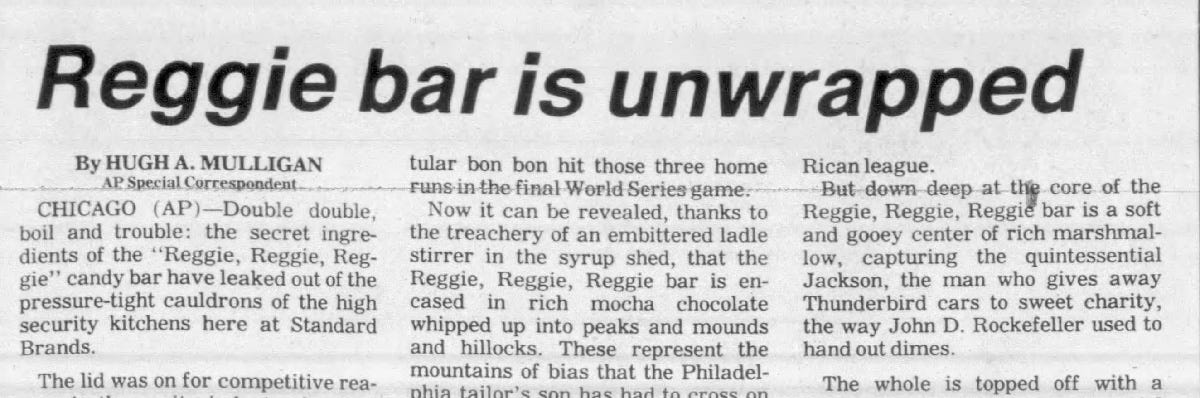
What followed involved plenty of anticipation before a single bar hit a shelf. AP correspondent Hugh A. Mulligan, writing his “Mulligan’s Stew” column in November 1977, described the development process in mock secretive terms, claiming the bar contained everything from marshmallow to rum butter. The ingredient list was a joke. Mulligan was having some fun. But the column ran in papers across the country and helped build national curiosity for a candy that did not yet exist in stores (or did it).
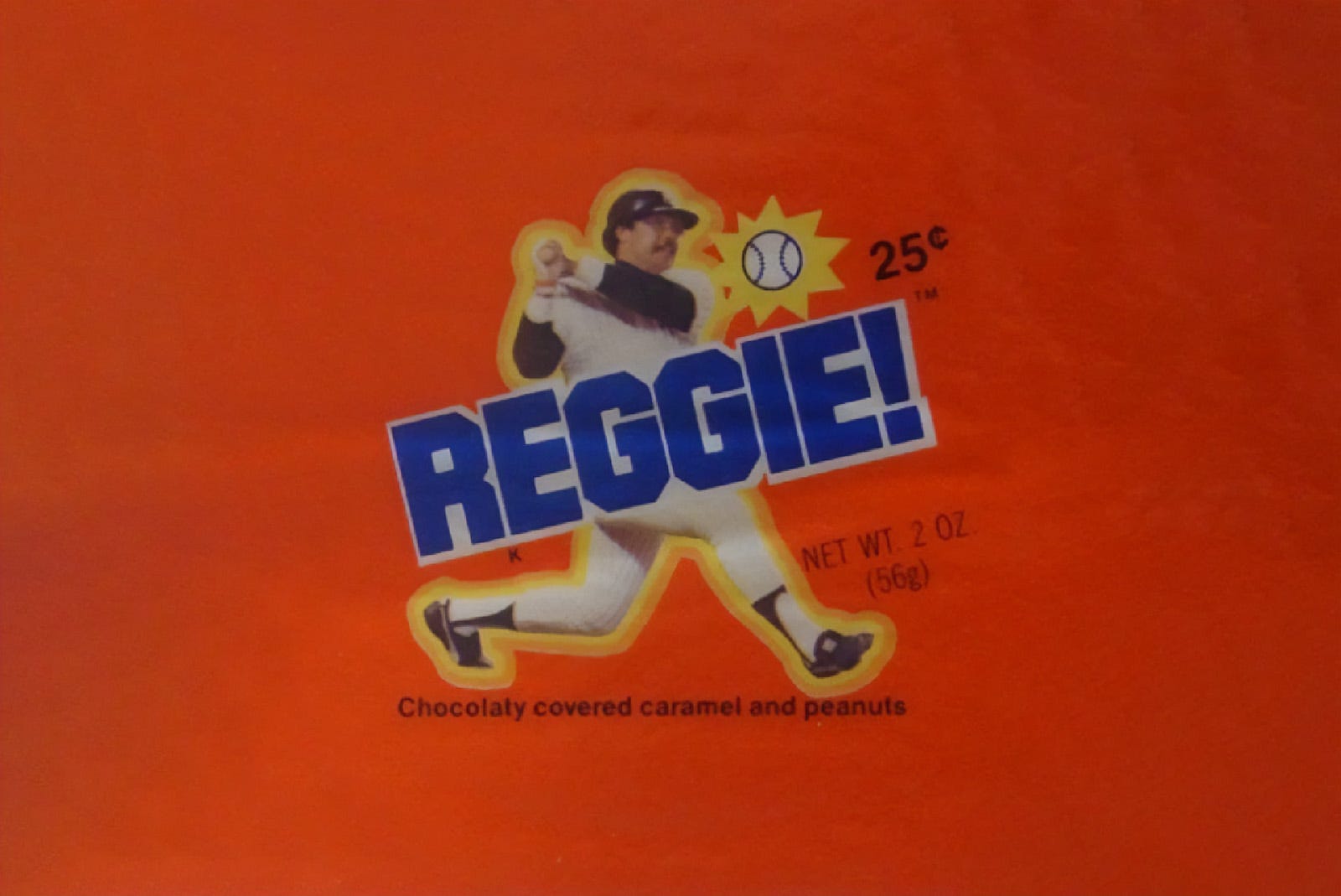
The bar’s actual composition was far more straightforward. At its core, it was just a repackaged Wayne Bun. Which is a delicious round disc of caramel and peanuts coated in milk chocolate that had been made at the Wayne Candy Company plant in Fort Wayne, Indiana since the 1920s. Curtiss acquired Wayne Candies through Standard Brands in 1973 and, a few years later saw an opportunity to give the old formula a new identity. They put Jackson’s image on a bright orange wrapper with REGGIE in bold blue letters and placed collector baseball cards inside each package. The bar sold for a quarter.
The official unveiling took place in February 1978 at the Plaza Hotel in New York, with club owner George Steinbrenner on hand and Jackson biting into the bar for the cameras. He admitted the commercials made him nervous, but he was characteristically unbothered about release. “This is serious, big business,” he told reporters. “It’s corporate planes and meetings and millions of dollars. It’s not going to spend all this money on a joke.” The bar was introduced in five cities, New York, Philadelphia, Chicago, Los Angeles, and San Francisco. These were identifies as markets where candy sold best. In other places, distribution lagged while machinery was still being tooled up, and local distributors were warned not to count on receiving stock immediately.
The thing about the Reggie Bar is that it didn’t need perfect day one distribution. It just needed Reggie doing his thing on Opening Day.
It was April 13, 1978 at Yankee Stadium. The Yankees were raising their championship banner, saluting Mickey Mantle and Roger Maris, and welcoming 44,667 fans who had each been handed a free Reggie Bar at the gate. The team had started the season 1 and 4 on the road, so the crowd was ready for something to celebrate. In the bottom of the first inning, Jackson took a couple of balls from the Chicago White Sox before sending a three run home run into the right center seats. The crowd exploded. Then, in one of those great live sports moments, fans began throwing their Reggie Bars onto the field. Hundreds of orange wrapped candy bars sailed through the air. The game stopped for several minutes while the grounds crew cleared them away. It made national news. That image did more for the Reggie Bar than any commercial.
Jackson later admitted that when fans threw the bars onto the field in 1978, he briefly worried that they didn’t like how they tasted. What he came to quickly understand was that the moment wasn’t really about flavor. It was a celebration of prowess.
When they did run commercials they showed Jackson hitting his three World Series home runs before turning to the camera to taste the candy. They worked. But candy raining down on Yankee Stadium was the kind of publicity that money can’t buy. Standard Brands’ public relations team later acknowledged that sales were meeting expectations in the initial markets, though specific numbers were not released. Jackson would later say the bar generated 11 million dollars in the New York area alone during its first year.
The bar expanded to additional cities through 1978 and into 1979. In Baltimore, where Jackson had once played briefly, it was reported to be doing surprisingly well. For a few years, the Reggie Bar was a real presence in ballparks, supermarkets, and candy stores across the country.
Then the pieces that had assembled it began to shift. Jackson signed with the California Angels after the 1980 season. Standard Brands merged with Nabisco in July 1981, becoming Nabisco Brands Inc. The Wayne Candy plant in Fort Wayne, the only facility producing Reggie Bars, was slated for closure that October. There was discussion of moving production, but it never materialized. A sizable inventory remained in warehouses for a time. Then it ran out. The bar was gone.
The first comeback attempt came in 1993, just in time for Jackson’s Hall of Fame induction. Clark Candy Company, operating out of the same Fort Wayne plant under new ownership, revived the Reggie Bar with a modified recipe that replaced the caramel center with peanut butter. It retailed for over 50 cents and returned briefly to shelves following Jackson’s induction and the retirement of his number 44 by the Yankees. The revival didn’t last.
The most recent return began in 2021. Crystal Westergard, a Canadian physiotherapist who had previously revived the discontinued Cuban Lunch bar, became interested in the Reggie Bar after seeing a television segment about it. Curtiss was long gone, and Jackson retained his likeness rights, which made a licensing deal possible.
Working with a chocolate manufacturer, Westergard developed prototypes and sought Jackson’s feedback. He wanted more peanuts. She insisted the caramel be gooey and amber colored, the way it appeared in the old commercials. Around six thousand bars were produced in the first 2023 run. Within a year, the candy was available in roughly two thousand locations nationwide and online. You can still buy them today!
Back in my family’s house, where rooting for the Yankees wasn’t acceptable, I didn’t know anything about mergers or Indiana factories. All I knew was that this man had hit three home runs in a single World Series game, that fans had showered him with candy, and that the bar with his name on it was everywhere. Reggie was bigger than life. You could dislike the Yankees all you wanted. The Reggie Bar didn’t care. It was loud, unsubtle, and surprisingly good. Just like the man himself.
This is great. I'll see your growing up in a Mets household and raise you one. I was born in '77 in a suburb of Boston, into a family of Red Sox fans. But seeing Reggie on a candy bar as a little kid was more than enough for me to abandon the Sox for the Yankees. 48 years later and here I am, still a diehard Yankees fan—much to my family's dismay!
I preferred the Baby Ruth bar