

The Panasonic Dynamite 8
A childhood want, a quirky 8 track player, and one of the most playful music machines of the 1970s

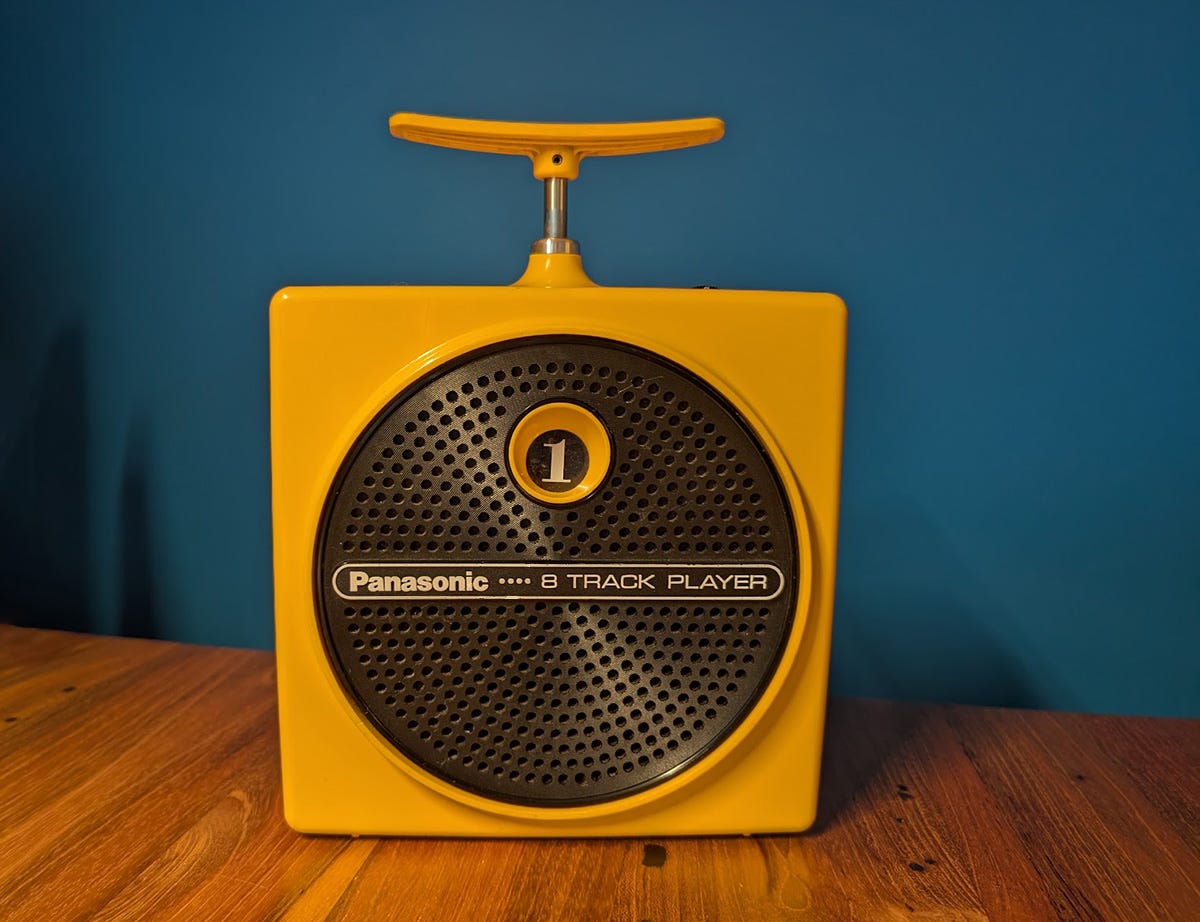
I first saw the Panasonic Dynamite 8 in a catalog, probably sitting on the carpet of our living room with a pen, which was how I communicated the things I wanted for Christmas to my mom. I circled it. I may have circled it more than once. Also known as the Panasonic RQ 830S, the Dynamite 8 was a portable 8 track player with a TNT style plunger used to change tracks, but to me it looked like a toy. That was exactly the point, and probably exactly why it never made it under the tree. My mom was a sensible person, with a limited budget. If you wanted music, you got something that looked like it played music. A little yellow 8 track player with a fake dynamite plunger on top was a harder case to make.
I eventually forgot about it, the way you forget about most things you wanted badly as a kid. Then, a few years ago, after patiently trying to find an affordable one in good condition, I bought one online. Before I talk about it, lets talk a littler bit about the technology
The story of the Dynamite 8 begins with the 8-track format itself, which had a somewhat unlikely origin. The technology was developed in the 1960s by a consortium that included RCA Records, Lear Jet, and the Ford Motor Company. Bill Lear, best known for his work in aviation, developed the 8 track as an improvement on the earlier 4 track cartridge system. The goal was something more practical for consumers, specifically something you could play in a car without handling reels of tape. In 1966, Ford became the first automaker to offer the new Stereo 8 format across its entire model lineup, and the format took off from there.
By the early 1970s, 8-track players were a fixture in American cars and living rooms. The tapes were chunky durable plastic bricks and you could find them everywhere. What the format never managed to shake was a fidelity problem. The sound was not great. Track changes happened mid-song, the tape hiss was real, and the whole experience was more convenience than quality. It was music you could take with you, and for a lot of people, that was enough.
By 1974, though, the 8-track format was aging. Cassette tapes were getting better and more widely available. The format needed something. What it got from Panasonic was one of the more imaginative product designs of the decade.
The Panasonic Dynamite 8, model RQ-830S, looked exactly like what its name suggested. The body was a squat, rounded square. The face was dominated by a large circular speaker grille with a track indicator. And rising from the top, on a thin metal stem, was a T-shaped plunger handle. The whole thing resembled a cartoon detonator, which was entirely deliberate. Panasonic’s own advertising made the comparison explicit: “It looks like a detonator. And sounds like dynamite.”
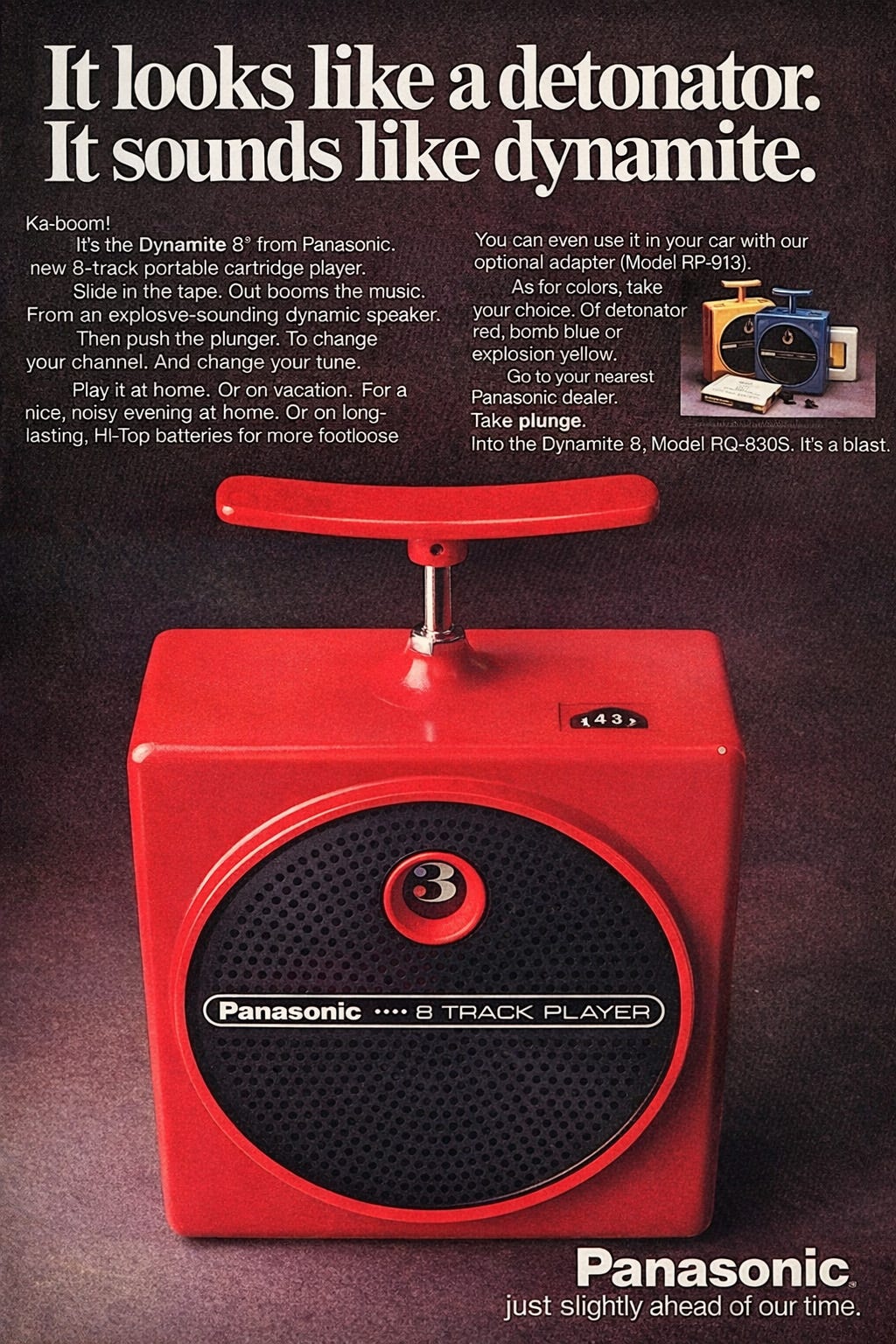
The plunger was not just decorative. Pushing it down changed the track and you would hear a different song. It was the only way to do it on this machine. Unlike other players on the market, the Dynamite 8 did not switch tracks automatically. You had to detonate it yourself. There was no headphone jack, no tone control, and it played in mono through its single 3-inch full-range dynamic speaker. It ran on batteries or AC current, and Panasonic sold an optional car adapter as well, model RP-913.
What it lacked in features it made up for in personality. The Dynamite 8 came in three colors at launch: Detonator Red, Bomb Blue, and Explosion Yellow. Panasonic was fully committed to the bit. Later versions added white and black to the lineup, and a clear version also appeared at some point in the production run. The color-coded, pyrotechnic naming was not an accident. This was a product aimed squarely at kids, teenagers and playful adults, and Panasonic’s marketing treated it as such from the beginning.
Advertising from the period leaned into the detonator concept. One consumer magazine ad opened with “Ka-boom!” and walked readers through the experience in the language of an explosion: “Slide in the tape. Out booms the music from an explosive-sounding dynamic speaker. Then push the plunger to change your channel and change your tune.” Another ad headline read “Sound Explosion.” A third said simply “Have a Blast.” The retail price held steady at $39.95 for most of the product’s life, with sales periodically dropping it into the high twenties. That was a real price for a kid’s item in the mid-1970s, roughly equivalent to $240 today, but the ads kept running, and the thing kept selling.
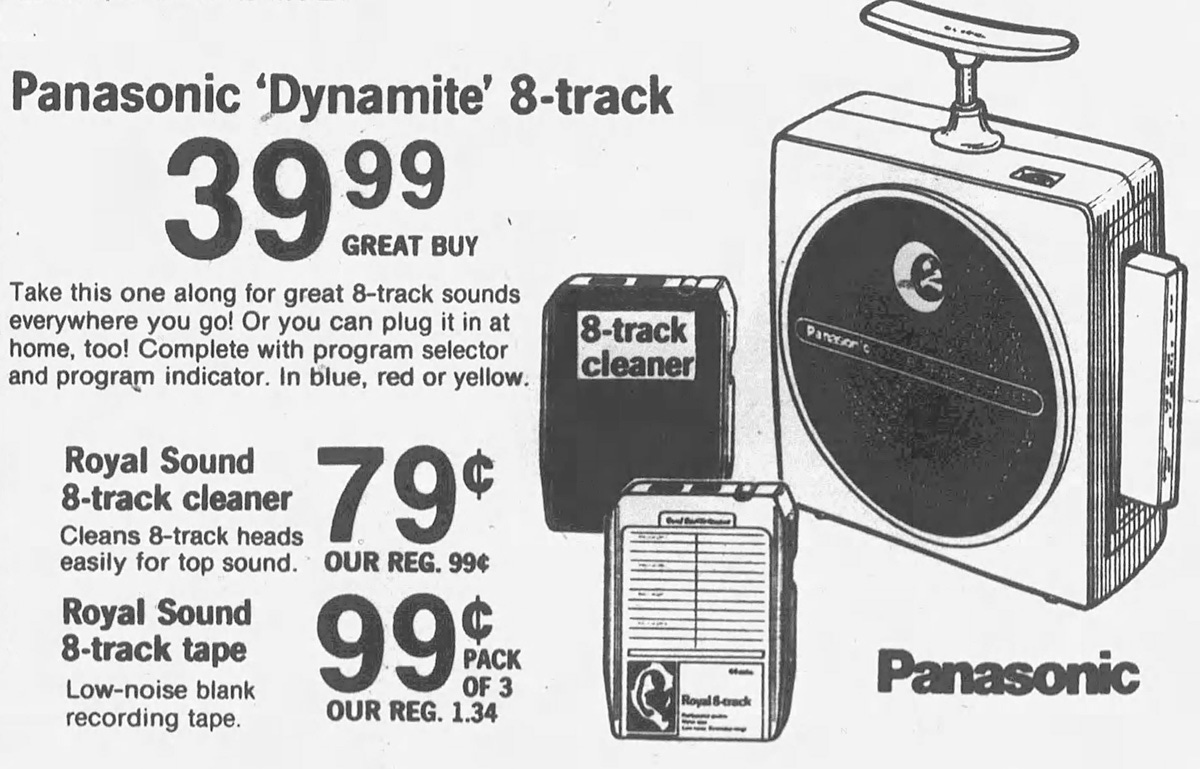
The retail price at launch of $39.95 in 1974 was consistent across newspaper ads from Sarasota to Santa Barbara through 1979, with promotional prices occasionally dipping to $28.88 or $29.95. For a device with this few features, that price held up remarkably well for five years. It was a testament to the attractiveness of the form rather than the quality of the audio itself.
To really move units, Panasonic went looking for a spokesperson, and they found the perfect one. Jimmie Walker was then starring as James “J.J.” Evans Jr. on Good Times, the Norman Lear sitcom that ran on CBS from 1974 to 1979. Walker’s character had a catchphrase that the writers leaned on heavily: “Dy-no-mite!” It was everywhere, the kind of phrase that got on t-shirts and into playgrounds and that every kid in America could do a passable impression of. Panasonic saw the connection immediately.
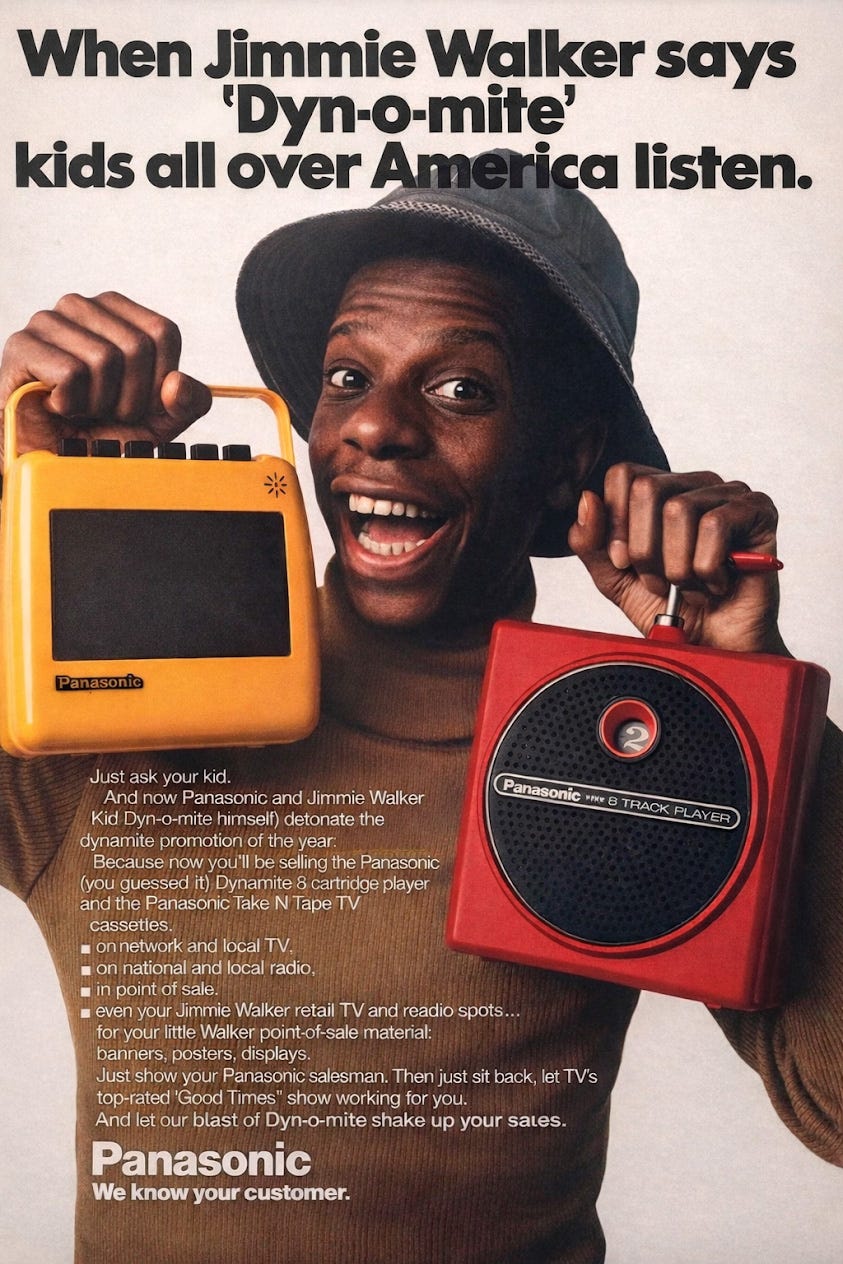
The resulting campaign was a marketer’s dream. A dealer-facing ad from around 1975 laid it out plainly for retailers: “When Jimmie Walker says ‘Dyn-o-mite,’ kids all over America listen.” Panasonic promised Walker would promote the Dynamite 8 on network and local TV, on radio, in magazines, and at point of sale. The ad copy called him “Kid Dyn-o-mite himself” and listed the publications where the campaign would run: Seventeen, Hot Rod, Senior Scholastic, and Motor Trend. There was a full in-store display package: wall banners, posters, streamers, window spots, counter cards. Panasonic even mentioned a singing group called, of all things, “The Dynamite 8,” tied to the promotion.
Walker’s television spots became a genuine part of the product’s identity. In one version he addressed the camera as “My fellow music lovers!” before walking through the features of the Dynamite 8 and the companion Take-N-Tape cassette player Panasonic had introduced. The campaign’s final notable push came during the 1979 holiday season, when the tagline became “put a little dy-no-mite under the tree.”
It worked. The Dynamite 8 became a genuine pop culture sensation, the kind of thing that showed up in Christmas wish lists and bedroom photographs and that a certain generation remembers with the specific warmth reserved for things that were cool.
The Dynamite 8 was not only a North American phenomenon. In Japan, Panasonic’s parent company Matsushita sold consumer electronics domestically under the National brand name, which it used until retiring it in 2008 in favor of a unified Panasonic identity. The same basic platform that became the Dynamite 8 in the US appeared in Japan as the National RQ-8, and it was adapted for something that was just beginning to find its audience there: karaoke.
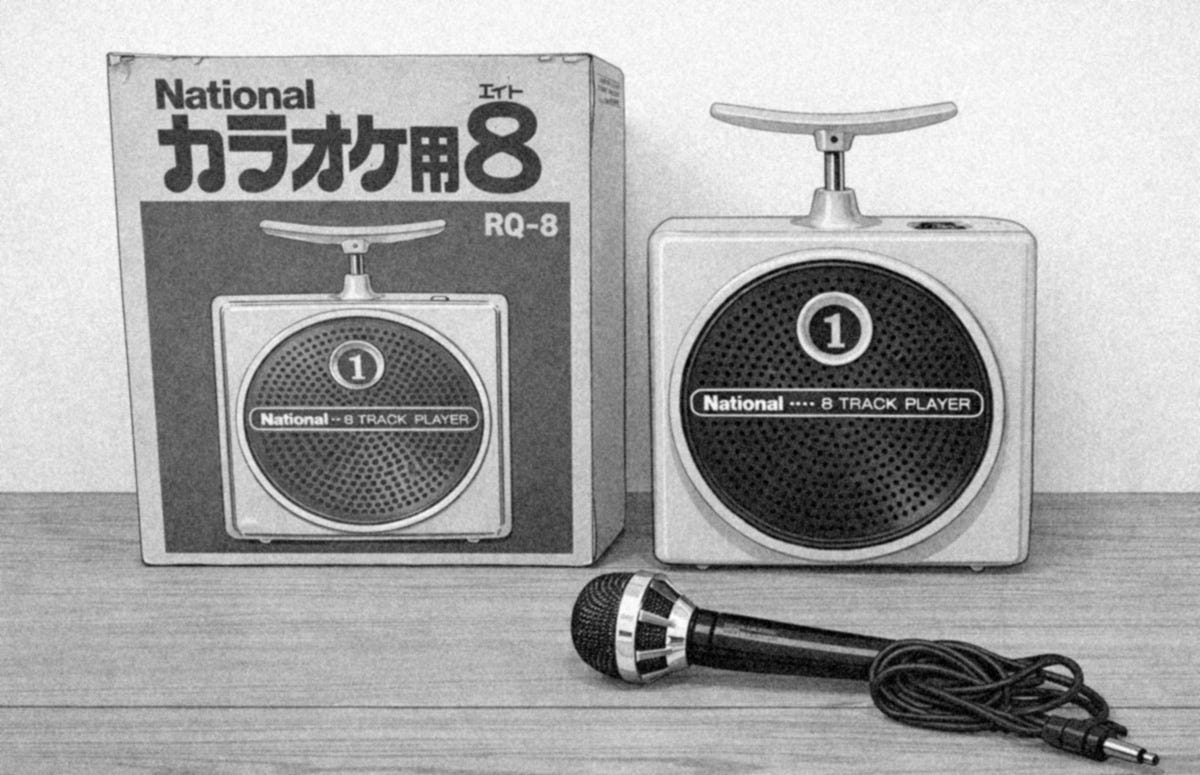
The National RQ-8 came bundled with a dynamic microphone, instruction sheets, and catalogs for karaoke 8-track tapes. The box art showed the unit with the number “1” on the bull’s-eye indicator, and the product was positioned as a home karaoke system at a time when karaoke was still a novelty outside of bars and clubs. Karaoke emerged as a commercial product in Japan around the turn of the 1970s, and Daisuke Inoue is often credited with popularizing it in 1971 with a machine that played backing tracks for people to sing along to, though some later accounts credit Shigeichi Negishi with an earlier karaoke machine in 1967. The RQ-8 brought that same idea into the home in a package that was portable, colorful, and cheap enough to be a reasonable purchase. It is a strange and delightful that in its own home market this same-looking device could be used as a portable karaoke machine.
The The Panasonic Dynamite 8 I picked up was in reasonable shape, cosmetically. Functionally it needed work. The belt had degraded, which is the most common failure point on these machines after decades of storage. Replacing it is not a complicated job, but you need to know what you’re doing, and I had a useful guide: the YouTube channel Techmoan, run by British tech enthusiast Mat Taylor, who has made a long and well-regarded series of videos on obsolete audio formats and the machines that played them. His coverage of vintage portables like the Dynamite 8 has sent more than a few people down the same rabbit hole I fell into. A new belt, a replacement speaker, and the thing was playing again.
I think mine turned out pretty well. Here are some photos of it before I cleaned it up and nice photo of it all cleaned up.


And here is a video of Dynamite playing a K-Tel collection
Here’s the thing though. The Dynamite 8 sounds like what it is. It’s a mono device with a small speaker, playing a format that was never known for fidelity, on tape that is at least forty years old. If you upgrade the speaker, as I did, you will get a noticeable improvement. But you are not going to be bowled over. The warmth that people associate with analog formats, the quality that vinyl enthusiasts talk about, is not what you are getting here. What you are getting is something that sounds like the 1970s, which is its own thing entirely.
What strikes you more than the sound is the object itself. Holding the Dynamite 8, you understand immediately why kids wanted it. It has a confidence in style and form that modern devices have almost entirely given up on. It is solid, colorful, and hard to look away from. The plunger on top is genuinely satisfying to push. The track indicator is easy to read. For an audio player that reads almost as a toy, it has a presence that most consumer electronics never achieve. It looks exactly like what it was designed to look like, and that is rarer than it sounds.
The 8-track format faded quickly once cassettes became dominant in the late 1970s. Cassette tapes were smaller, sounded better, and did not interrupt songs at arbitrary intervals to change tracks. The Dynamite 8 continued appearing in newspaper sale ads into 1979, still at its stubborn $39.95 retail price, but the window was closing. The format that had ridden into American life on the back of the Ford Motor Company was being pushed out by a wave of Sony Walkmans.
The Dynamite 8 itself though, was never really about the format anyway. It was about the idea that a piece of audio equipment could be fun, could be designed with a sense of humor, could look like something other than a serious black rectangle. That idea did not survive the 1970s in any commercially meaningful way. Portable audio became about miniaturization and sound quality, and the personality got engineered out. The Walkman was a revolution, but you would never describe it as playful.
Today, working examples of the Dynamite 8 are not as easy to find as you might expect. Refurbished models in good condition have sold for several hundred dollars, and even Jimmie Walker print ads have their own market among collectors. There is a dedicated community of people who restore and collect them, and the repair information is out there if you go looking.
The one sitting on my shelf still plays. I put a tape in now and then, push the plunger, and listen to something that sounds that takes me back. It is not the sound I was hoping for as a kid circling it in a catalog. But the object is exactly what I imagined it would be. Sometimes that is enough.
Love this. Was hoping you video’d it playing. You did not disappoint. Fun stuff , Nostalgia.
Excellent piece. Thanks for the deep dive into a great memory!