

The AKAI VS-303U VCR
Rediscovering my family's first VCR the AKAI VS-303U


There is a certain kind of loss that comes not from forgetting something, but from having it taken away before you were ready. The AKAI VS-303U that sat in my family’s living room was like that for me. I was a kid when it arrived, and I had no framework for appreciating it more deeply. It was the VCR we happened to get and the one that changed everything.
Then one day it was gone. Donated, discarded, lost to the slow disappearance that eventually claims most electronics once their first owners move on. I eventually got a VCR of my own and moved on. I did not think much about that first machine again. Then for a while it was all I could think about.
It started while I was working on a Retroist podcast about VCRs. The VS-303U began pulling at me again. I mention it in my opening story and while recording it I started to realize that I couldn’t remember the name and model of the VCR. There was clearly something I needed to figure out. What I didn’t expect was how long it would take to track one down, or how much I would learn once I finally did.
To understand why that particular VCR stuck with me, it helps to know where it came from. AKAI was not just another electronics brand in the early 1980s. The company had already spent decades building its reputation around one thing, tape.
Formally known as AKAI Electric Company Ltd., the firm was founded in Tokyo in 1929 and spent much of the twentieth century establishing itself as a serious name in audio equipment. Outside Japan the brand was especially associated with tape recorders. Reel to reel machines, cassette decks, and the company’s distinctive GX glass and crystal ferrite heads gave AKAI a reputation for durability and precision. By the time home video began to take shape, AKAI was already a trusted name among audio enthusiasts. When the company turned its attention to VCRs in the early 1980s, it brought that engineering mentality with it. It also brought something else, a desire to prove that it could innovate in a field that was quickly becoming crowded.
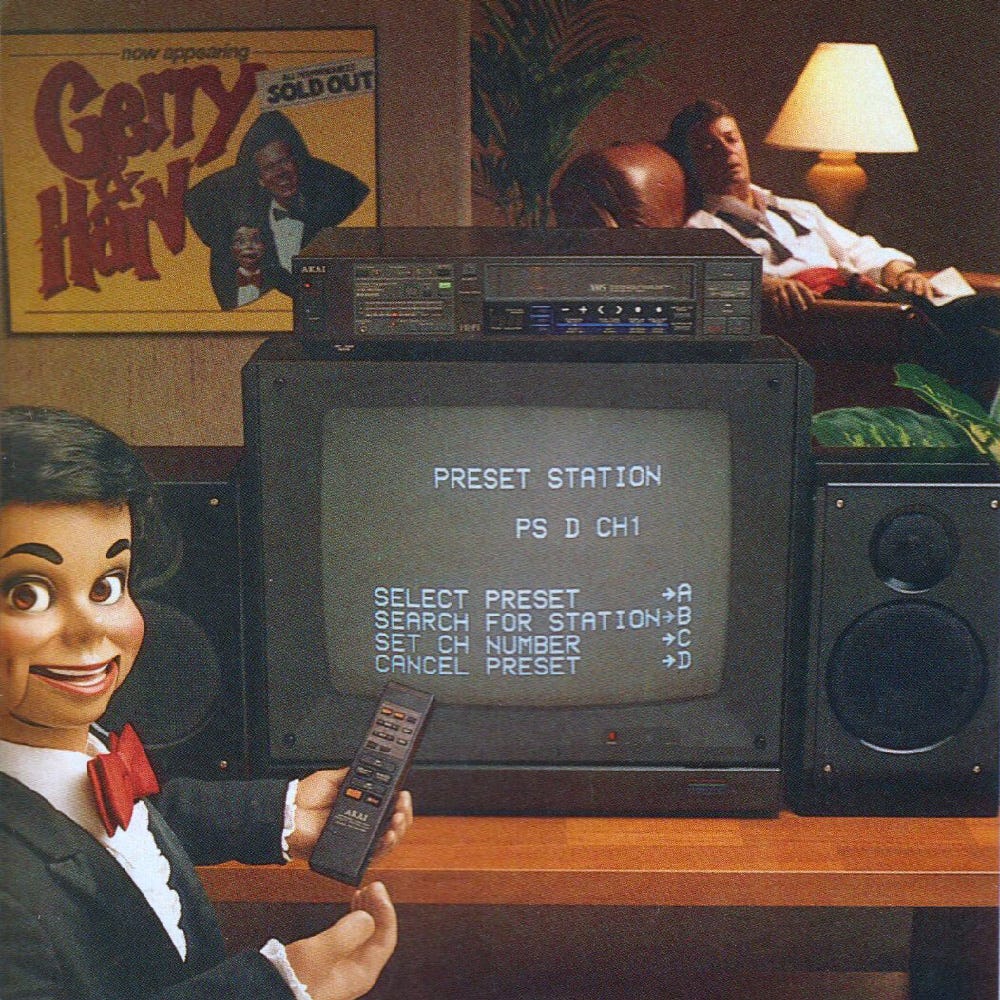
One of AKAI’s most important early contributions came in 1982 with the VS-2, the first VCR to feature an on screen display interface. Akai called it the Interactive Monitor System (IMS). Instead of forcing users to interpret blinking lights or cryptic front panel indicators, the machine could place programming and status information directly on the television screen. Timer settings, counters, and instructions appeared in plain language. The VS-303U, released in 1985, arrived as a consumer friendly descendant of that idea.
Here is a commercial for the VS-3, where you can hear the pitch for IMD and see it in action.
I have no idea how my family got this machine. It seemed high end for us. By the time the VS-303U appeared, the VCR market itself was changing quickly. When VHS machines first arrived in the late 1970s they were expensive appliances, often selling for between one thousand and fourteen hundred dollars. Ownership was limited largely to early adopters and well off households. Prices began to fall during the early 1980s, but the machines were still significant purchases. In 1980 a typical VCR might cost anywhere from seven hundred to fourteen hundred dollars depending on brand and features. By the middle of the decade competition was pushing those numbers downward.
The VS-303U entered that environment with a list price of around $349. That placed it near the middle of a market that had suddenly become very crowded. By the mid 1980s the format war between VHS and Betamax had effectively been decided, and manufacturers were now competing primarily on price and features rather than format. Korean manufacturers had begun producing lower priced models. Japanese companies were cutting prices to maintain their positions. Retailers were running aggressive promotions to move inventory.
The numbers reflected this surge in volume. Industry estimates suggested that about eleven and a half million VCRs would be sold in the United States in 1985 alone, roughly fifty percent more than the previous year. Demand was exploding. By the middle of the decade the VCR was rapidly shifting from a luxury appliance into a mainstream household device.
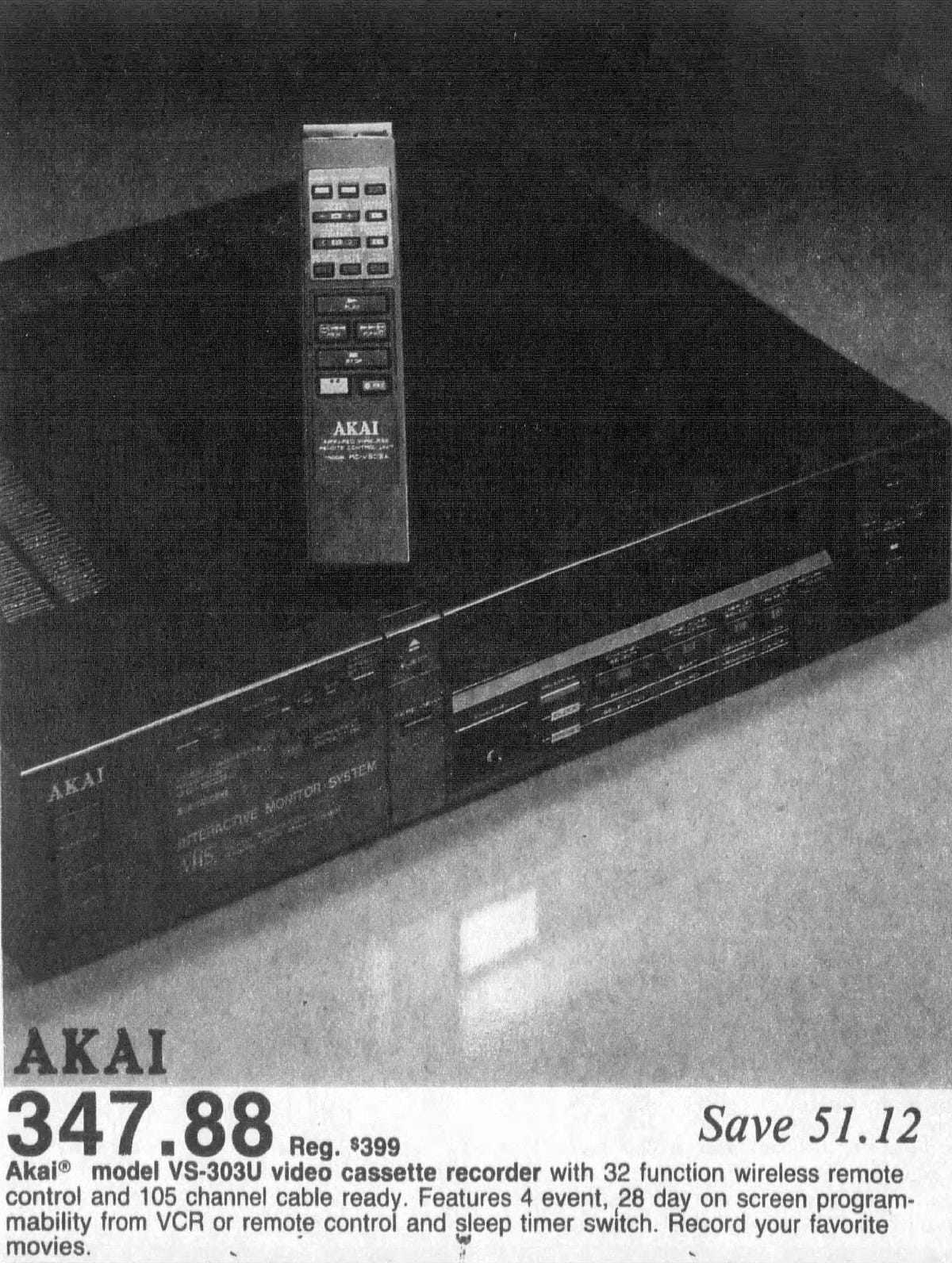
Newspaper advertisements show how quickly the price of the VS-303U shifted as the market evolved. A December 1985 ad in The Record in NJ advertised the same model for $329. A January 1986 circular from Roses department stores showed it at $347.88. So not much changed, but by December 1987 a listing in the San Francisco Chronicle placed the price at $219.95.
This pattern was typical for consumer electronics of the era. New models launched as premium products, then rapidly dropped in price as competition intensified and manufacturing scaled up. Families that waited a year or two could often buy the same machine at a fraction of its original cost. My own family probably picked up the VS-303U somewhere along that downward slope.
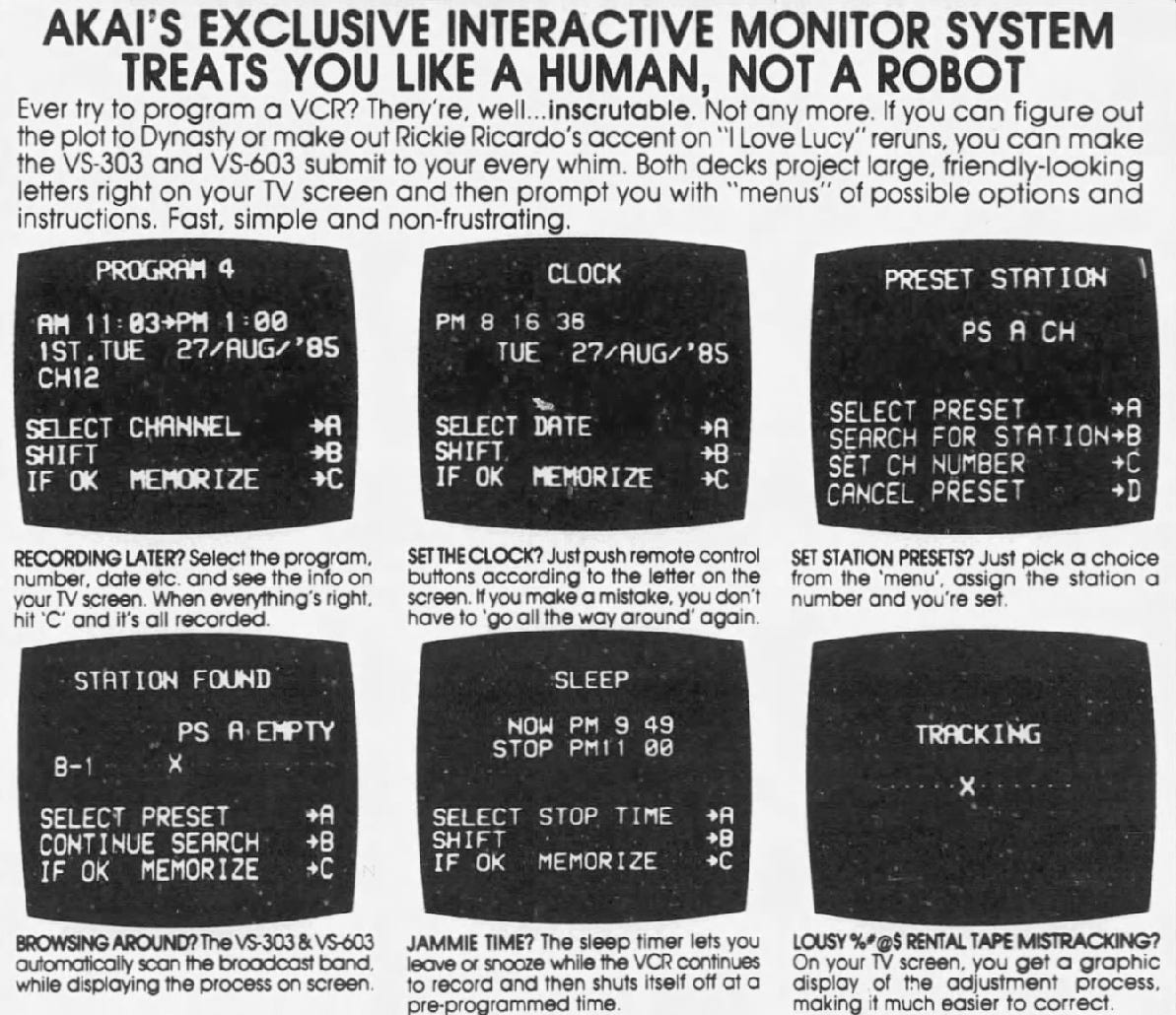
What separated the VS-303U from many competing machines was not simply its price or its specifications. It was the way the machine helped the person using it. Many VCRs of the mid 1980s were notoriously difficult to program. Setting up a timer recording often required consulting the manual, pressing a series of buttons in the correct order, and hoping nothing went wrong. A mistake could send the entire process back to the beginning. As one Rogersound Labs advertisement from 1986 memorably put it, you could easily find yourself “back around the whole cycle.”
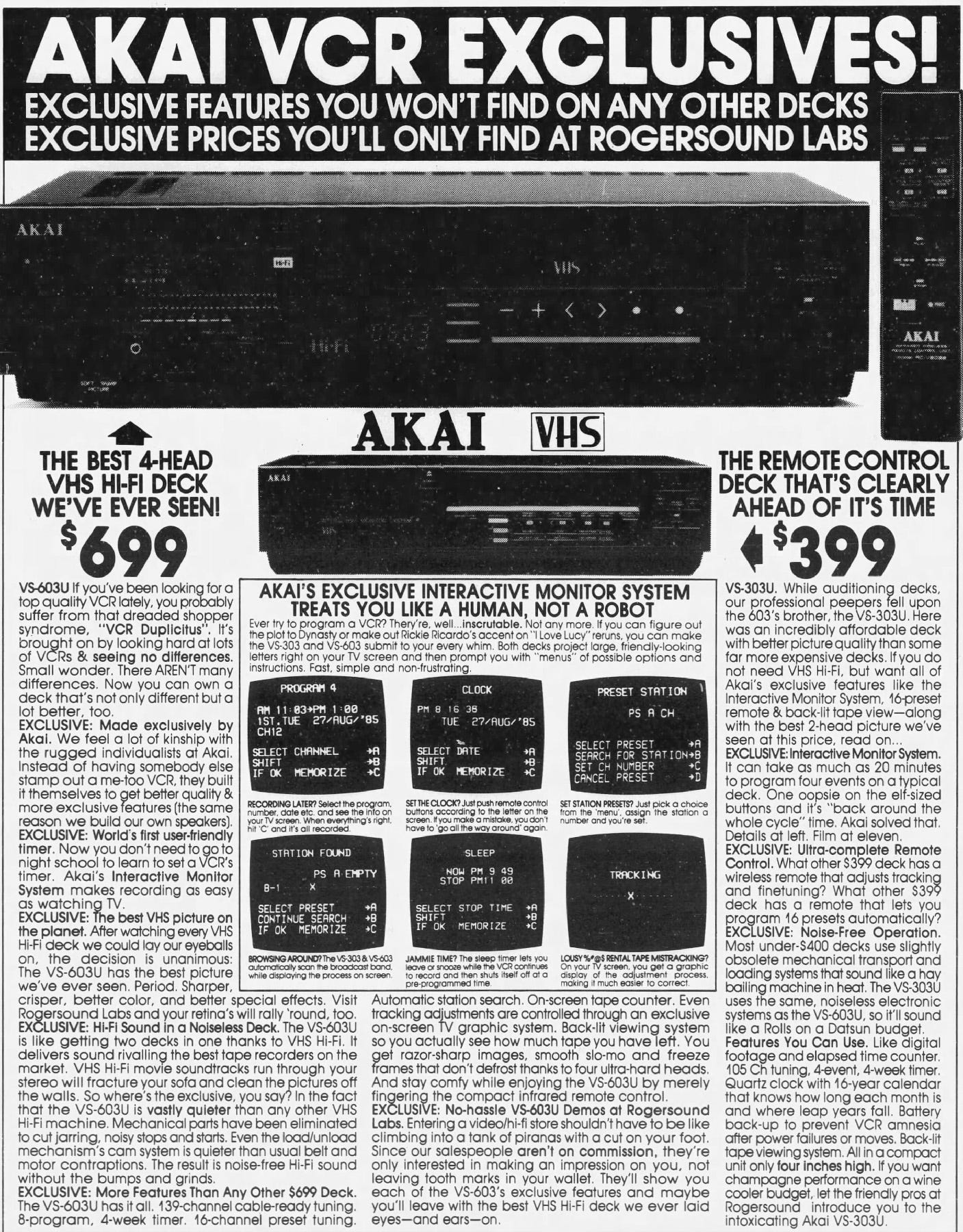
The Interactive Monitor System changed all that by putting those instructions directly on the television screen. Selecting a channel, entering the date, choosing the start and stop times, and saving the entry all appeared as prompts. If you made a mistake, you simply moved back through the menu and corrected it. Instead of memorizing button sequences, you followed instructions. It was something we take for granted now, but it felt cutting edge at the time.
The service manual reveals how elaborate the system actually was. The IMS interface displayed prompts such as “SELECT TIME” and “IF OK MEMORIZE,” with letters corresponding to specific buttons on the front panel or the remote control. The machine supported a four event timer that could be programmed well in advance. A built in sixteen year calendar accounted for leap years. Battery backup preserved the settings during power outages. Inside a machine less than four inches tall was a small but capable piece of consumer hardware.

That design philosophy extended beyond the front panel and onto the remote control. The RC-V603 remote included thirty two separate functions, unusually extensive for a mid 1980s VCR. It allowed users to perform nearly every task available on the front panel without leaving the couch. Transport controls were joined by counter reset, return to zero, fine tuning, adjustable tracking, and timer programming functions. The remote also included an auto mute feature that inserted several seconds of blank audio during recording, a useful tool when editing between segments.
At a time when some competing machines shipped with wired remotes or basic playback controls, the VS-303U allowed the entire programming process to take place from across the room. Which was amazing and the IMS menus worked exactly the same way whether you were using the front panel or the remote. The remote itself is worth a moment of attention. It was longer than many remotes and on the thin side. It also had tactile rubber buttons that made it enjoyable to use.
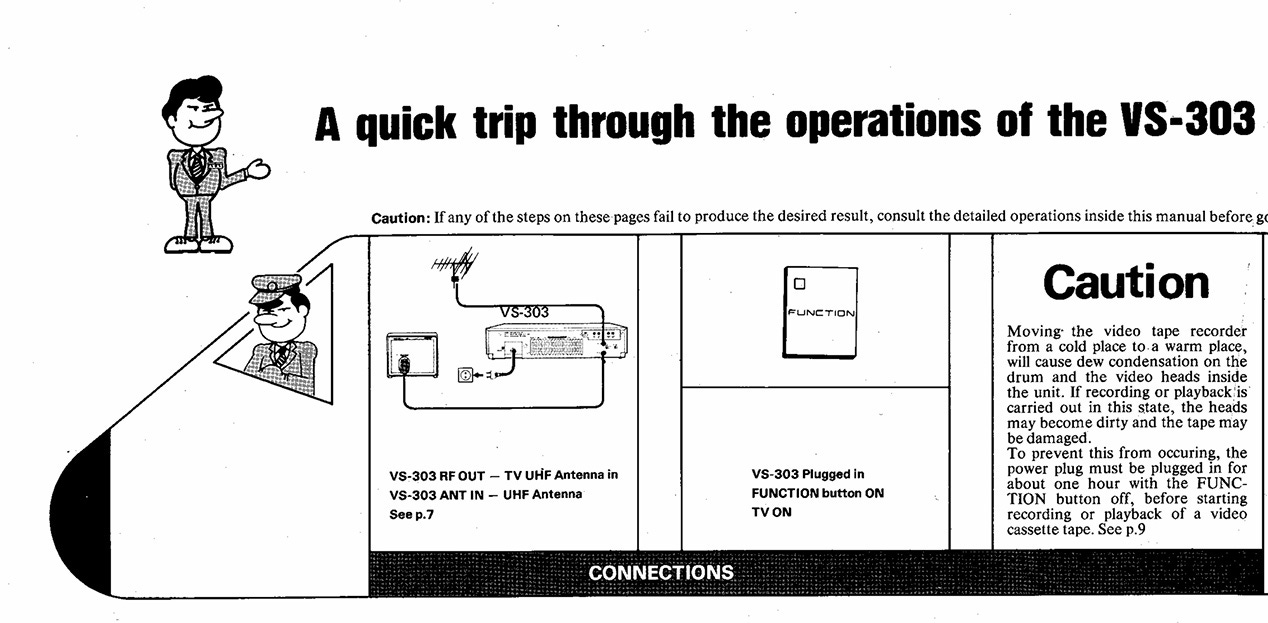
The service manual also hints at how much engineering went into the machine. The VS-303U was labeled as a three speed unit, though it actually recorded in only two speeds, Standard Play and Long Play. With longer tapes, those modes could push recording time close to eight hours. The three speed label likely carried over from related models that supported additional recording modes.
AKAI emphasized quiet operation in its advertising, and the internal design helps explain why. The transport used a microcomputer controlled direct drive system paired with a dedicated servo board. This configuration reduced the mechanical noise associated with belt driven transports that were common in cheaper machines. The tape path itself was designed with durability in mind. During fast forward and rewind operations the tape disengaged from the video head drum, reducing wear on both the tape and the heads. Not every machine in the lower price tiers took that precaution.
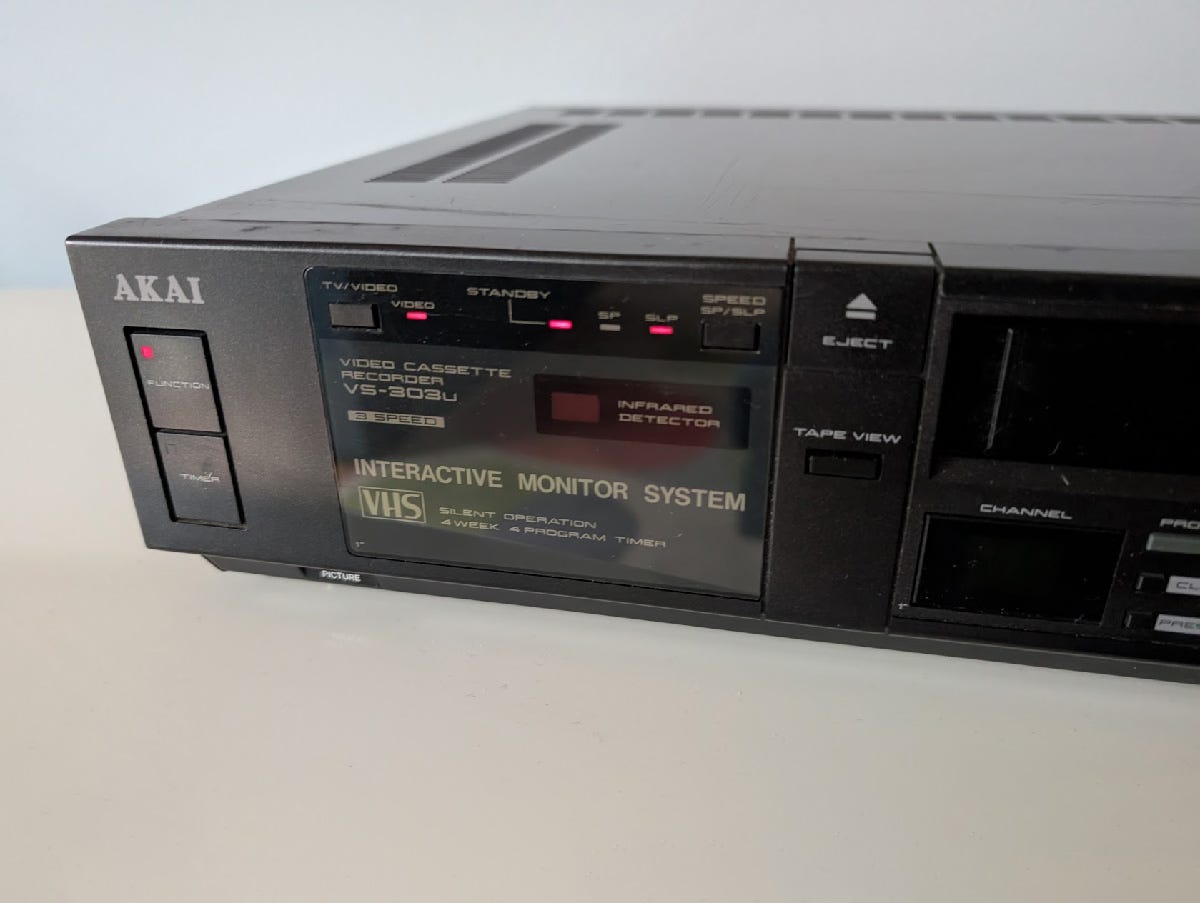
One of the most distinctive, but simple features, was the Tape View System. A small illuminated window in the cassette compartment allowed users to see the reels of the tape turning inside the cassette. Pressing the Tape View button activated the light, which shut off automatically during playback.
It was a small touch, but a memorable one.
The machine also included a physical guide block that prevented users from inserting a second cassette while one was already loaded. It was a simple mechanical solution to a problem that apparently occurred often enough to justify the design.
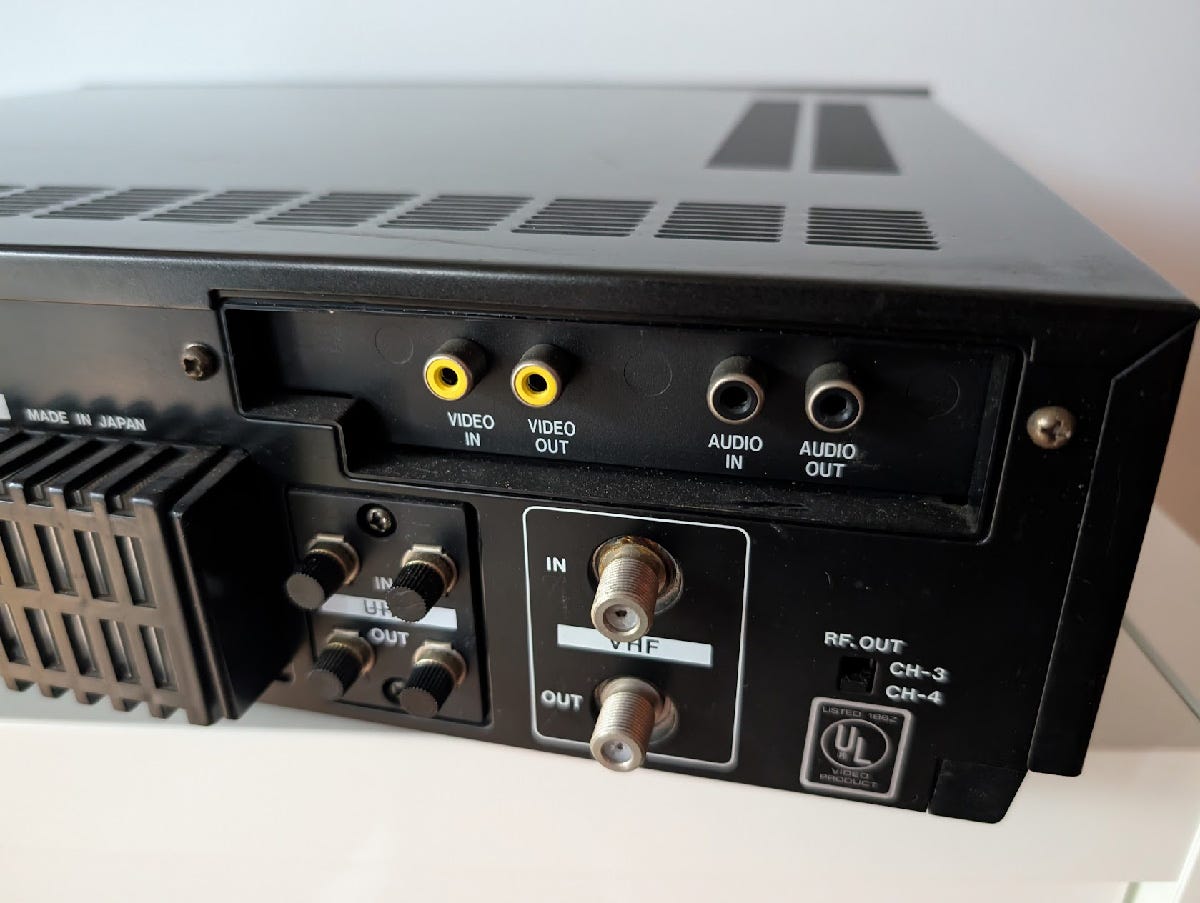
Around the back of the unit were the standard connections for the time. Composite video input and output, audio input and output, VHF and UHF antenna connections, and an RF output with a channel three or four selector switch. The unit itself was manufactured in Japan.
Many of us remember what it was like to get a VCR. Suddenly there were movies at the video store that we could bring home and my family could record television while we were out. The television was no longer a schedule you simply followed. It became something you could bend around your own time. These are memories we have in common from the device in all its forms.
But what I remember most about the VS-303U is the experience of it. The glow of the display in the living room. The soft mechanical whir as the tape threaded itself around the head drum. The moment the IMS screen appeared with its prompts, telling you what to do next. The confusion as my sisters and mom tried to figure it all out and how heroic I felt when I took the time to understand it all by studying the manual.
Looking back, the machine was doing something very little consumer electronics of the time bothered to attempt. It was making itself understandable, simple enough that a kid (me) could figure it out.
Decades later, when I started trying to find another VS-303U, I discovered the machine had settled into a strange kind of obscurity. It was not rare enough to command serious collector attention, but not common enough to appear regularly in the usual places. When one did surface it was often untested, incomplete, or priced weirdly high for reasons I couldn’t really understand.
That meant doing some research.
The service manual on the Internet Archive turned out to be essential. The complete document covers operating instructions, service procedures, schematics, and a full parts list. It also explains how the machine was designed to function and what tends to fail after decades of sitting in basements or garages. Some examples? The IMS display system relies on a character generator circuit that can degrade in specific ways. Rubber components in the tape transport eventually harden or break down with age. Armed with that information, I had a better sense of what to look for and what warning signs to watch for when a unit finally appeared.
When I eventually got my hands on a working VS-303U, the first thing I did was press the clock button. The IMS screen appeared exactly as the manual said it would. The display asked me to select the time. I followed the prompts, just as someone would have done forty years earlier. The machine responded without hesitation.
It worked.
For reasons that are difficult to explain, that small moment felt comforting. Like reuniting with a long lost friend after many years.
The VS-303U was not the rarest VCR ever built, and it was not the most elaborate machine of its time. What it represented instead was a particular way of thinking about consumer technology. The machine should help you use it.
At the core of that was that Interactive Monitor System. Within a few years, systems like it would appear across the industry. Once people experienced a machine that showed them what to do, there was little reason to return to the old blinking displays and cryptic controls.
The VS-303U is the machine that introduced my family to home video. The first trip to the video store (the very one I would work at a few years later). The illuminated window showing the reels turning (so cool). The feeling that the television in the living room had suddenly become a little more exciting than it had been the day before.
Decades later I ended up making a podcast about VCRs because of it. While I may have researched, recorded, and released that episode over the course of a week, the story behind it started much earlier in a living room in New Jersey. With a machine that properly showed you what it was doing and treated you like a human, not a robot.
Forty years later, that still sounds like a pretty good idea.
I don’t recall the brand of my family’s VCR, but we did manage to learn to program it to tape shows to watch later. That led to my favorite feature of the VCR era: the ability to “zap” the annoying commercials. I often long for that ability when all I can do now, in the era of streaming, is to mash the mute button.
So expensive!