

My Buddy
My Buddy, the toy adults could not stop explaining

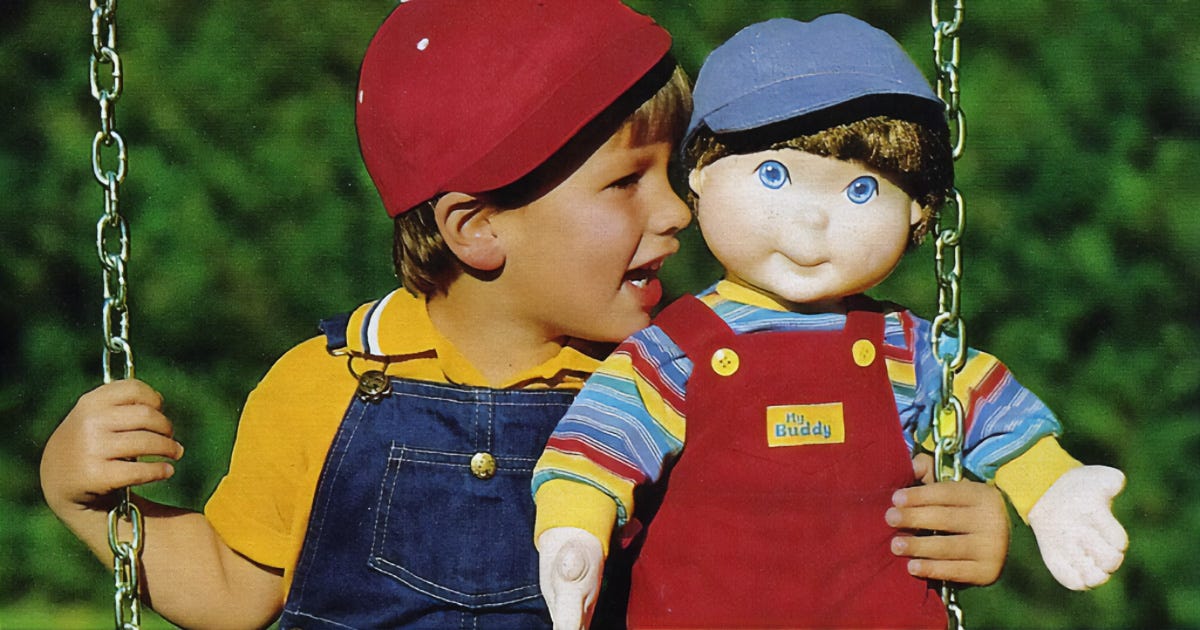
I was never really a doll kid. Action figures were fine, and I liked stuffed animals, especially bears. Those were easy to love. Dolls that looked like actual children just never appealed to me. I understood why other kids liked them, and I never thought there was anything wrong with that, they just were not my thing. As a kid in the eighties, I leaned toward toys that did something, or let me build or arrange something. I liked toys that suggested action or purpose, rather than ones that mostly sat there and waited for me to imagine everything about them.
So when the My Buddy commercials started running constantly during Saturday morning cartoons, I knew pretty quickly it was not for me. They were selling the idea of a built in human-like friend, made of fabric and stuffing, who would always be there for you. That was fine as a concept, just not one that spoke to me. In retrospect, what really stood out was how carefully it was framed, a doll for boys, complete with overalls and a baseball cap. It felt like someone assumed the problem of selling dolls for boy had never been dolls themselves, only the clothes they were wearing.
My mom was very determined that I should have a Cabbage Patch Kid when they came out, even though I never asked for one and did not show much interest. It was not a bad toy, it just wasn’t one I connected with, and it spent most of its time in my closet. I did not feel much affection toward it, but it did teach me something useful. I learned that if I was not clear about what I did and didn’t want, things could still show up anyway, sometimes wrapped and waiting on Christmas morning. So when the My Buddy commercials started airing, I made a point of letting my mom know early on that this was not a toy I wanted. Even if I could sing the jingle by heart.
That warning worked, and Christmas morning came and went without a My Buddy under the tree. Avoiding ownership, though, did not mean avoiding the toy itself. The commercials were everywhere, and I couldn’t stop singing that jingle. When I went to the toy store, I saw the boxes stacked high. The push was so constant that even without owning one, I ended up remembering My Buddy more then some toys I actually owned. That is probably why, years later, I started wondering where the whole idea came from, and how a toy company in 1985 landed on the notion that what boys really needed was a stuffed doll dressed in overalls.
When I finally looked into it, the answer turned out to be pretty practical. By early 1985, Cabbage Patch Kids had been such a massive hit that toy companies were openly trying to figure out how to stretch that success without starting over. Articles from the time talk about My Buddy as a close relative, not a brand new idea, just something aimed a little younger and clearly marked as being for boys. It was meant to be a best friend more than a plaything, soft and familiar rather than an “active” toy. They were looking at the biggest trend of the moment and hoping it would carry a little farther with a new audience (the half that they might have been missing).
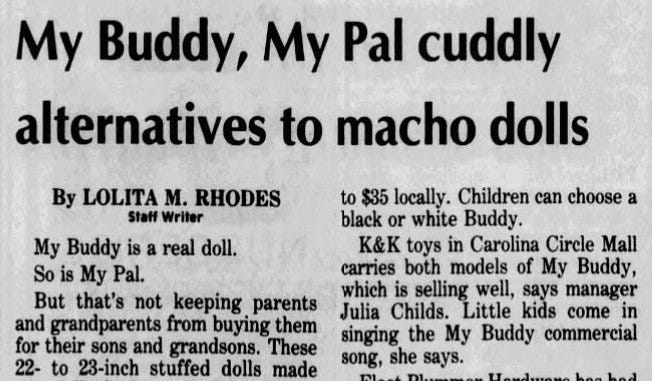
By the fall of 1985, the conversation around My Buddy had become very interesting. In a November Greensboro News and Record article, they go into detail about the doll nature of the toy. These were meant to be an alternative to the macho end of the toy aisle, with GI Joe and He Man named directly as contrasts. No weapons, no battles, no muscles, just a soft, kid sized companion that a boy could drag around like a large stuffed animal, about twenty two to twenty three inches tall. The same idea shows up in other reporting from the time. It was clear, and for the moment surprising to many, that Hasbro was trying to carve out a doll category for boys, and they leaned hard on the image of a buddy who could keep up with a kid’s day.
A lot of that discussion is aimed squarely at adults to tell them its okay to buy a doll made for boys. still the tone is always reassuring. Store managers talk about kids singing the commercial song in the aisles, while grandparents come off almost relieved, like they finally had a doll they could buy for a grandson without hearing complaints from the men in the family. A Hasbro executive in the article puts it pretty bluntly, saying they did not see anything in the toy aisle aimed at preschool boys that filled this role. From there, the rest of the messaging follows, soft and nurturing, but constantly framed as being boy appropriate, even though it was still, at the end of the day, a doll.
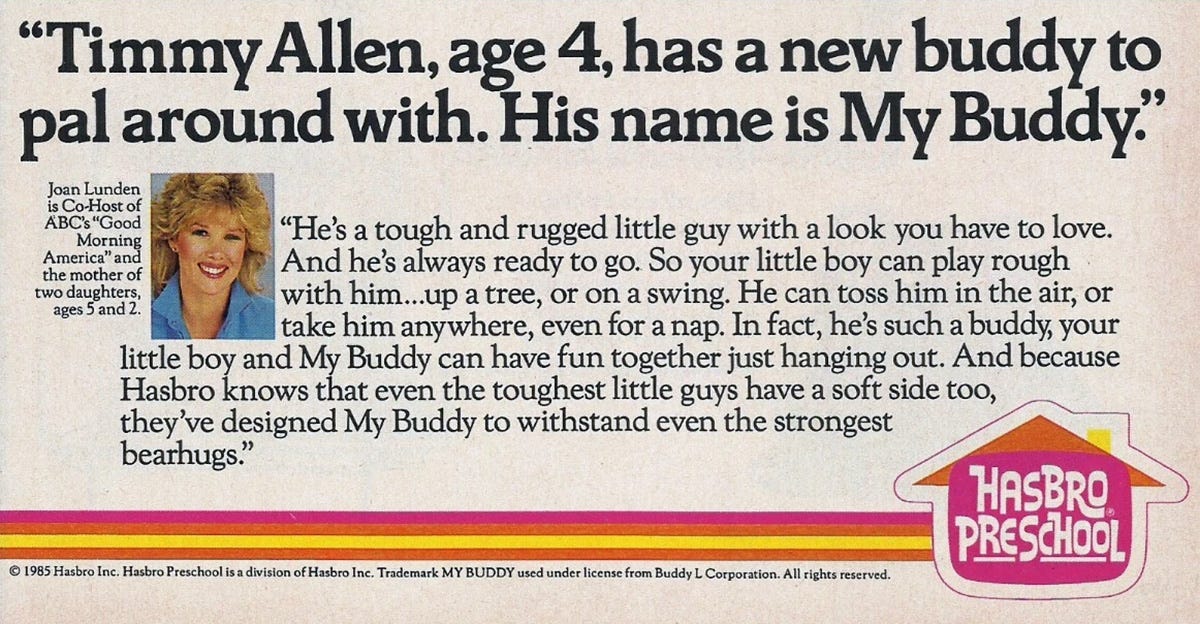
Remember this was 1985, so it is not surprising that they go one step further to try and clarify the value of a doll for boys. They bring in an expert voice to calm nerves, basically saying there is nothing wrong with boys having dolls as long as it fits into “acceptable behavior.” At this point, My Buddy has stopped being just a toy and turns into something people feel the need to explain. You can almost hear the sales pitch shifting from kids to parents. It is not just buy this, it is also do not worry about buying this.
It definitely feels like these articles are tied into a broader more subtle marketing campaign. With Hasbro, selling the toy through Playskool, seeing the objections people might have to buying a boy a doll and worries that it fell out the gender norms of the time. Instead of straightforward advertising, they manage to get some well-placed pieces written and experts to quote.
It worked and the doll was a big seller and once that approach took hold, the follow up was straightforward. The line expanded with Kid Sister. The name was different, but in practice it was the same large, soft companion doll, restyled and marketed for girls. In the mid eighties, My Buddy came with explanations and reassurance. Kid Sister did not.
My Buddy had a solid run. It hit the market in July of 1985 and did well during the holiday season, well enough to justify the Kid Sister spinoff. Since most people associate it with the eighties, you might assume it flared out quickly, but it did not. My Buddy and Kid Sister were still being listed in stores during Christmas of 1996. If it was there then, it almost certainly lingered into 1997 and probably showed up in clearance aisles in 1998. That is roughly an eleven year run, not bad at all, and that doesn’t even count the much more recent revival by The Loyal Subjects.
And yes, this is the doll that helped inspire Chucky from Child’s Play, at least in part. According to writer and director Tom Holland, the starting point for Chucky was the popular My Buddy doll, though the design quickly became something much stranger. Holland has explained that Chucky was originally named Buddy, but the name could not be used because of the existing toy line. To refine the look, he started with some other well-known dolls, including a My Buddy, a Raggedy Ann, a Raggedy Andy, and a life size baby doll he still owns. What he wanted was the basic Buddy form combined with Raggedy Andy colors. This meant the buttoned overalls, freckles, and yarn hair, which would then be pushed into the meanest and most unsettling version possible, with the added creepiness of the infant doll. The result was not a copy of any single toy, but a deliberate mash up that turned something familiar and friendly into something openly hostile and disturbing.
Looking back at My Buddy, what stays with me is not the toy itself, but how much work went into explaining it, something I did not see or hear at the time. My Buddy feels less like something kids demanded and more like something adults carefully assembled and defended in advance, just in case anyone challenged its existence as a boy’s toy. That said, it was a well thought out creation with a smart marketing strategy. Millions of kids loved My Buddy, but even those who skipped it were influenced by it and remember it almost as clearly as the toys they actually owned.
🎶…my buddy and meeee. Kid Sister, Kid Sister…🎶
Thanks for the flasback.🙏💐
As someone born smack dab in the middle of-80s, I wasn’t quite “present” for the launch of My Buddy, but I definitely remember the commercials for it that were still going strong by the time the 90s kicked off and I was watching Maya the Bee on Nickelodeon.