

Mr. Mouth
The yellow-headed chomping toy that found its way into Pac-Man history.

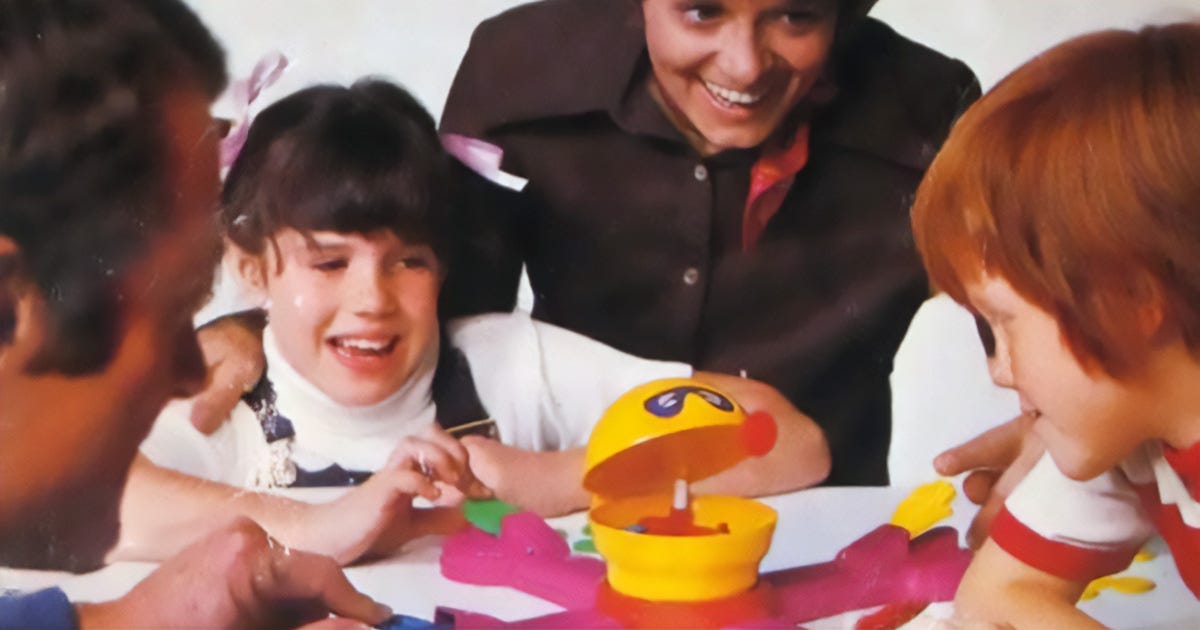
My cousins had two games that never stayed on the shelf for long. One was Hungry Hungry Hippos, which everyone has heard of. The other was Mr. Mouth, which people remember less, if they remember it at all. We would rotate between them on the floor of their basement, and the noise level was about the same no matter which one we picked. We all played to win. The version of Mr. Mouth we played was the yellow head version, not the frog that came later. I didn’t think about it then, but both games had Japanese routes into the American toy market and reached kids in the United States within two years of each other. One became a household name. The other did okay. Eventually changing its face and becoming a part of an interesting court case involving Pac-Man.
Mr. Mouth was developed by Tomy Kogyo Co., Ltd. in Japan. The inventor named on the US patent is Takao Matsumoto. A Japanese priority date of July 4, 1975 appears in the patent record, and Tomy filed for US protection on June 23, 1976. The patent number is US4109914A, titled “Game structure employing a revolving target,” and it was granted on August 29, 1978. The mechanism it describes is the game in miniature, with a rotating receptacle, an opening and closing lid, and spring operated launchers that players use to send disks toward the moving target. Inside the same patent, a non patent citation reads “Mr. Mouth, TV, Tomy 1976 Catalog, p. 15,” which ties the patent directly to the product Tomy was already selling that year.
Tomy was not a small operation by 1976. The company had been founded in Tokyo in 1924 by Eiichiro Tomiyama. Initially making tin toys, it had been exporting to the United States since the early 1950s when a B-29 Bomber friction toy became one of their first major international sellers. By the mid-1970s, Tomy was expanding into many overseas markets, exporting toys through department stores like Sears and under its own name through a new American distribution company. That same decade, the company developed a new specialty in hand-held skill-based toys. At first they were mechanical but they would increasingly turn towards electronics like so many other companies. Mr. Mouth fit right into that period. It was a battery powered mechanical game from a company that was becoming known for small toys with a lot of action built into them.
The game itself is easy to understand. It ran on a single C battery. A yellow head sat at the center of an X shaped plastic base and rotated, opening and closing its mouth as it turned. Four players, one at each arm of the X, used spring loaded hands to flip plastic chips toward the opening. The chips were color coded, ten per player in red, blue, green, and yellow. The first player to land all ten chips in the mouth won. It was basically tiddlywinks with a moving target, but that moving target is what made the game work. You were not just flipping a chip. You were waiting for the mouth to come around, open up, and give you the shot.
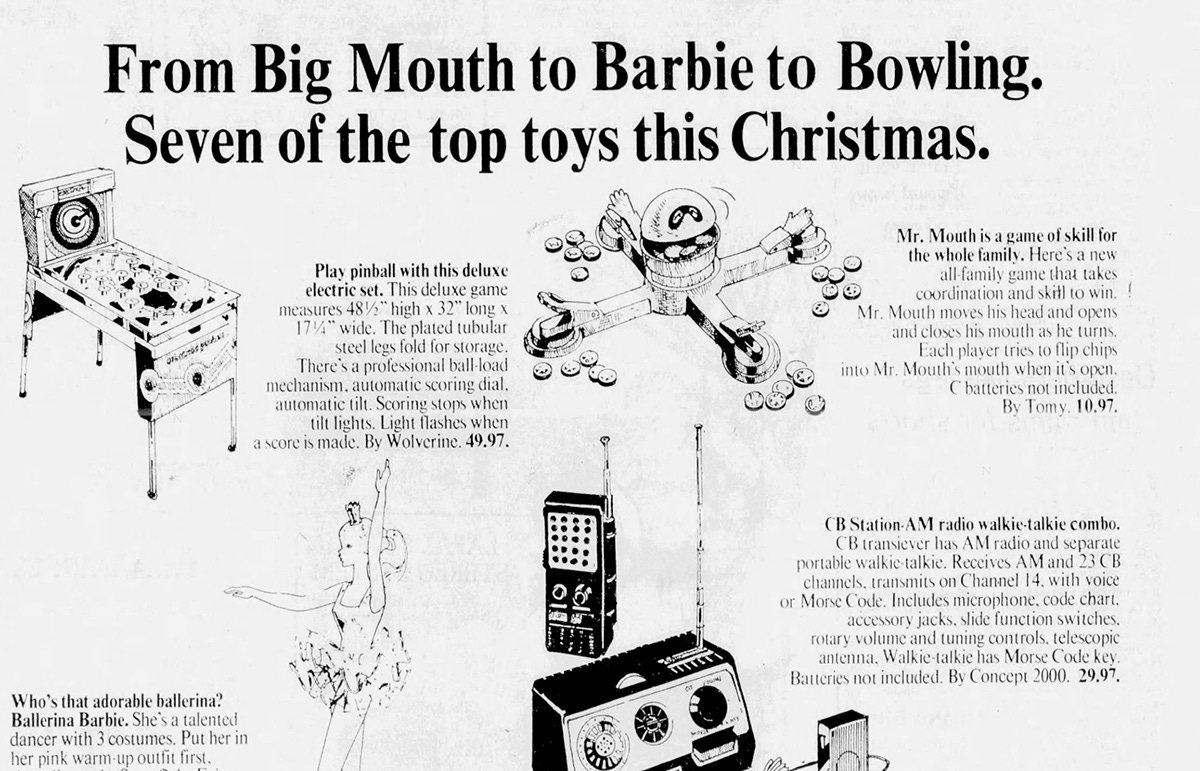
During the Christmas season of 1976, Mr. Mouth was already showing up in stores nationwide. A Ventura County Star advertisement from November 25 placed it among seven top toys, priced at $10.97, alongside Barbie, a deluxe pinball set, and a CB radio combo. A letter to Santa published in the Vacaville Reporter on December 5, 1976 listed Mr. Mouth alongside Stretch Armstrong, Connect Four, Jaws, and Monopoly and this was not an isolated letter. Up in Canada, the Waterloo Region Record in Kitchener, Ontario that same month listed Mr. Mouth among top sellers at a local department store, in an article noting that parents were steering away from gimmicks toward quality.
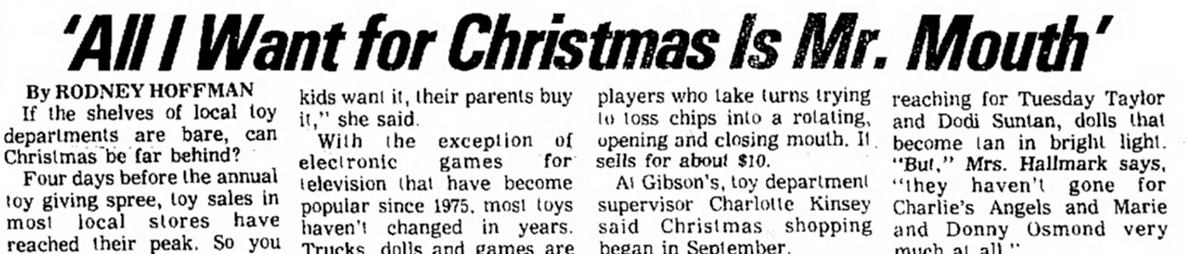
By the following Christmas it had not faded. A Garden City Telegram story from December 21, 1977, headlined “All I Want for Christmas Is Mr. Mouth,” described it as the most asked for game among several players at a local store. The piece ran on the front page. So popular, and still selling for about ten dollars. It was a solid game and had a steady presence on shelves. A few years later though, the Mr. Mouth story would take an interesting turn.
In 1982, Mr. Mouth was part of a copyright fight that had almost nothing to do with tabletop toys. The case was Midway Mfg. Co. v. Bandai-America, Inc., decided by the US District Court for the District of New Jersey on July 22, 1982. Midway was suing Bandai over handheld games it alleged infringed on its Pac-Man and Galaxian copyrights. Bandai, looking for prior art that might undercut Pac-Man’s originality, pointed to three things it claimed were precursors to the Pac-Man character, a Sega arcade game called Head-On, a Japanese cartoon ghost called Kyutaro, and Tomy’s mechanical Mr. Mouth. The court rejected the first two handily. Mr. Mouth received more careful treatment.
The court described Mr. Mouth as a yellow plastic mouth that opened and closed while the toy rotated and players flipped pieces into it. Then it added the strange part, saying the game was “apparently called Pac Man in the Japanese tongue.” That does not prove the Japanese box said Pac Man, but it does show that the name was part of the legal record. The court did not say Pac Man copied Mr. Mouth. It only said the resemblance was close enough that the question could continue in the case. The ruling also noted that Tomy had given Midway any rights it might have claimed to the Pac Man name and to what the court called “Tomy’s mechanical game of the same name.”
That language is the closest primary evidence I have found that the original Japanese version of Mr. Mouth may have had a connection to the Pac Man name before Pac Man existed as a video game. It is not the same as finding the original Japanese box or catalog listing, but it is a court record tying Tomy, Mr. Mouth, and the Pac Man name together.
Pac-Man, originally titled Puck Man in Japan, was released in 1980 by Namco. The character was a simple yellow figure with a V-shaped aperture that opened and closed like a mouth, and the name derived from the Japanese onomatopoeia “paku-paku,” describing the sound of chomping. The patent for Mr. Mouth’s mechanism had been filed in Japan in July 1975, five years before Pac-Man appeared in any arcade. Whether the designers at Namco knew the Tomy game, or whether two separate designers arrived at similar yellow chomping shapes from different directions, is not something the court resolved. What the court found was that the question was legitimate enough to put before a jury. The case was ultimately settled before a verdict, so no jury ever answered it.
The version I knew was the yellow head, but that is not the version many people remember now. By 1987, the game had a new publisher and a new face. Milton Bradley released its own version that year, and Tomy released a companion edition simultaneously. The yellow chomping head was gone. In its place was a green frog. The chips became plastic flies. The spring loaded hands remained, the X shaped base remained, and the rotating motorized center remained, but the thing you were feeding had changed entirely. The mechanism was still what Matsumoto had patented in 1976, but the theme had been rebuilt around it.
I guess the redesign made sense. A frog eating flies is easier to understand than a yellow head eating plastic chips. Children can accept both, but the former’s theme is understood before the box is even opened. Why the change? By the time Milton Bradley took on the game, the toy market around it had been saturated. A mechanical skill game still had plenty to offer, but the frog gave Mr. Mouth a refresh and I think they hoped it would make it stand out more to a new generation.
The frog version lasted a while. A 1999 Milton Bradley reissue appeared, keeping the same basic design. Tomy eventually reclaimed the game and currently sells it in the frog format under its games line. The product description on their site reads “catapulting insects has never been so much fun,” a sentence that would not have made any sense in 1976, when the thing being catapulted was a small plastic disc and the thing eating it was an abstract yellow face. The current version still runs on the same basic principle Takao Matsumoto filed for protection in 1975.
BoardGameGeek lists ten versions of Mr. Mouth across its publishing history, under names that include Greedy Green Frog, Rod Hull’s Emu Game, and Shrek Bug Bounce, the last of which was a licensed tie-in to the DreamWorks animated film. Each version put a new face on the same basic game. The emu version was sold in the United Kingdom. The Shrek version replaced the frog with an ogre. Underneath all these was still a rotating target, a set of spring loaded launchers, and the judgment call of when to flip.
Mr. Mouth never became a cultural landmark the way Hungry Hungry Hippos did. It has had a longer life than most toys from 1976 manage and it's been an interesting one. It changed when the market required it, found a clearer form as a frog, and is still available. The patent for the mechanism expired in 1996 after the standard twenty year term. So the game has already outlasted the legal protection for its own invention.
The frog version is not the one I knew at my cousin’s house. To me, Mr. Mouth was still the yellow head in the middle of the floor, turning in circles while we tried to flip chips into its mouth. I did not know about the patent, the Japanese name question, the Pac Man court record, or the frog version that would replace it later when I played it. I just knew it was fun, odd, and harder than it looked, which was enough to keep us playing.
OMG - we had one of these things here in Oz -that ticking churning mechanism - nightmare fuel.
I had the yellow head version as well & it’s definitely a toy I remember fondly. I’m guessing it was a Christmas gift in either ‘79, ‘80 or ‘81. Thanks for the article!!