


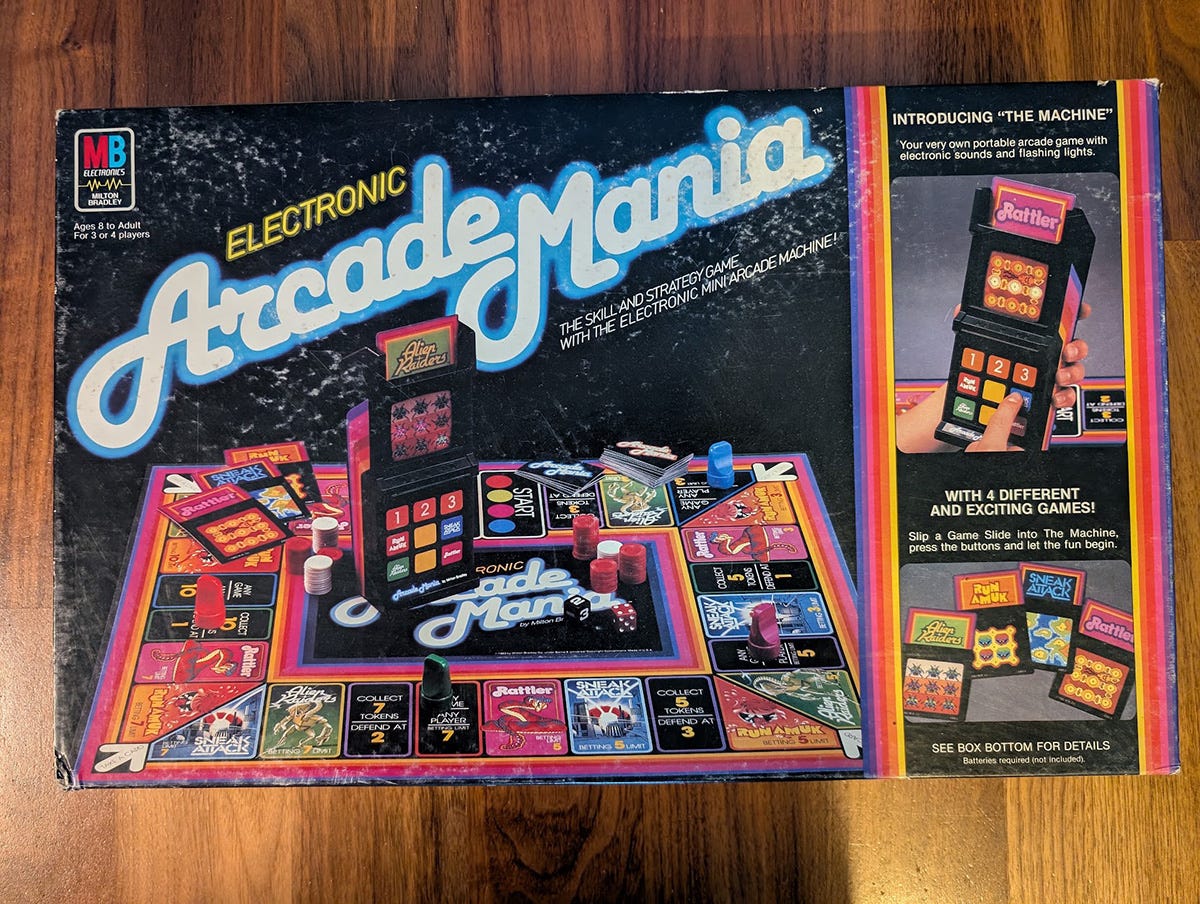
I got Arcade Mania as a kid, and I think my mother was trying to find something that fit my interest in arcades while still making sense to her. A board game was familiar. The electronic machine pictured on the box made it look closer to something I would want. She was right about that part.
My interest in arcades was not limited to the games. I liked the cabinets, the sounds, and watching other people play. Arcade Mania promised a small version of that experience at home. It was not based on one licensed video game. Milton Bradley had already released board games built around Pac Man, Donkey Kong, Zaxxon, and several other arcade hits. Arcade Mania tried to cover the whole subject.
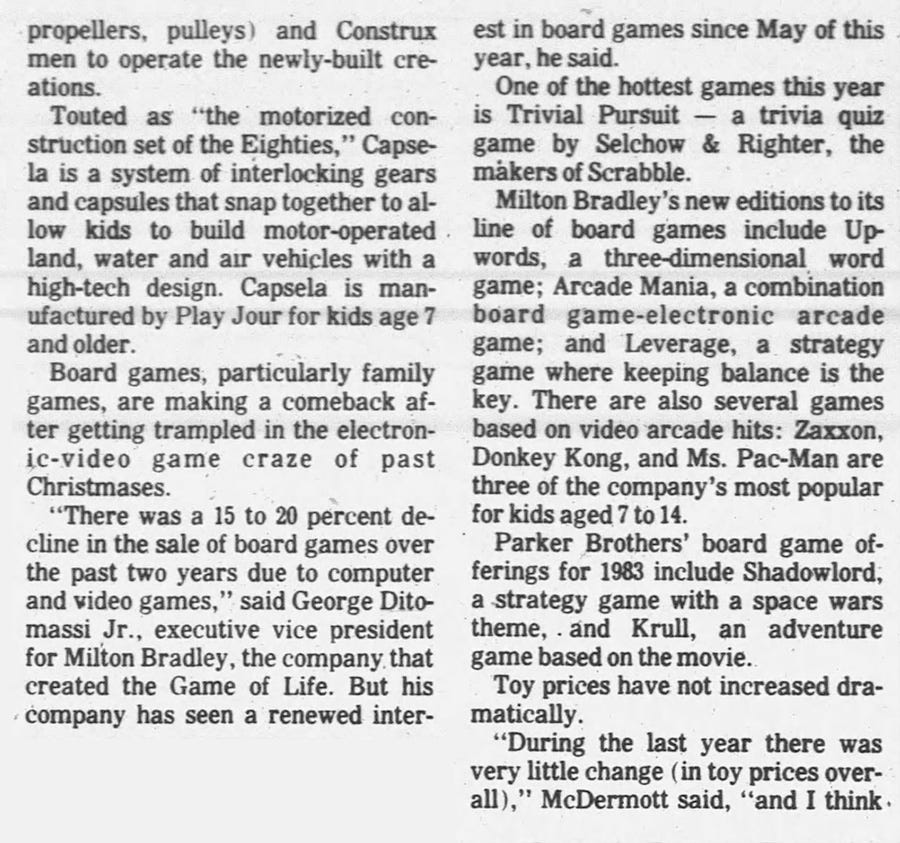
The game arrived in 1983, when board game companies were trying to work out their relationship with electronic entertainment. A newspaper article published that December quoted Milton Bradley executive George Ditomassi Jr. saying that board game sales had fallen between 15 and 20 percent over the previous two years because of computer and video games. He also said the company had seen renewed interest in board games since May. Arcade Mania was mentioned as one of Milton Bradley’s new releases.
Milton Bradley was not new to electronic games. Simon had been released in 1978 and became an immediate success. It had also been inspired by an arcade game, Atari’s Touch Me, although Ralph Baer and Howard Morrison reworked the idea into something better suited to the home. Arcade Mania followed a related path. It took familiar arcade ideas and rebuilt them around the limitations of a tabletop electronic toy.
Arcade Mania was made for three or four players, ages eight and up. The box held a large board and a battery operated unit called The Machine. It also included four game overlays, pawns, dice, chips, betting cards, and event cards. The Machine required six AA batteries, which was a commitment before the game even started.
The Machine looked like a small arcade cabinet. It stood about nine inches tall, with nine buttons matched to nine lights. Sliding a different plastic overlay across its face changed the labels and rules. The electronics remained the same, but the lights behaved differently for each game.
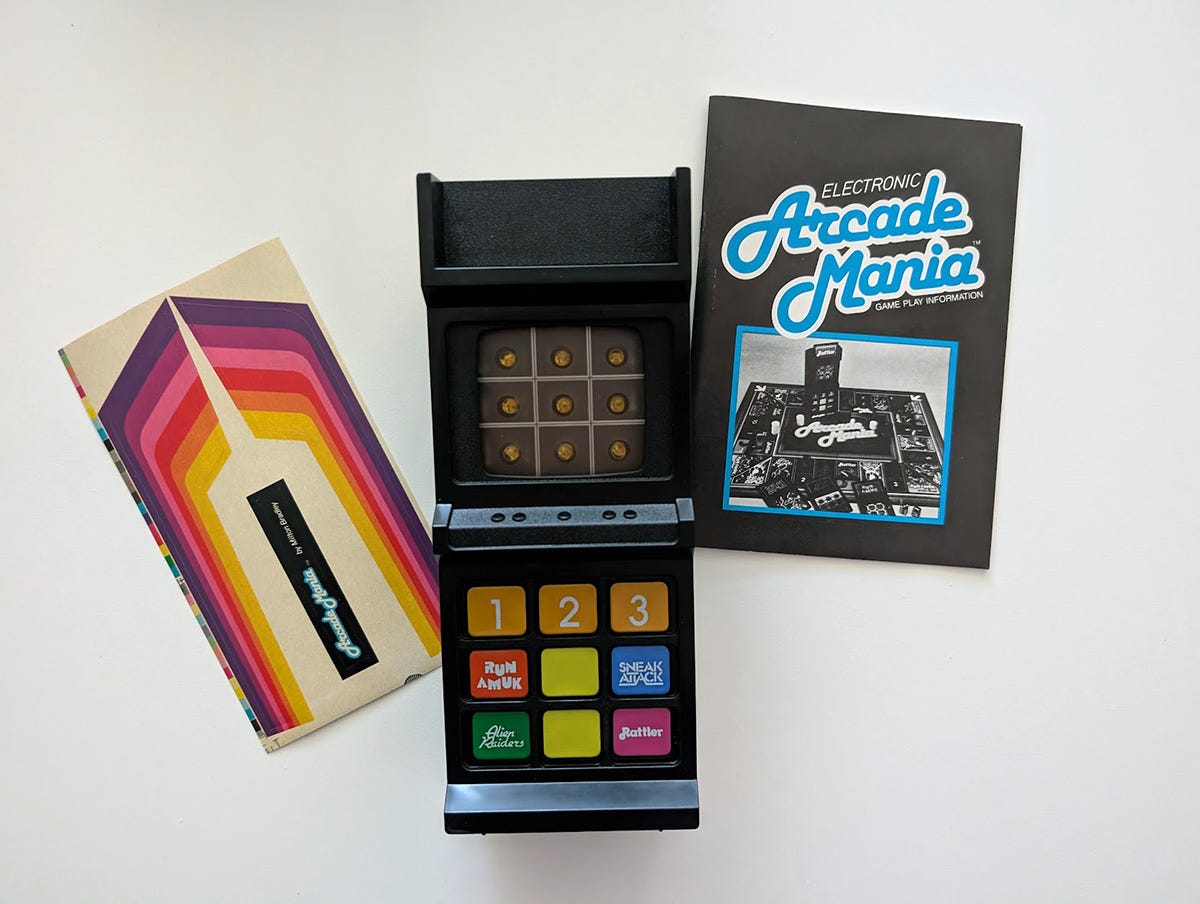
Arcade Mania also owed something to the electronic games that had appeared during the previous few years. Parker Brothers released Merlin in 1978, using a group of illuminated buttons to play six games from one electronic unit. The Machine followed a similar basic design. It also used a Texas Instruments TMS1100 processor, but placed nine lighted buttons inside a miniature arcade cabinet. Four overlays turned that same arrangement into four different games. There is no known development connection between Merlin and Arcade Mania, but the family resemblance is difficult to miss.
There were four games. Alien Raiders was modeled after Space Invaders. Sneak Attack borrowed from Missile Command, while Rattler resembled Centipede. Run Amuk placed the player in a situation similar to Berzerk, avoiding a pursuing monster while trying to survive. These were not licensed versions, and Milton Bradley did not use the names of the arcade games on the box. The connections were still easy to see.
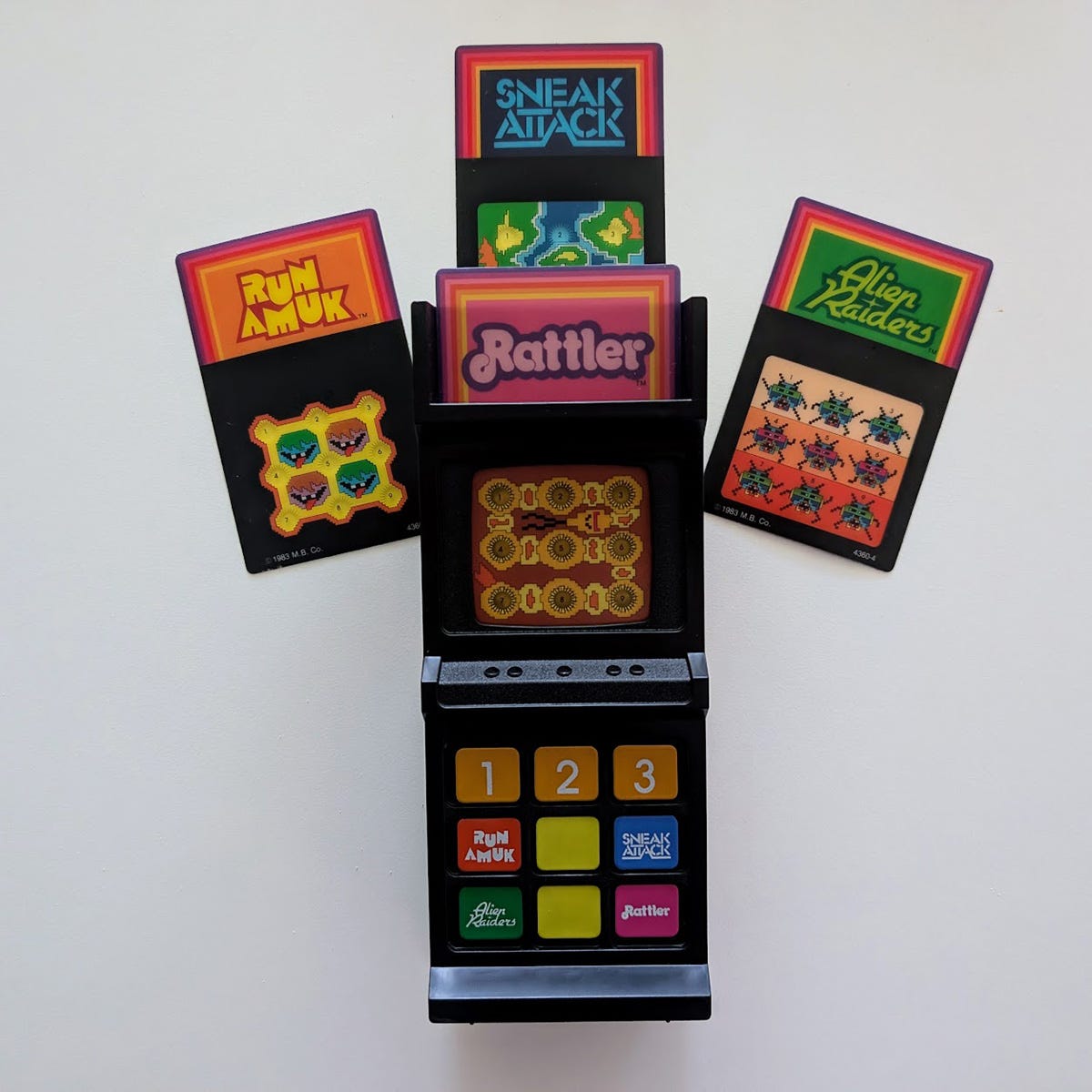
Each electronic game was simple, but changing the overlay did more than change the artwork. The buttons had different functions, and the flashing lights represented new threats. A die roll determined which of the available difficulty levels a player had to face. The Machine could not reproduce the graphics or controls of an arcade cabinet, so it concentrated on speed and reaction.
The board surrounding The Machine was more conventional. Players rolled the dice and moved along a track, collecting chips or challenging opponents when they reached certain spaces. A challenge sent two players to the electronic unit. Whoever earned the better score received chips.
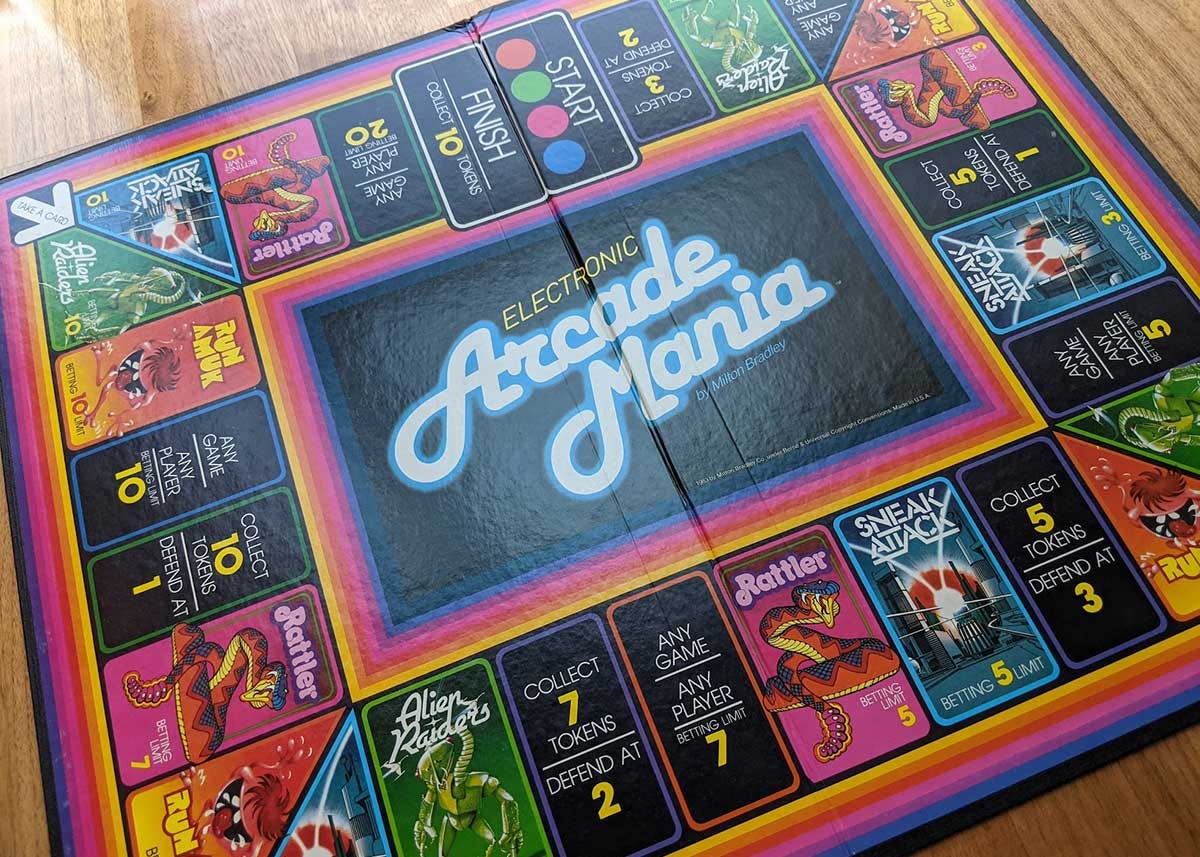
The players who were not competing could bet on the result. Event cards could also alter a match by changing scores or making the electronic challenge more difficult. One card might force a player to use only one hand. This kept everyone involved while two people took their turns on The Machine. The game ended after someone reached the finish space and collected a ten chip bonus. The player with the most chips won.
That betting system may be the game’s best idea. An arcade visit included plenty of time spent watching someone else play. You paid attention to who was good at a certain machine and who was likely to lose quickly. Arcade Mania turned that into part of the board game. The other players were not only waiting for the electronic portion to end. They had something riding on the outcome.
The event cards also captured some of the behavior around an arcade machine. People would distract each other or offer unwanted advice. Sometimes they would make a challenge harder just to see what happened. Arcade Mania made that interference official and gave the spectators a way to affect the player whose turn it was.
The game’s advertising described it as a combination of arcade speed and board game strategy. That was accurate, although neither part was especially deep. The board gave structure to a series of electronic matches. The Machine gave an ordinary roll and move game something that felt new.
In my house, the combination did not work equally well for everyone. We could all understand the board game portion. The electronic challenges were another matter. The older members of the family were not interested in getting better at The Machine, so Arcade Mania became a game was more of a game “for the kids.”
That was the problem with using an electronic game as the center of a family board game. Anyone who did not enjoy the challenges had little reason to care about collecting chips. A good roll could help, and the cards could interfere with an opponent, but success eventually depended on playing The Machine. There was no way to avoid it and still have much chance of winning.
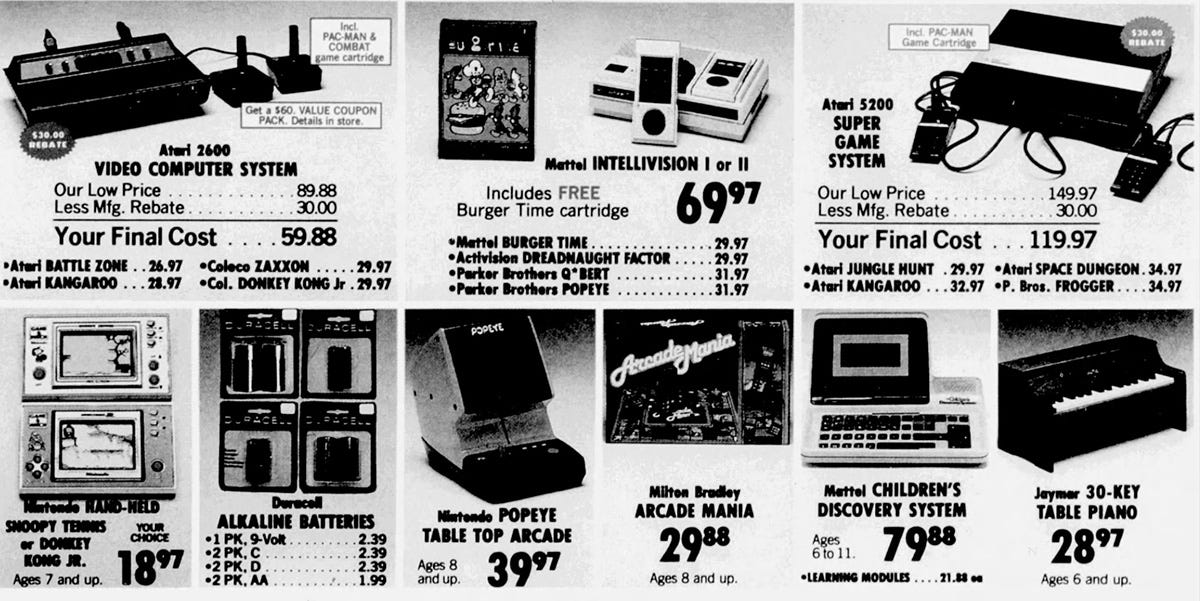
Arcade Mania was also a fairly expensive board game. A Buffalo News advertisement from November 1983 priced it at 29.88. The same advertisement offered an Atari 2600 for 59.88 after a rebate and placed Arcade Mania beside an Intellivision, an Atari 5200, and Nintendo’s Popeye tabletop game. It was being sold among electronic products rather than separated from them as a conventional board game.
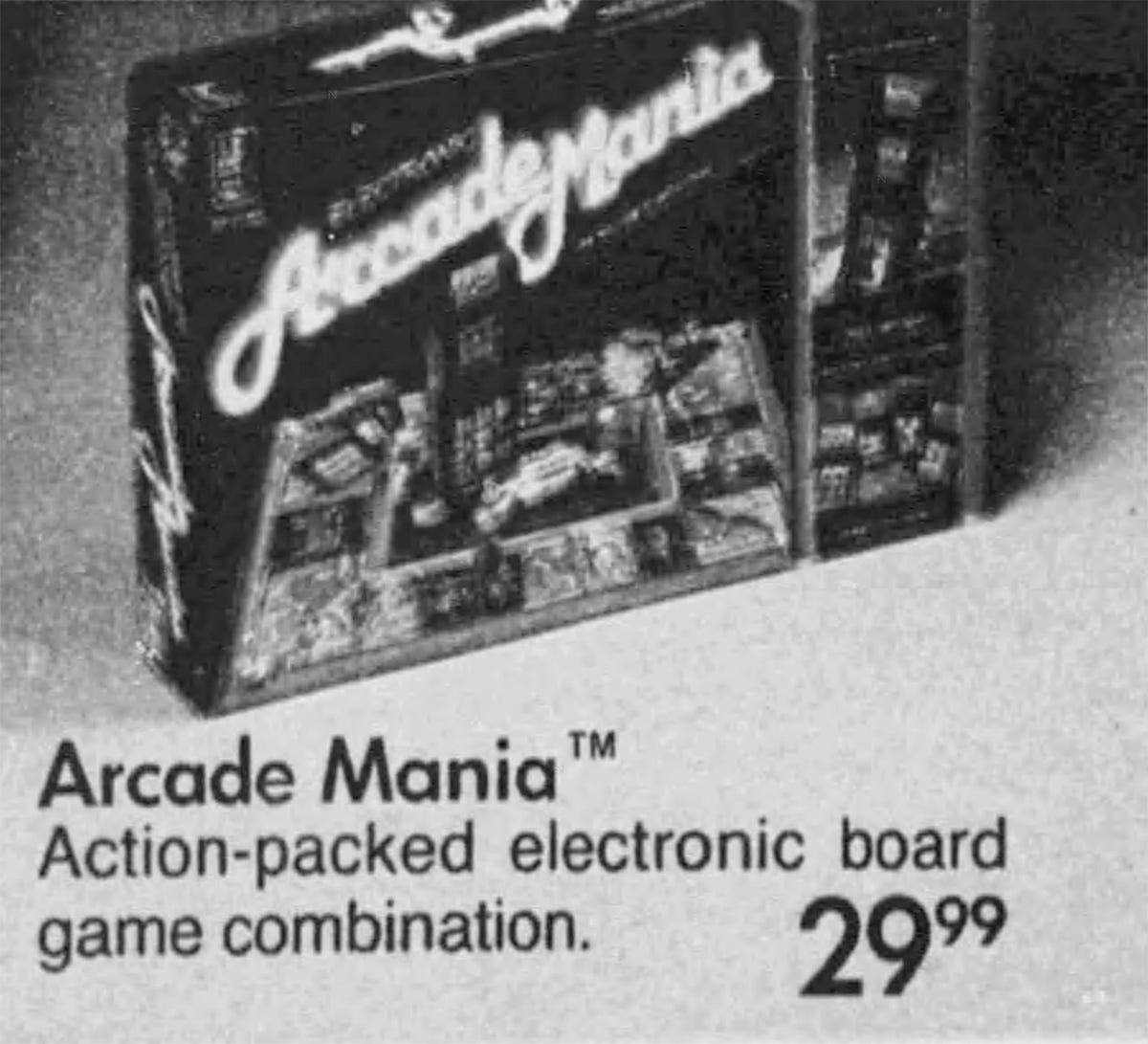
Advertisements in The Boston Globe and the American Press priced it at 29.99. Both used the same description, calling it an action packed electronic board game combination. The box was large, and The Machine made it look more substantial than the average board game. But at that price, it needed to.
The game does not appear to have developed much of a life beyond its original release. Its designer remains uncredited, and there were no expansions or revised editions. Arcade Mania now has only a small presence on BoardGameGeek, where it is classified as an electronic action game with betting and roll and move mechanics.
It is easy to look at The Machine now and see only nine lights behind a plastic overlay. In 1983, the idea of getting four electronic games inside a board game box was much more appealing. The individual games were limited, but they were different enough that changing the overlay felt like choosing another cabinet.
Arcade Mania did not replace going to the arcade. It also did not turn the older members of my family into video game players. My mother may have bought it because it made my arcade obsession look like something she understood. It did not become the family bridge its design suggested, but it gave me a board game built around something I cared about.