

Colorforms
From a New Jersey bathroom wall to millions of toy boxes.

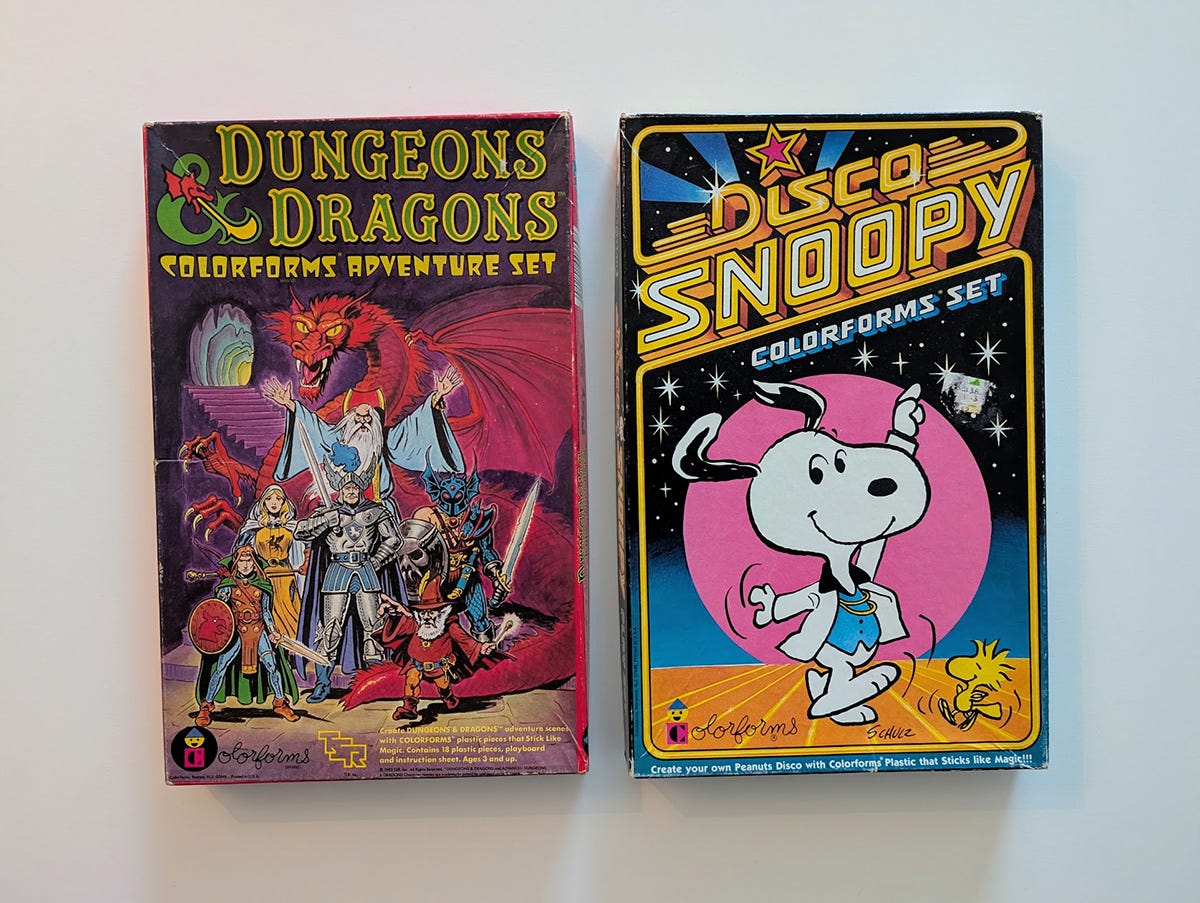
My first Colorforms kit showed up when I was four or five years old, and I fell for it completely. The pieces were reusable, and the sets were affordable, which mattered a lot in a house where new toys could be kind of rare. This was years before computers and electronics filled every room, so a bag of sticky vinyl shapes felt like something close to magic to me. Of course at the time I never thought much about where they came from, and I decided to dive into their history.
Colorforms began as a bathroom remodel that got out of hand. Harry and Patricia Kislevitz met as art students, and in 1951 they were looking for a way to fix up their bathroom walls without paying for real paint. Several accounts place that bathroom in River Edge, New Jersey, instead of Manhattan. Always happy to see a NJ connection for things I like. A friend who worked with vinyl for pocketbooks gave the couple a few rolls of the thin colored material, and they discovered it stuck to glossy paint without any glue at all.
They cut the vinyl into shapes and covered a wall with a private little mural. Guests who came over wanted to try it too, so the Kislevitzes left out spare vinyl and a pair of scissors for anyone who wanted to add a piece of their own. Harry noticed how much fun people were having with a bathroom wall, and that observation turned into a business plan.
The couple hand cut and assembled the first sets themselves, somewhere near a thousand of them, and brought the batch to FAO Schwarz in Manhattan. The store agreed to carry it on concept alone, with no guarantee the toy would sell. The stock disappeared almost immediately. Early mail orders went to an address on Hudson Street in the city, but production itself soon settled into a real factory in Norwood, New Jersey, not far from where the Kislevitzes lived.
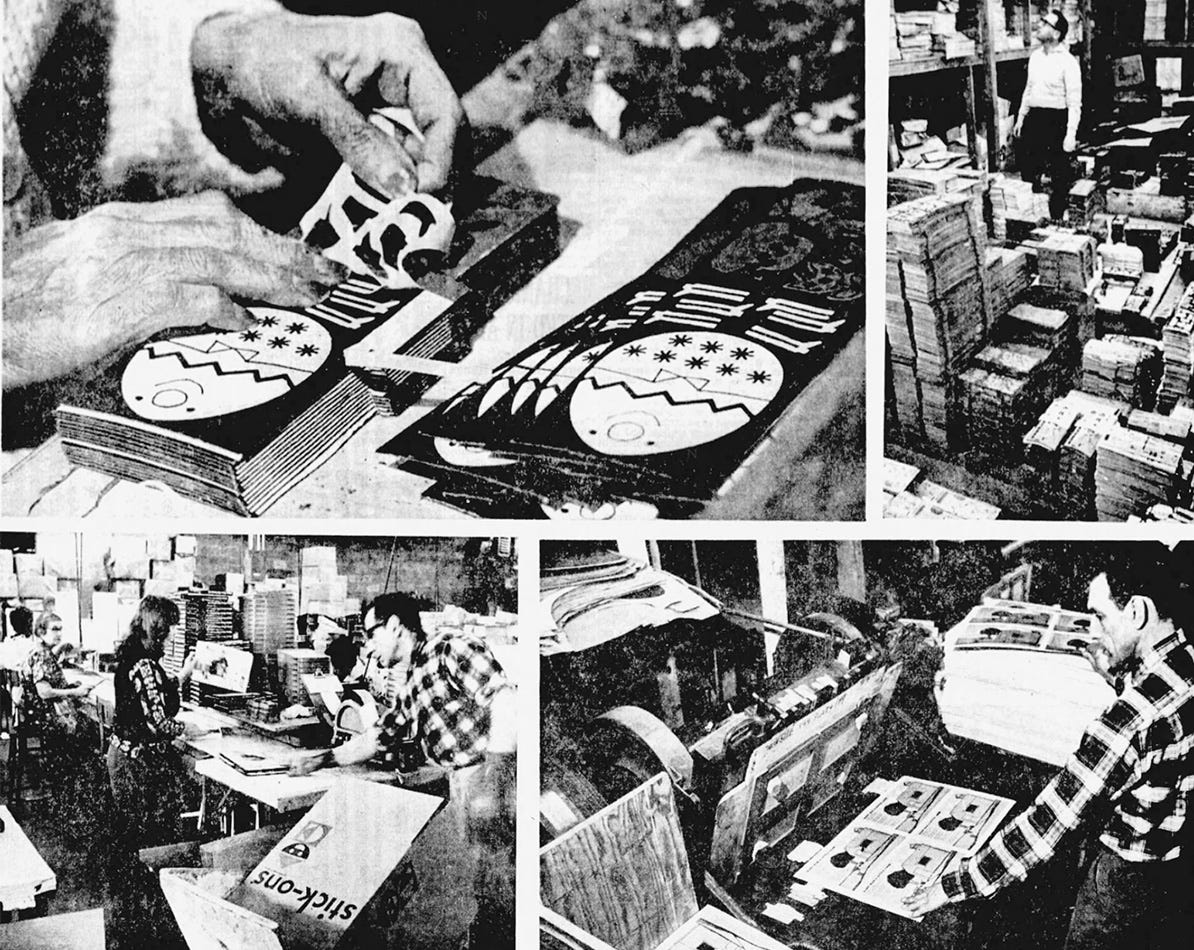
A 1965 newspaper feature on that Norwood plant makes the whole operation sound very low tech. Workers peeled freshly stamped patterns off the press, and a production manager named Hy Moskowitz checked finished stock before it went out the door. Plant manager Pat Dinitto ran the die cutting unit that turned rolls of cardboard into the familiar Colorform base, while a full assembly line packed pieces for shipment.
Newspaper ads from the era sold the toy on simplicity. One ad from 1953 opens with the line “No need to putter with paint,” then promises 350 separate plastic shapes packed into a five-page spiral bound book, plus one black and one white plastic surfaced board to stick them on. The whole kit ran from three to five dollars depending on size. The basic idea might change, but something remained the same. Reusable plastic shapes that clung to a smooth surface, even as the sets, boards, and packaging changed.
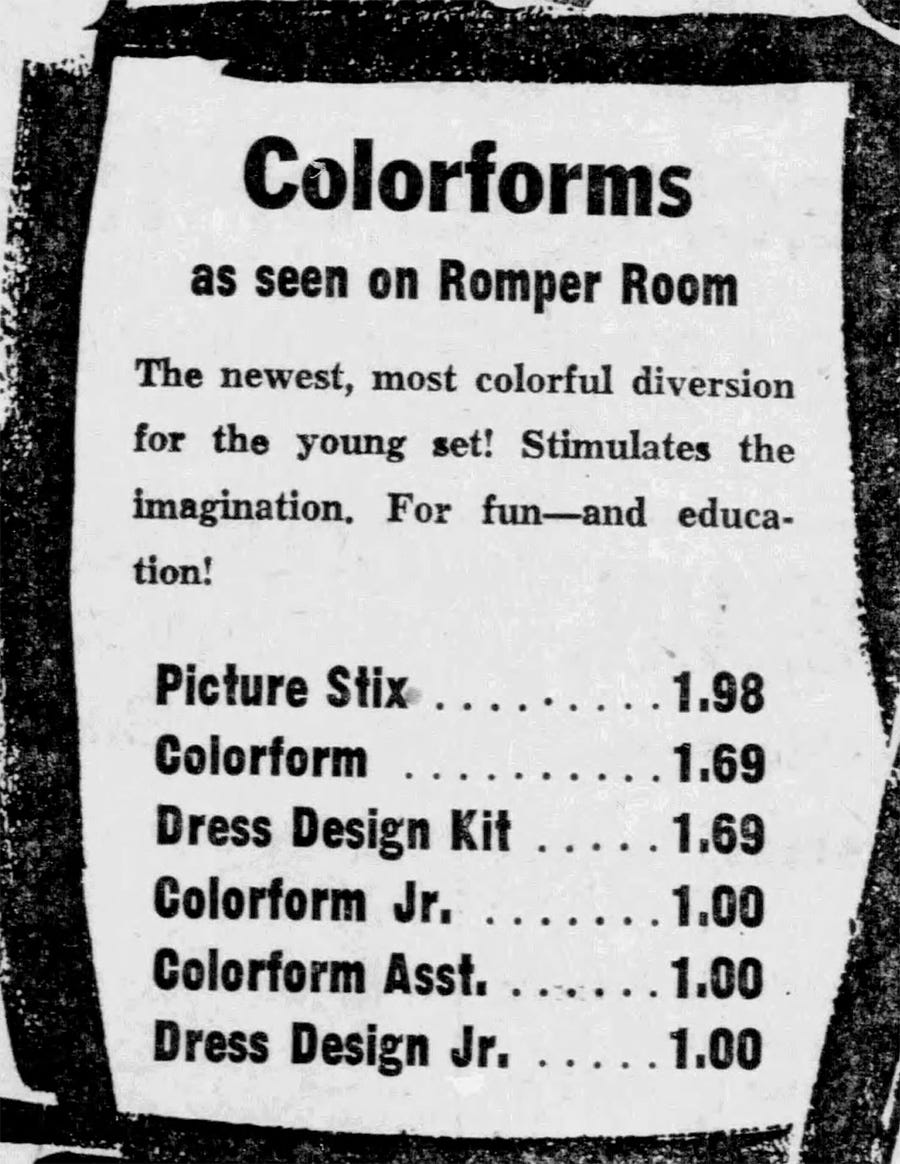
By 1956, Colorforms ads were promoting the toy as seen on Romper Room, a beloved show in our house. The connection included a Willie the Weatherman set that let children dress its cartoon figure for the day’s forecast. I believe Willies original gimmick was that he was made of felt. So this was an all new take on him. A Buffalo ad from that year also shows how quickly the Colorforms line was expanding, with Picture Stix, a Dress Design Kit, Colorform Jr., and other sets selling for between $1 and $1.98.
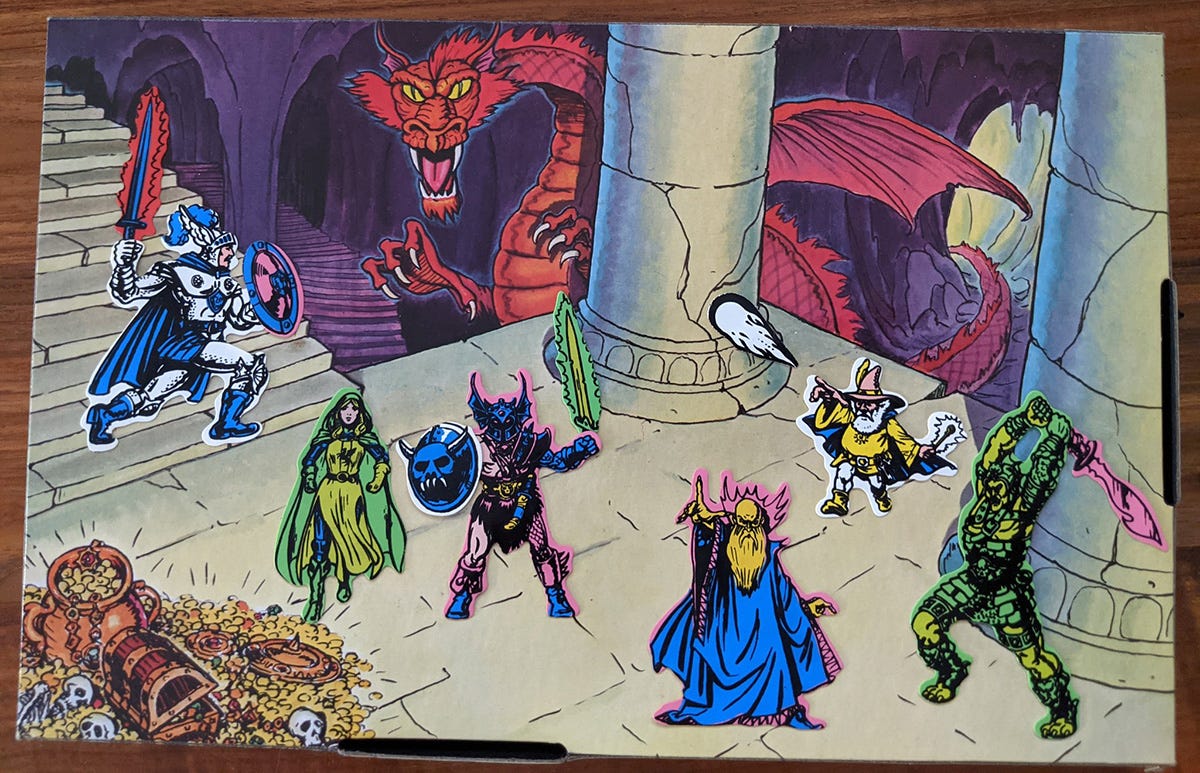
The first big licensed character to appear on a Colorforms box was Popeye, in 1957, and it opened the door to a licensing strategy the company leaned on for decades. Mickey Mouse followed, then Peanuts, Star Trek, Batman, the Beatles, and eventually properties as far apart as the Three Stooges and Steve Urkel. If a character was popular enough to sell lunchboxes, there was a decent chance it eventually showed up as a Colorforms set too.
In 1959, Colorforms hired graphic designer Paul Rand to create a new trademark and packaging. Rand had begun working with IBM a few years earlier, though many of the corporate logos that would make him famous were still ahead of him. His Colorforms mark used the same simple geometric shapes found in the toy, arranging them into a playful figure that remained closely associated with the brand for decades.
Colorforms occasionally tried to move beyond the flat plastic pieces that had made the company successful. The most ambitious attempt was the Outer Space Men, a group of bendable alien figures created by designer Mel Birnkrant. He conceived them after seeing Mattel’s Major Matt Mason toys and noticing that the astronaut line had no alien opponents. The figures were developed during 1968 and reached Toy Fair the following year, where Colorforms had to introduce a product unlike anything its sales staff normally handled. Birnkrant recalled that many people inside the company resented the extra work required to sell something that did not fit the familiar Colorforms category.
Colorforms made another attempt to expand its place in the toy store in 1974. Its new Color n’ Play sets combined coloring activities with cardboard figures that could be used after they were colored. Birnkrant and Colorforms founder Harry Kislevitz rejected the cheap crayons commonly packed with activity sets and insisted on using genuine Crayola crayons. Birnkrant later believed the product helped awaken Binney and Smith to the possibilities of Crayola branded activity kits. The crayon company introduced a line of its own the following year, although the direct connection rests largely on Birnkrant’s recollection.
Other experiments were less successful. Popeye Puppetforms, also released in 1974, became what Birnkrant described as the worst selling product in Colorforms history. The company normally ordered printed materials for at least 50,000 sets, but only about 4,000 Popeye sets were sold. Roughly ten years later, Birnkrant asked Kislevitz if he could keep one piece of original artwork from the company archive. He chose the Popeye cover. According to Birnkrant, Kislevitz looked at him and replied, “You bastard!” He had apparently wanted it for himself.
By the end of the 1970s, Colorforms needed still more room and moved production into a much bigger factory in Ramsey, New Jersey, bringing Harry Kislevitz’s two sons into the family business. New Jersey stayed the manufacturing home of Colorforms for decades, right up until the company changed hands in the late 1990s.
By 1981, Kenner had turned Strawberry Shortcake into a major toy line built around small scented dolls and their accessories. Colorforms designer Mel Birnkrant later recalled that Kenner would not allow the company to produce a Strawberry Shortcake activity set, even though its reusable plastic pieces did not compete directly with Kenner’s dolls. Colorforms responded by creating Sugar and Spice, a candy themed character line deliberately modeled on Strawberry Shortcake. Kenner objected when it saw the first version at Toy Fair, and Birnkrant redrew the characters overnight before presenting a revised design the following morning.
The Sugar and Spice became successful enough that other toy companies shut out of the Strawberry Shortcake license came to Colorforms wanting to license Sugar and Spice instead. The same standoff with Kenner also kept Colorforms from ever landing an official Star Wars license, a franchise that I think all of us would have loved to see get the Colorforms treatment.
Colorforms found another use for its large collection of character licenses in 1981, when it acquired the rights to make and distribute Shrinky Dinks kits. The company eventually produced more than 50 of them, using properties from television, movies, comics, and other toy lines. Colorforms had not invented Shrinky Dinks, but its licensed kits are still well-remembered by anyone how lived through the eighties.
By 1986, more than 300 million Colorforms sets had reportedly sold since the company’s founding. That was also the year Colorforms moved into home video, releasing playsets bundled with VHS tapes through Scholastic and Lorimar, with titles like Journey to the Magic Jungle and Voyage to Mermaid Island. A newspaper review from that year praised the combination of a physical play board with a story you could watch alongside it, priced at $14.95 per tape and playset.
The format kept shifting with the technology available. By 1994, a company called Gryphon released My First Colorforms Computer Fun Set, a piece of software for home computers running Windows 3.1 that let kids build Colorforms scenes on a screen instead of on cardboard, complete with sound effects and a microphone for recording their own voice into the mix.
Ownership of the company changed hands several times beginning in the late 1990s. Toy Biz bought Colorforms in 1997, followed by University Games the next year. It later passed to Out of the Blue Enterprises in 2014. The following year, the company invited fans to suggest names for the little figure from Paul Rand’s logo and vote on a group of finalists. The character later emerged as Charlie. After 9 Story Media Group acquired Out of the Blue in 2018, it worked with DHX Media to make Charlie the star of the Netflix series Charlie’s Colorforms City, taking Colorforms from a toy advertised on television to a television property in its own right.
Colorforms picked up its share of awards along the way too. The Toy Industry Association named it one of the top ten toys of the century in 2000, and Time magazine included it on a list of the hundred greatest toys of all time in 2011. Patricia Kislevitz’s original hand cut set from 1951 sits today in the permanent collection of the Museum of Modern Art in New York, a strange but fitting place for something invented to cover up a bathroom wall. PlayMonster now makes Colorforms under license from 9 Story, and marked the toy’s 70th anniversary in 2021 with a special edition set.


None of that history was on my mind when I was four or five years old playing with my first Colorforms set. What I remember is exactly what the Kislevitzes had discovered in a New Jersey bathroom decades earlier. A handful of simple shapes on a shiny surface could hold a kid’s attention for hours, then do it again the next day. Colorforms would pass through new owners and new formats, but the pleasure of arranging those pieces on a board hasn’t changed at all.
Great post that brought back wonderful memories. Thanks!
I’m not into Disco, but I make an exception for Disco Snoopy.