

The Rise and Fall of Fotomat
A History of those Little Yellow Kiosks That Once Seemed to Be Everywhere

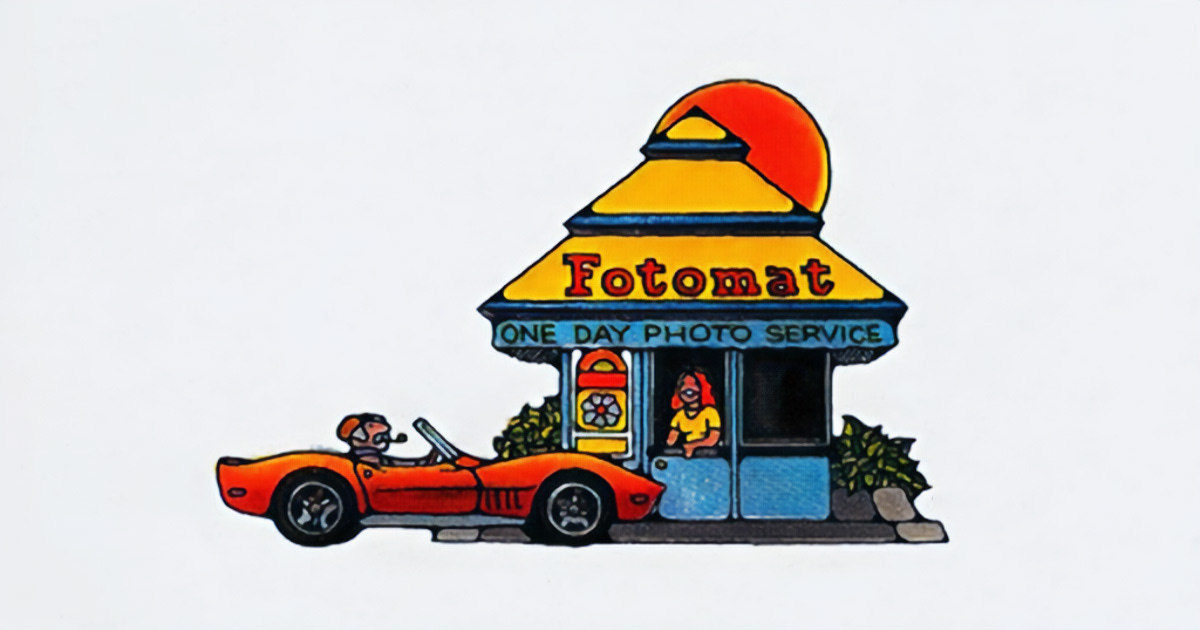
There was a Fotomat in the parking lot of the Acme Supermarket in my hometown. It was still open when I was a kid but barely. That same supermarket started processing film as well and that took away a lot of it business. Still, it didn’t close all at once. It was open less frequently at first. Then one day, it closed and never re-opened. Finally, years later someone unceremoniously hauled it away.
Fotomat is worth remembering for more than its little kiosks. The company was way ahead of its time in many ways. It built a business around drive up photo processing when that was still a new idea, and later rented home movies years before Blockbuster existed. The problem was that Fotomat often seemed reluctant to move too far beyond the business it already knew, even when it had a head start on what was coming next.
Fotomat started with a man named Charles Brown (Charlie Brown!?), who built the first version of the idea in Florida in 1965. It was recognizable as a Fotomat. A drive up kiosk where customers could drop off film for processing. Two years later, Preston Fleet heard about it. Fleet came from a wealthy aviation family and had also been one of the founders of WD 40. In La Jolla, California, he met a local businessman named Clifford Graham. Graham had a reputation for talking investors into risky ventures.
Fleet and Graham bought out Brown’s stake in the Florida operation and founded the Fotomat Corporation in 1967. Graham became president, while Fleet was one of the company’s vice presidents. By May, Fotomat had opened its first California location, a five by nine foot booth near Rosecrans and Midway in San Diego. According to the Daily Breeze, it reached its break even point on its fifth day in business.
An ad placed by Fotomat, Inc. of St. Petersburg, FL was still recruiting new franchisees that August. They were offering a one man operation for a total investment of $9,500 and the promise of up to $1,000 a month in extra income.
Word got around fast after that. The concept grew to 1,800 locations within its first eighteen months and it had a thousand stores nationwide by 1970. The franchise fee climbed just as quickly. In 1967 it ran around $9,800 plus $300 a month in rent. By the summer of 1968, to buy the rights to Houston, TX, the fee had jumped to $21,000.
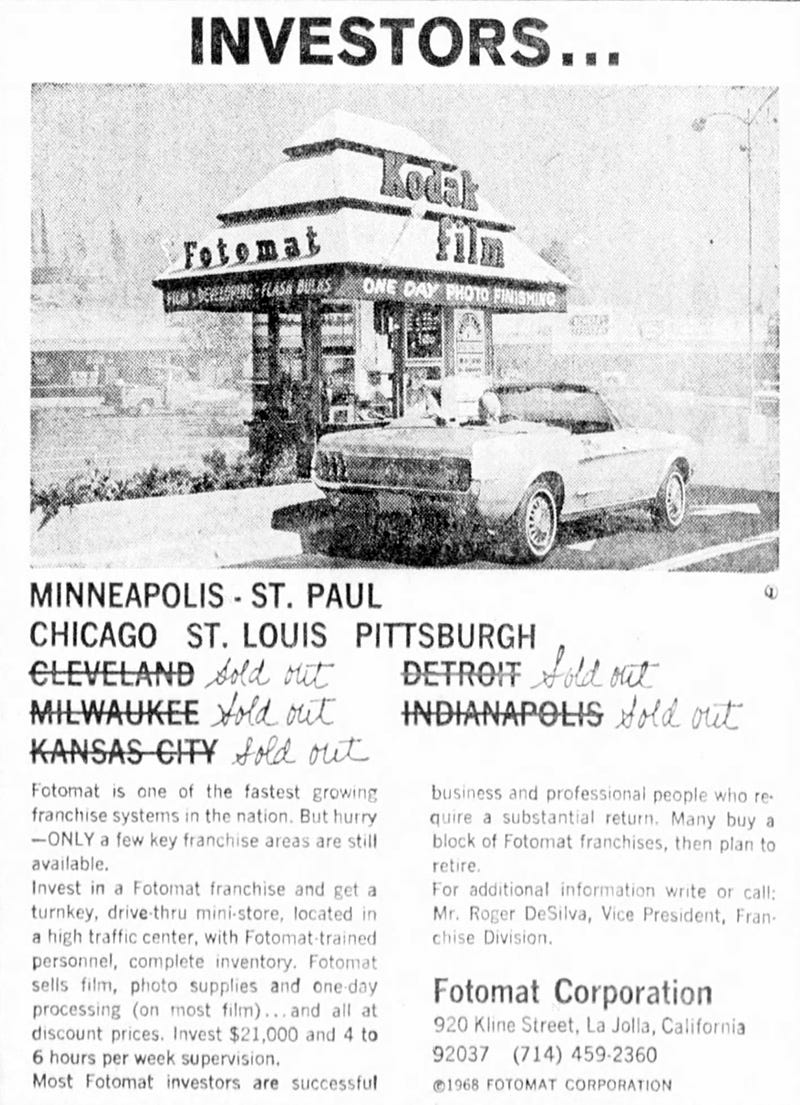
By October of that same year, an investor ad in the Pittsburgh Press was crossing cities off the list as they sold out. As you can see, Cleveland, Detroit, Milwaukee, Indianapolis, and Kansas City were gone. Minneapolis, Chicago, St. Louis, and Pittsburgh were still open. Back in California, the pace was just as fast. The tenth Fotomat in the San Diego area opened in Chula Vista that August That is just four months after the first one.
Fotomat’s yellow and gold kiosks were hard to miss, film giant, Kodak had a problem with that. They said some customers thought the two companies were connected because the colors and lettering resembled Kodak packaging. By 1970, Kodak and Fotomat were fighting over the trademarks and the appearance of the kiosks. Fotomat fired back with a $321.5 million antitrust suit against Kodak. The fight eventually ended in a settlement the next year. Fotomat would change its look and Kodak contributed $500,000 toward the cost of doing that.
All of the kiosks came from the same factory outside Cincinnati, a location Fotomat chose because it made shipping them around the country easier. Each one was only thirty six square feet. For a while, the factory was turning out about three kiosks a day. By 1981, it was making only about two a month.
Finding places for new kiosks was getting harder. Local planning boards were paying more attention to what Fotomat wanted to put in their parking lots and wanted custom work to match the style of their towns or cities. For example, near Tampa, FL, they wanted the kiosk to look more like a palm tree. So they built one with a green roof and horizontal siding. Don Hausrath, who was the Fotomat employee who had to deal with this new trend, remembered that they were happy with how it turned out. He was not.
With parking lots getting harder use, Fotomat eventually opened more than three hundred locations inside shopping malls. There it didn’t have to deal with the same restrictions. This is one of the reasons locations started to disappear even when the company was still going strong.
By the mid 1970s, Fotomat had grown to 2,269 stores, and net income reached $10.9 million. This is the best the company would ever look on paper. Over the next three years the chain kept adding roughly 500 stores a year, but per store sales fell 12 percent and net income dropped by more than 40 percent.
Fotomat had built its business almost entirely around the Kodak Instamatic, the cheap cartridge camera that dominated the 1960s and early 1970s. Instamatic film made up about ninety percent of what Fotomat processed in the early part of that decade. By 1981, 35 millimeter film had grown to half of everything the company handled, and Fotomat had been slow to notice. The company didn’t roll out a real push into 35 millimeter processing, a program it called Series 35, until December of 1978, years after the market had already started shifting under it.
While they might have been slow on film formats, they were willing to take a chance on new technology. In 1978 the company started transferring 8mm movies onto videotape and selling blank tapes. Then a year later, they took an en even bigger step and started renting movies.
Rentals were not like at other video stores. A customer looked through a catalog and called in their order. Then they would pick up the cassette the next day at whichever Fotomat was nearby. Paramount was the first studio they partnered with and offered titles like The Godfather, Star Trek, and Airplane. Disney followed in March of 1980. How much did it cost? A rental cost $12 for five days. This would later be cut to under 10 bucks. Either way, it was on the high side for rentals as the market grew.
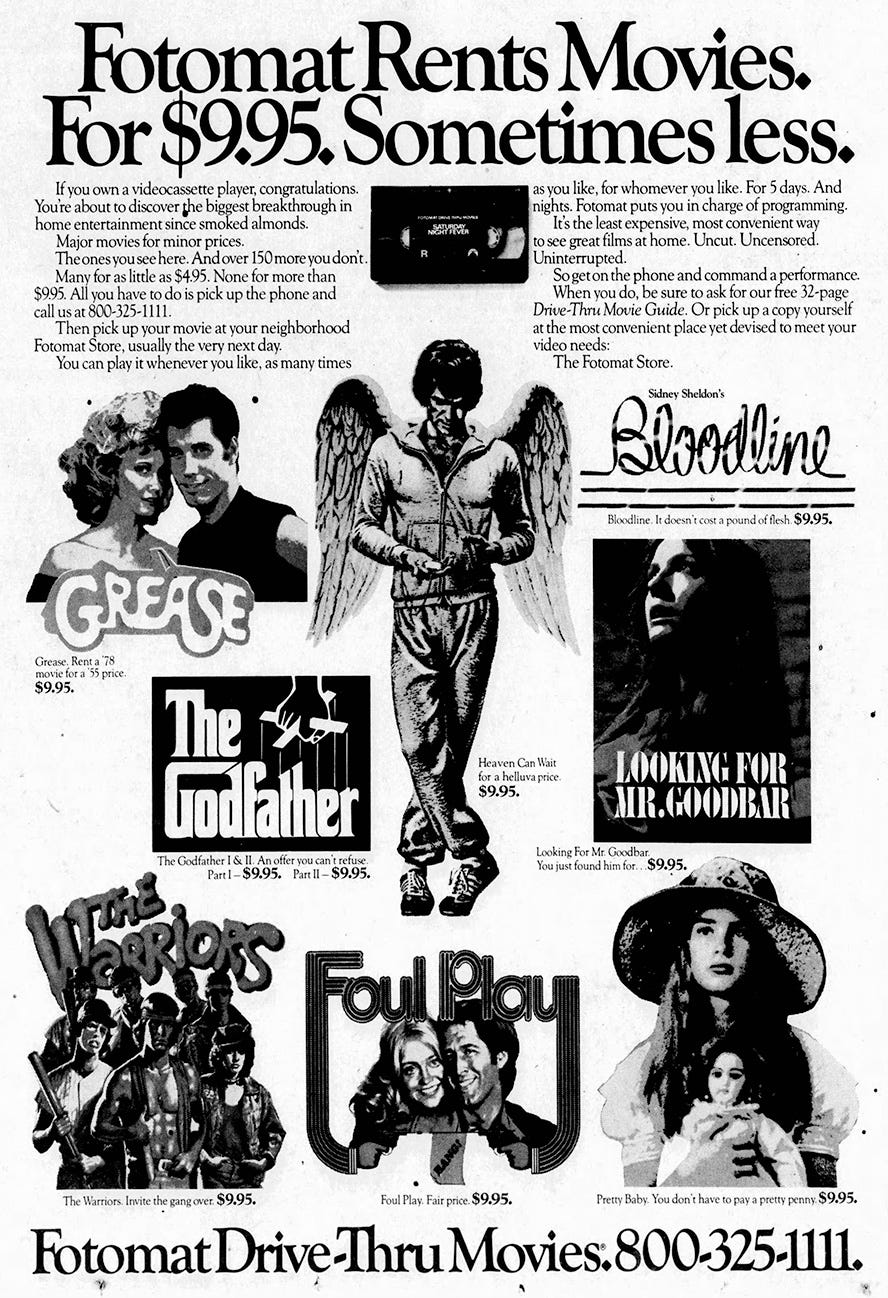
Fotomat already had thousands of locations and a business built around getting customers to drop something off and come get it later. While they had a good head start, they forgot that people didn’t like waiting for stuff. This would become a bigger deal as small video stores started opening up nearby offering same day rentals at lower prices. By 1982, they were already stopping rentals, but it would linger in some locations.
The video rental failure was just part of the problem. The bigger issue was their finances. In 1979 they had lost $4.7 million and decided to stop paying dividends to investor. The next year things were much better. They made less than a million in profit on revenue of over $236 million.
Fotomat’s chairman, Richard Irwin, was unusually candid when the New York Times asked him what had gone wrong. He said, “The biggest single factor was our own ineptitude,” It seems that in its rush to grow, Fotomat had opened new kiosks so close to existing ones that they simply stole customers from each other.
Over-expansion and a slow response to changing film formats hurt Fotomat. The real blow was the minilab. Starting around 1980, drugstores and other retailers began installing one hour minilabs. These were machines that let a store develop film on site. Their growth during the eighties would take a huge bite out of Fotomat's core business and they went from a peak of 4,000 locations to just 800 by 1990. Its last real product was an online photo storage site called Fotomat.com, which shut down in September of 2009.
Neither Fleet nor Graham stuck around to see any of that. Graham was pushed out of the company in 1971 over allegations that he was misusing funds. His life after Fotomat only got stranger. He later ran a company that promised investors it could turn sand into gold, was indicted on federal fraud charges in the 1980s, and vanished before he could be tried. He was never found.
Fleet sold his shares years before the company’s decline and spent much of the rest of his life helping popularize Omnimax movie theaters and writing a book arguing that Shakespeare didn’t write his own plays. He died in 1995.
Most old Fotomat kiosks often got some kind of second act They would be remade into a coffee stand or an ATM. The one in our Acme parking lot never got that far. It just sat empty in that same spot for years, going nowhere, until someone finally came and hauled it away.