


My mother swore it existed. There was a sit-down restaurant (maybe somewhere near the Jersey Shore) that sold Mister Softee ice cream alongside hamburgers and steaks. Not just a truck with a walk-up window, but an actual building with tables and booths where families could have dinner and end with that signature swirl of soft serve. She mentioned it so casually, as if everyone remembered these places, but when I pressed her for details, the specifics dissolved like ice cream on a hot summer day. Where was it exactly? What was it called? When did it close?
By the time I got curious enough to start searching, whatever restaurant she remembered had long since vanished. No one else I asked seemed to know what I was talking about. It became one of those family mysteries, tantalizing precisely because it couldn’t be verified, made more special by its elusiveness. If Mister Softee restaurants had existed, they had disappeared so completely that they felt almost mythical. Which, of course, made me want to learn more about them and confirm they were real.
Turns out, my mother was right.
The Snack House Dream
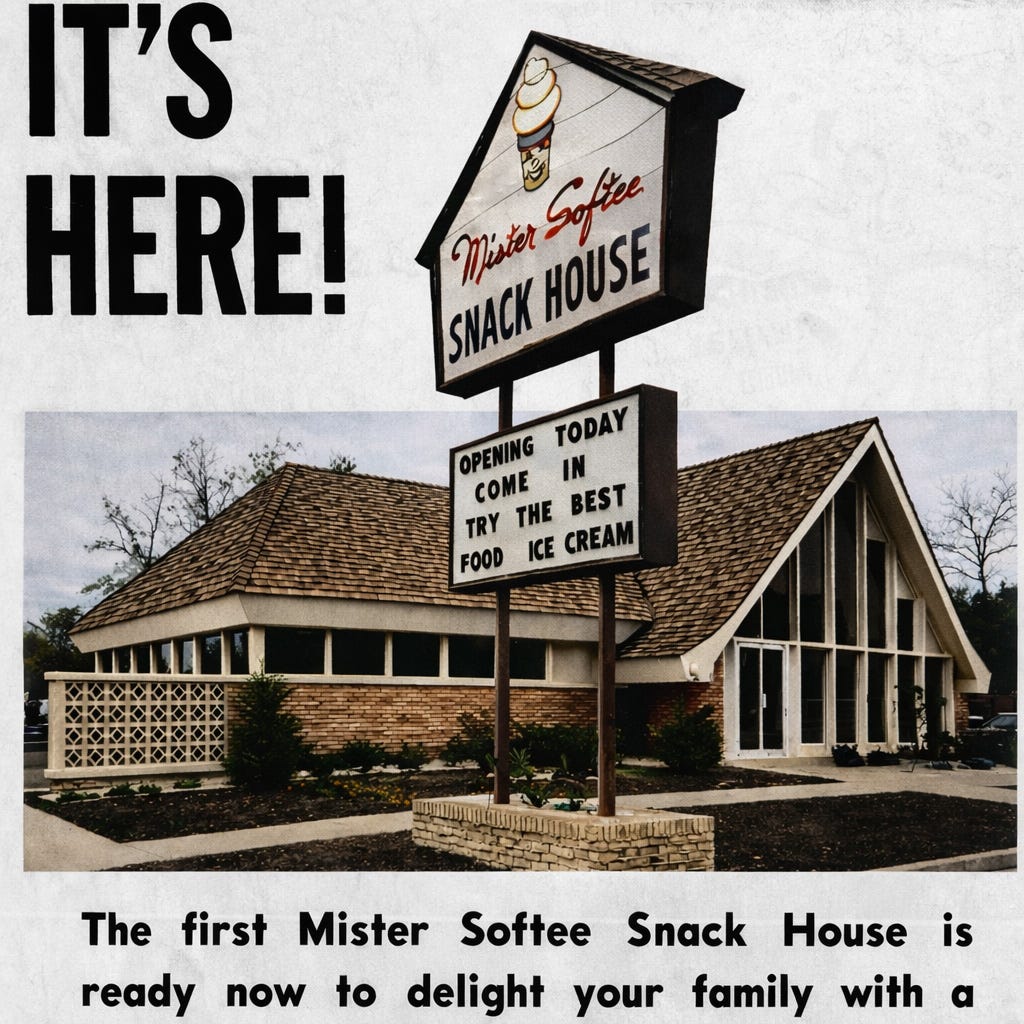
In 1964, something unusual appeared in the pages of New Jersey newspapers. An advertisement announced the grand opening of “The first Mister Softee Snack House” on Route 30 in Magnolia, complete with a photograph of a handsome mid-century building with a peaked roofline and those iconic Mister Softee signs out front. The tagline promised “a fun-filled new adventure in eating.”
Brothers William and James Conway had founded Mister Softee in Philadelphia just eight years earlier. They were pioneers in the concept of soft-serve ice cream sold from specially designed trucks. Their innovation was transforming the soft-serve machine (which had been confined to stationary soda fountains and diners) into something that could roll through neighborhoods, bringing treats directly to customers. By the early 1960s, Mister Softee trucks had become a familiar sight across the Northeast, their distinctive jingle announcing the arrival of creamy vanilla and chocolate swirls. They were a highlight of my summer growing up.
But trucks, it seems, were only part of the vision. At some point in the mid-1960s, the Conway brothers decided to expand into brick-and-mortar restaurants. The franchise brochure for the “Mister Softee Snack House” laid out an ambitious pitch: franchisees could open “Quick Service Drive-In Restaurants” that would serve not just ice cream but a full menu of food. The business model promised high profit margins, approximately 70% on soft ice cream and 60% on food items. A mobile franchise cost $2,500 in 1967, while a restaurant franchise would be ten times that amount.
The Magnolia location (that first Snack House, which might be the one my mother remembered) offered all the classic Mister Softee treats plus “an all-star cast of the most delectable characters in the history of snack-ery,” according to the December 1964 advertisement. The star of the show was “Mister Beef,” described as “four-and-a-half ounces of choice ground beef (100 per cent beef) broiled over a glowing fire of seasoned hickory charcoal and served on a big, toasted ‘n buttered bun.” They also advertised fish fry specials on Wednesdays and Fridays and a barbecue beef sandwich for 55 cents.
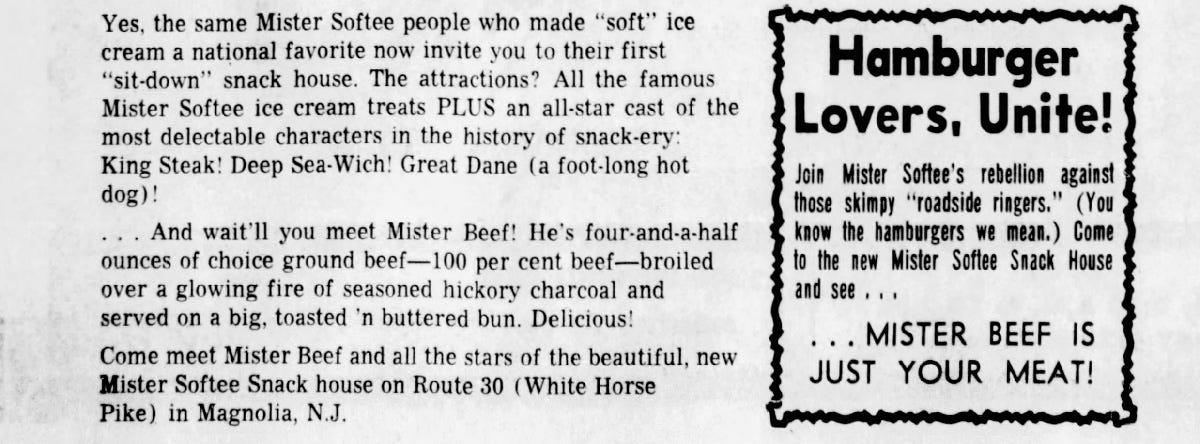
The menu reflected that curious mid-century confidence that a single restaurant could be all things to all people: ice cream parlor, burger joint, and fish fry rolled into one cheerful package.
Enter Jimbll’s
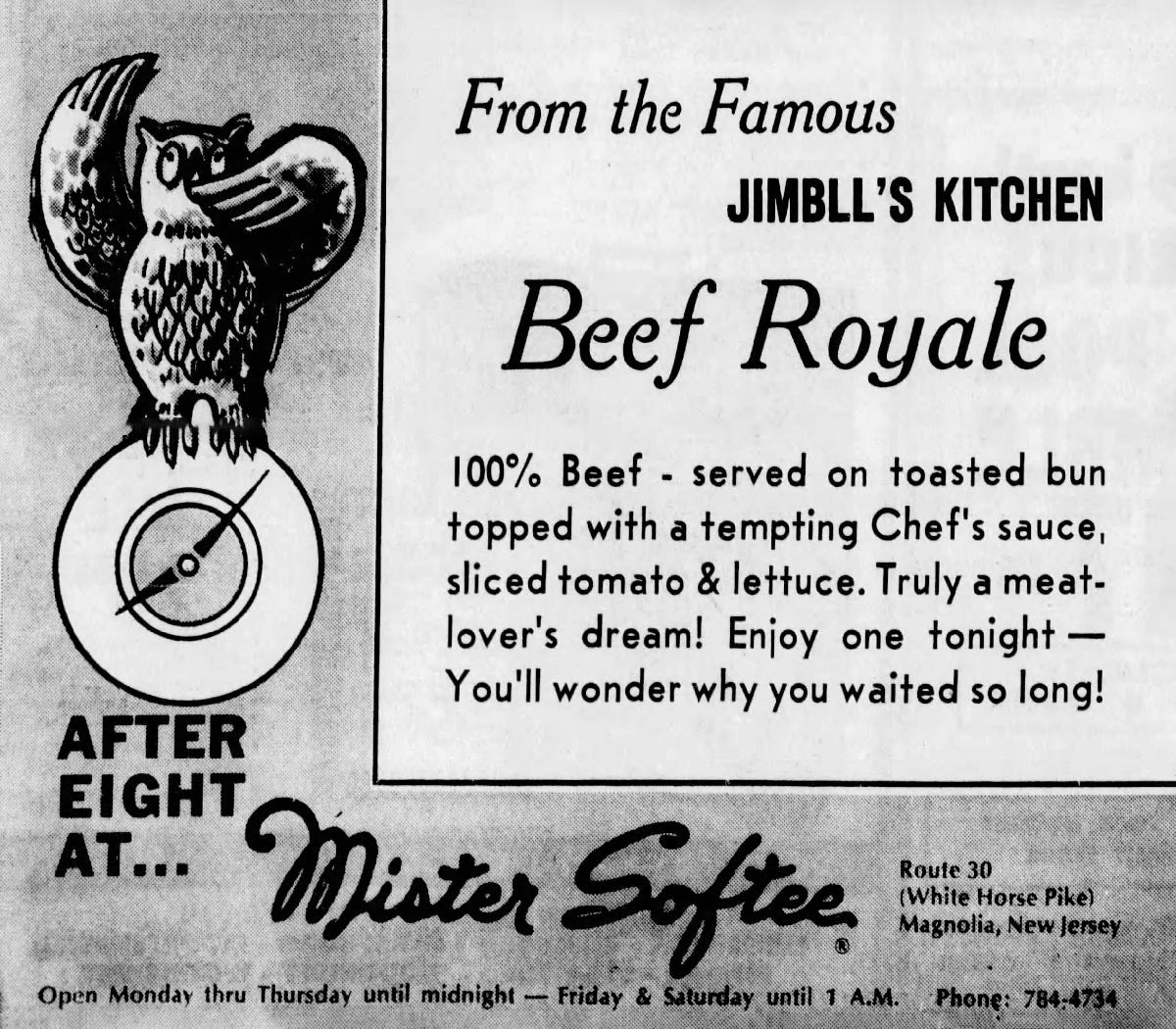
By 1967, something had changed. The same Route 30 location in Magnolia began advertising under a different name: “Jimbll’s,” proudly mentioning food was from the famous Jimbll’s Kitchen. The apostrophe suggested a possessive, but who or what was Jimbll? It’s an odd name, but the concept was clear. Jimbll’s was positioned as a family restaurant with moderate prices. They would offer everything from Mister Softee ice cream to steak dinners. An article in The Cincinnati Post from March 1968 explains that “Jimbll’s is the name of the venture, taken from James and Bill Conway, the two brothers who founded the New Jersey-based soft ice cream franchising firm 14 years ago.” So the mystery resolves itself in the most obvious way: Jimbll = Jim + Bill, the Conway brothers themselves.
The evolution from “Snack House” to “Jimbll’s” seems to have been part of a broader franchising push. By 1968, Jimbll’s locations had expanded well beyond New Jersey, with restaurants opening in Cincinnati (Fairfax), Wilkes-Barre, Pennsylvania, and Glassboro, New Jersey.
Not a lot of info exists about the chain, but its did get a mention in a 2006 article. They state, “at one point, Mr. Softee branched off into a small chain of ice cream restaurants called Jimbll’s, three of which were in South Jersey.” A member of the Conway family, reminiscing about childhood trips, recalled, “We would often go there and have dinner. Their deal was gigantic sundaes called Tummy Busters.” So my mother’s hazy memory was likely of one of these South Jersey locations, where families could settle in for a real meal and cap it off with an absurdly oversized ice cream creation.
The menu had grown more ambitious. Jimbll’s featured “charcoal sirloin steaks,” “Big Jim Beef” sandwiches (described as “sliced roast beef piled high on a toasted bun”), fried chicken, seafood platters, and shore dinners. The Cincinnati location’s steak platters ranged from $1.50 to $2.19, while dinners from appetizer to dessert cost between $1.85 and $2.35. And yes, dessert was still Mister Softee ice cream. Multiple flavors and “a couple of dozen styles from plain dishes to the $2.25 Tummy Buster that consists of everything in the shop piled on half a gallon of ice cream.”
A 1969 advertisement for the Wilkes-Barre location emphasized the casual, come-as-you-are atmosphere: “Although the outside of Jimbll’s gives the impression that you have to get ‘dressed up’ to go there, this is not the case... part of the ‘charm’ of Jimbll’s is that it’s the come-as-you-are place to eat.” They served full dinners from $2.20, and children’s meals for $1.75. It was affordable family dining with the added draw of legitimate Mister Softee treats for dessert.
As the Jimbll’s brand developed, they introduced a mascot character (a cheerful figure in a striped vest and bow tie, styled like the Mister Softee mascot but distinct to the restaurant concept) that appeared prominently in their advertising by 1969.
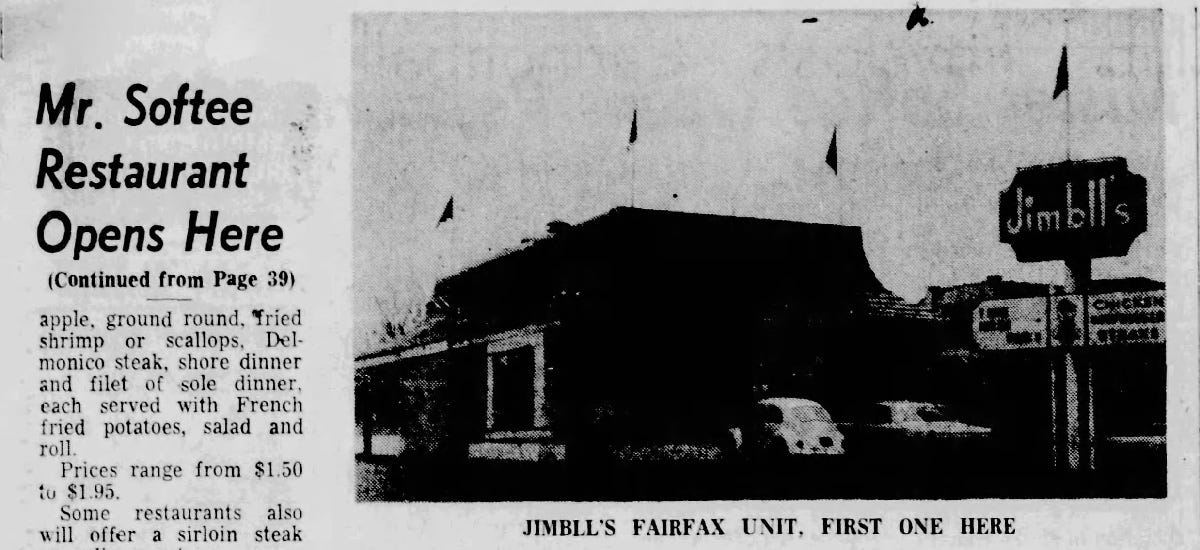
Each location seems to have adapted slightly to its market, although this could just be discrepancy in their approach to adverting. Some locations emphasized take-out service. While others had contests, giveaways, two-for-one offers, and special prices for kids .
The Curious Case of Larry’s Dawg House
While Jimbll’s appears to have been the primary restaurant brand, newspaper records point to at least one additional Conway connected venture. In Lancaster, Ohio, a restaurant called Larry’s Dawg House appears in 1977 coverage, described as serving soft ice cream and sandwiches. That same year, local reporting noted that a former gas station at the corner of Eastwood and East Main Street was being converted into Larry’s Dawg House, which would “serve soft ice cream and sandwiches.”
A 1982 lawsuit filing further clarifies the connection. Mister Softee, Inc., based in Runnemede, New Jersey, and Larry’s Dawg House, Inc., based in Athens, Ohio, jointly sued a Carroll, Ohio man over unpaid rent on the property. The suit identified James Conway, co founder of Mister Softee, as a partner with Larry Young of Athens in the ownership of Larry’s Dawg House.
Beyond these records, little documentation has surfaced about the concept. What is clear from the available newspaper and court filings is that Conway was directly involved in the venture, and that Mister Softee, Inc. was formally tied to it in legal proceedings in the early 1980s.
Why the Restaurants Faded
What’s striking about this history is how thoroughly it’s been forgotten. If you search online for Mister Softee, you’ll find endless coverage of the trucks (their distinctive jingle, their role in American nostalgia, their surprising persistence into the 21st century). But the restaurants? They’ve all but vanished from the record outside of a few social media mentions.
The economics probably explain why. As I mentioned earlier, according to the franchise documentation from the 1960s, a restaurant franchise cost $25,000 compared to just $2,500 for a mobile unit. Restaurants required buildings, leases, full kitchens, more staff, and longer operating hours. They were competing not just with other family restaurants but with the emerging fast-food giants (McDonald’s, Burger King, Kentucky Fried Chicken) whose streamlined operations and aggressive expansion were redefining casual dining.
Meanwhile, the Mister Softee trucks were thriving. Mobile, low-overhead, perfectly suited to seasonal operation, they could go where the customers were. At the company’s peak in the late 1960s, there were over 1,000 trucks operating across 15 states. The trucks were the business. These restaurants were an experiment.
By the late 1970s, the Jimbll’s name disappears from newspaper advertisements and business directories. The last references I can find are from around 1978. The Larry’s Dawg House venture would continue until the early 1980s, but Jimbll’s as a brand might have already been gone. So, no grand closing announcements and no retrospectives that I can find. The buildings were just repurposed, the signs taken down and the concept quietly shelved. Unlike the Mister Softee trucks, which remain part of the cultural landscape, these restaurants left almost no trace.
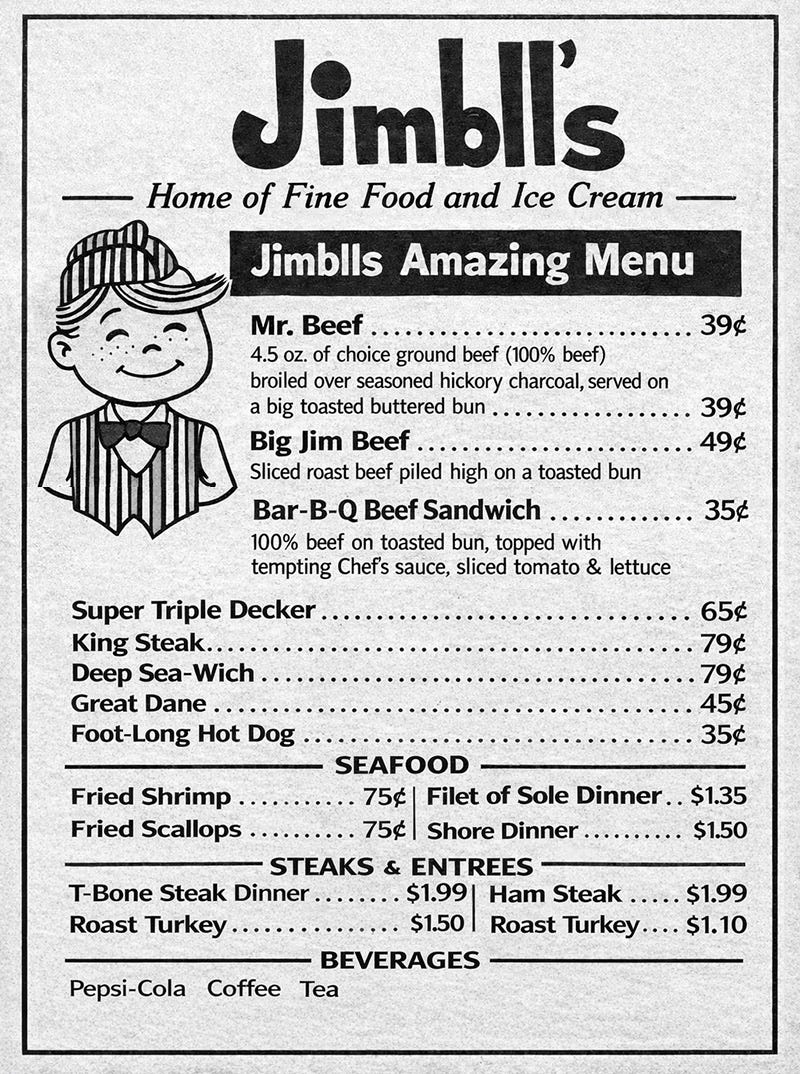
One last thing, while I was not able to find a complete menu. I was able to put together my own based on various ads I found online. It turned out pretty good.
History Repeating?
Here’s where the story gets interesting. After more than fifty years, Mister Softee is trying the brick-and-mortar experiment again. But this time, they’re being smarter about it.
In 2015, franchisee Jeff Hiller, who had driven a Mister Softee truck in the late 1980s, opened a standalone Mister Softee store in Old Town Camarillo, California. It was one of the earliest modern attempts to give the brand a permanent home again. Unlike the ambitious Jimbll’s restaurants of the 1960s with their steaks and shore dinners, this location stayed focused on what Mister Softee has always done best, soft serve ice cream. Cones, sundaes, shakes, banana boats. No charcoal grilled hamburgers, no fish fries. Just ice cream.
That West Coast storefront was not alone for long. In late 2023, two former employees from the Camarillo shop opened a second California location in Santa Barbara⁸. These were independent franchise efforts, not a large national campaign, but they showed that a permanent shop built around soft serve could work.
Back on the East Coast, the company has more recently begun expanding storefronts in its traditional Northeast territory. In March 2025, a brick and mortar shop opened in East Islip, New York, described in local coverage as the first of its kind on Long Island. Additional locations have since opened or been announced in the region. The marketing frames this as an expansion into storefronts across the Tri State area, with no mention of the restaurant ventures of the 1960s and 1970s.
It’s worth noting the timing. The truck fleet has shrunk considerably. At the company’s peak in the 1960s, over 2,000 trucks operated across 38 states. Today, there are around 625 trucks in 21 states. Rising costs, competition, and changing neighborhoods are making the mobile model harder to sustain. A permanent storefront starts to make more sense when you can’t rely on trucks alone.
So Mister Softee is returning to stationary locations, but with a crucial difference. In the 1960s, they tried to become something they weren’t. In 2025, they’re doubling down on what they’ve always been. They are the Mister Softee brand, just in a building instead of a truck.
Conclusion
The Mister Softee restaurants show how far the Conway brothers were willing to stretch their brand beyond the trucks that made them famous. In the mid 1960s, they put their name on full service locations that served steaks, seafood platters, and fried chicken alongside soft serve. It was a larger bet, with higher startup costs and permanent buildings instead of seasonal routes. Other chains had already proven that ice cream and comfort food could anchor a restaurant business, so the idea was not outlandish. Still, it is striking to think of the Mister Softee brand associated with a sirloin steak instead of an ice cream sundae.
Sadly the gamble didn’t pay off. The trucks were too good at what they did, delivering exactly what people wanted from Mister Softee, ice cream. The restaurants tried to be something more, but they couldn’t carry over their success.
The modern storefronts suggest that maybe, just maybe, there was a good idea buried in the Jimbll’s experiment. But it took fifty years and a complete rethinking of what a Mister Softee location could be to find it. No steaks, no seafood dinners, no Mister Beef. Just soft-serve ice cream, the way it was always meant to be.
Still, for a brief period in the late 1960s, you could walk into a Jimbll’s on a Friday night, order a shore dinner or a sirloin steak, and finish with a Tummy Buster sundae. And my mother, wherever she was, remembers it happened. That’s good enough for me.
If anyone reading this has photos of a Jimbll’s interior, an original menu, or memories of eating there, I’d love to hear from you. These places may be gone, but their stories deserve to be remembered.
It's articles like this that make this one of my favorite sites! Great stuff.
Interesting article! As a southerner, I’ve never heard of any of this.