

The Living Unicorn at the Circus
A Goat Named Lancelot, a Circus Full of Believers, and One Very Famous Horn

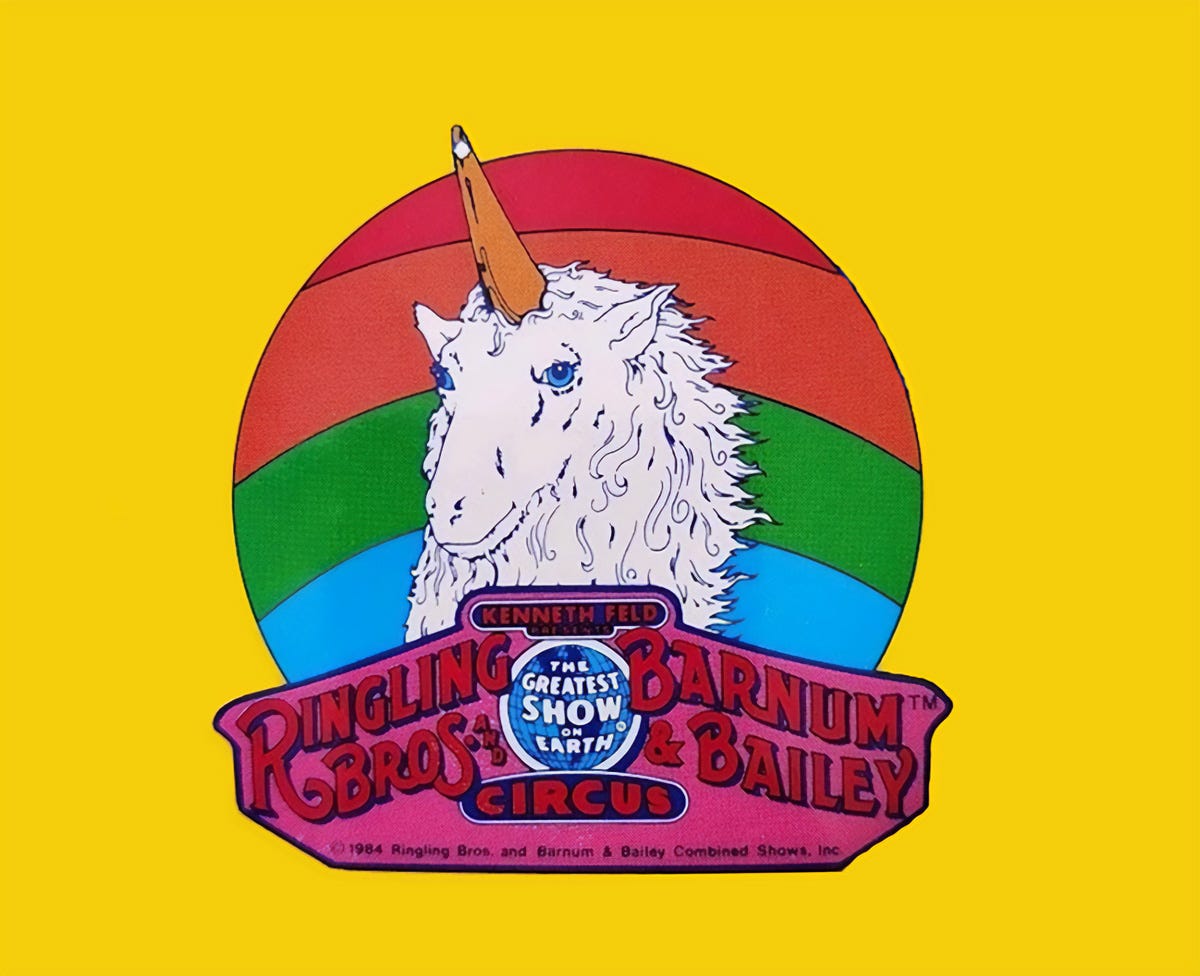
When Ringling Bros. and Barnum and Bailey Circus started hyping its newest attraction for the 1985 season, I was exactly the right age to fall for it completely. I was a kid in New Jersey, and the ads were everywhere. A beautiful white creature with a single horn rising from its forehead, standing in a spotlight like something that had wandered in from another century. “Seeing Is Believing,” the posters said. My mother took me. I believed.
What I did not know then was that before long people would be arguing over what, exactly, they were looking at. The Living Unicorn had a creator, a backstory, and even a patent behind it. Beneath the spotlight and the circus language was something much stranger and much more earthly, with a goat named Lancelot at the center of the story.
To understand Lancelot, you have to go back a few decades before he was born, and a few miles north of anywhere the circus ever pitched a tent.
In 1933, a biologist at the University of Maine named W. Franklin Dove decided to find out if a unicorn could be made rather than imagined. Dove’s research had revealed that at birth, the horn buds of animals were not yet connected to the skull but were independent, floating beneath the skin. That small anatomical fact opened a window. He took a day-old Ayrshire bull calf, removed the two horn buds, trimmed them flat so they would fit together, and repositioned them at the center of the animal’s forehead. As the calf grew, the buds fused. The experiment was successful: a single, massive horn grew from the skull, molded directly into the frontal bone. Dove published his findings in 1936 in a paper with the wonderfully earnest title “Artificial Production of the Fabulous Unicorn.” The bull became the leader of its herd and with his centered and very dangerous horn, he was rarely challenged.
Dove’s work sat largely in the scientific literature for decades. It might have stayed there, too, if not for a self-described wizard living on a commune in northern California.
Oberon Zell, born Timothy Zell in St. Louis in 1942, seemed almost destined to end up behind one of the stranger circus stories of the 1980s. He was a Neopagan religious leader, co founder of the Church of All Worlds, an early advocate of what would later be called polyamory, and founding editor of a publication called Green Egg. He and his partner, Morning Glory, were operating far outside the mainstream, but that only made them more likely to take the idea of a unicorn seriously.
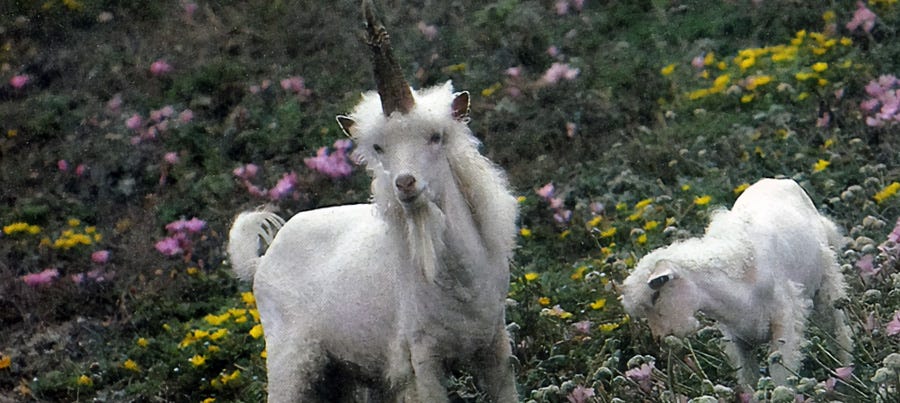
In the 1970s, the two of them were researching a book on legendary animals when they came across Dove’s old paper. The idea lit something up in Zell. He studied the technique and using angora goats for their luxurious coats and cross-breeding them with Saanen goats to get slightly higher legs, he was able to successfully get his bleating patients to grow a single horn without complication. The procedure, just like with Dove’s bull, was done within the first week of a kid’s life while the horn buds were still loose under the skin. This left the animal with a single fused horn growing from the center of its forehead (again, just like with the bull). Lancelot was born in the spring of 1980. He was the first to get the procedure.
By 1982, Zell had five living unicorns and was taking them to Renaissance fairs, county fairs, pagan festivals, and schools. The 1982 Kilgore News Herald described Lancelot as “about three feet high and 150 pounds,” small enough to be handled easily, with a “white, bearded” appearance and a single horn growing from the center of his head. Zell told interviewers that he was convinced the real medieval unicorns of legend had come from the goat family, not horses, which is why they were described as small enough to rest in the laps of maidens. He carried a reproduction of the famous Unicorn Tapestries with him so people could compare the “real thing” to his animals.
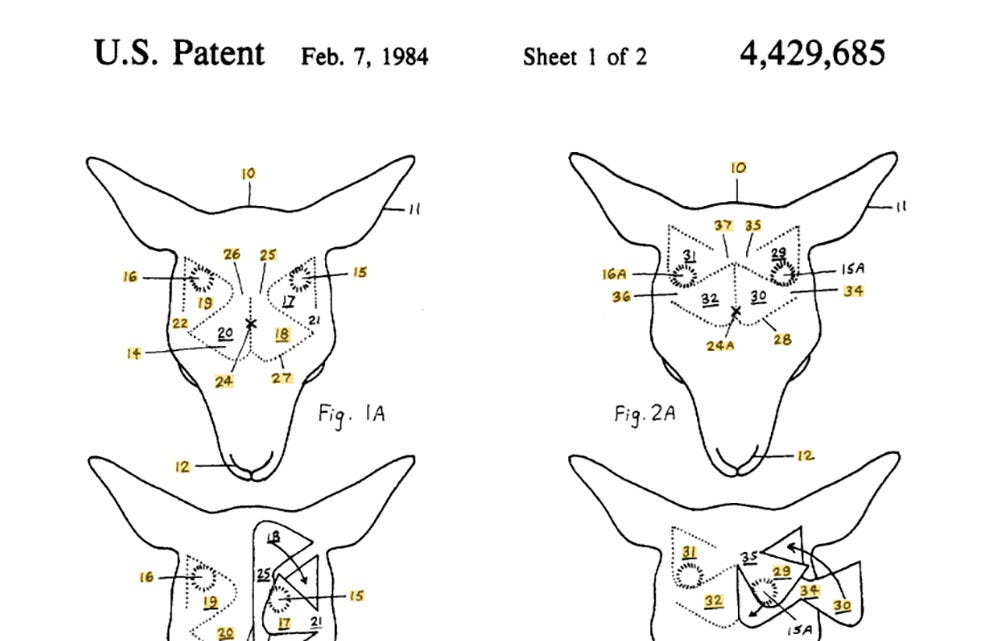
In 1981, the Governor of Texas, Bill Clements, officially named Lancelot the State Unicorn of Texas. By 1984, Zell had produced nine unicorns total. He was granted US Patent #4,429,685, described as “a method of growing unicorns in a manner that enhances the overall development of the animal.”
That same year, a manager named Jeffrey Siegel, a graduate of the Ringling Brothers and Barnum & Bailey Clown College, negotiated a four-year licensing deal for four of Zell’s animals worth around $500,000. The four chosen were Lancelot, Galahad, Avalon, and Percival. The deal came with a condition that suited the circus perfectly. Zell was prohibited from discussing publicly how the animals were made.
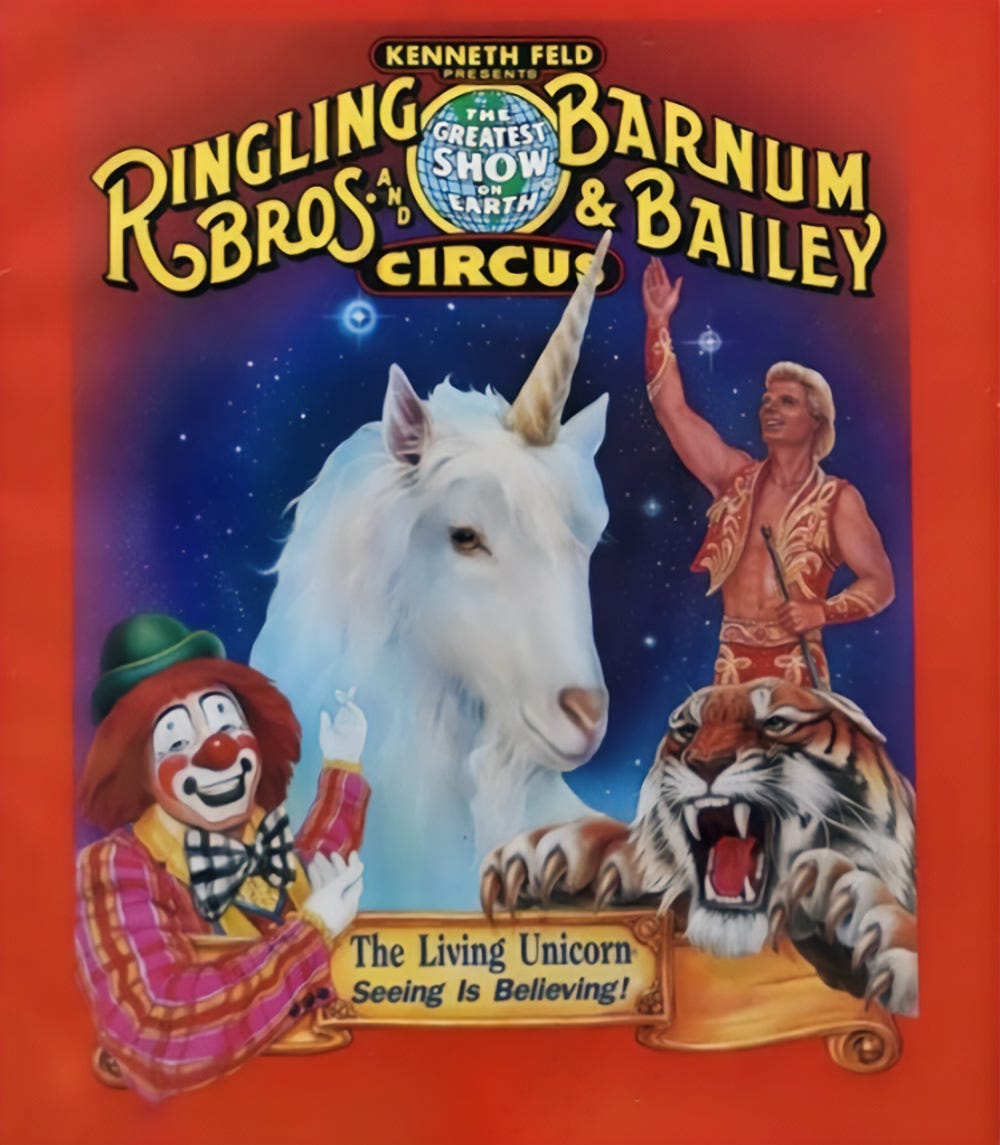
The circus opened its 1985 season at Madison Square Garden in April. Lancelot made his entrance to the Rocky theme, parading through the arena on a hydraulic float trimmed in gold, a handler in sequins waving beside him. According to the official circus story, he had simply wandered up to the tent in Houston the previous July, his origin unknown. The circus had taken him in and given him a home. His keeper was a former dancer named Heather Harris, who was assigned the title Keeper of the Unicorn and who, to her credit, played the role with total conviction.
“He just appeared to us six months ago,” she told reporters. “I think it was in Houston. I don’t know whether it flew here, or walked or took a train.”
The circus programs were full of this kind of delightful mythology. He had appeared out of the blue and joined up with the Greatest Show on Earth because it felt like the right place for him. For kids, it worked beautifully. The program had a pullout poster. There were fact sheets answering questions like where unicorns come from and how old they were. The answer to age was “ageless.” The answer to origin was “from beyond myth and legend.” His favorite food was “rose petals.” The circus had trademarked the name “The Living Unicorn” and was not about to let a little thing like biological reality get in the way of a good show. Behind the scenes, Lancelot traveled with three understudies who were kept out of sight. Only one unicorn appeared in the actual show, but four were part of the touring troop.
With all this hype and news coverage, it took about five minutes for the ASPCA to get involved.
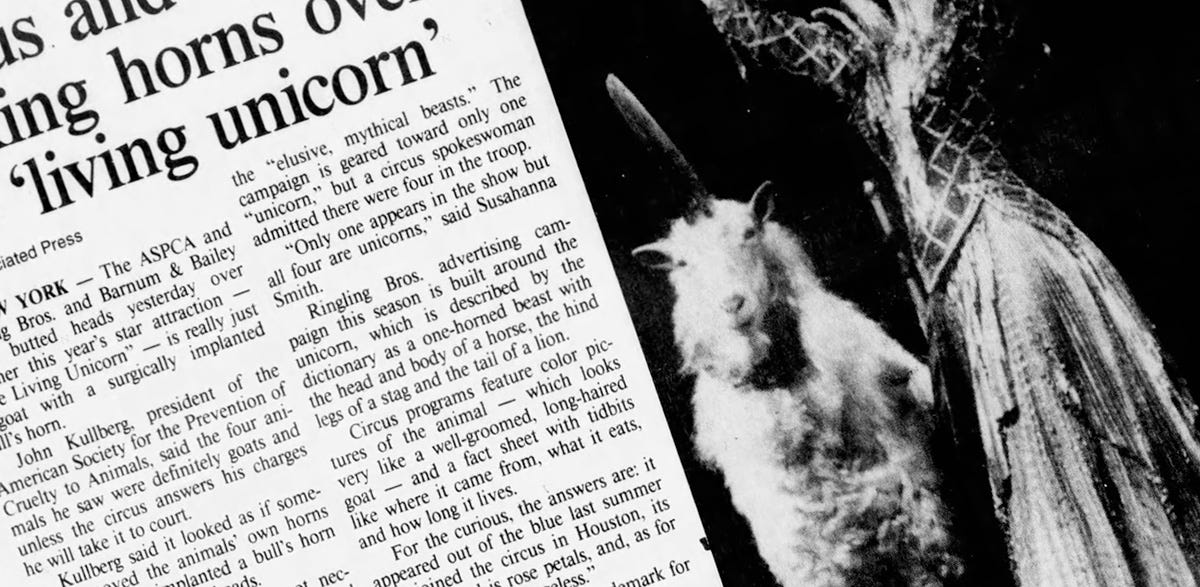
When the circus hit New York, animal welfare groups went to see for themselves what was going on. ASPCA president John Kullberg assumed they would find a prop. A chin strap. Something rigged. What they found instead was an animal with a horn that appeared to be part of its skull, which concerned them even more. If the horn was real, it meant something had been done to the animal while it was still very young.
Kullberg called the procedure “cruel and severely unethical” and urged a public boycott. The New Jersey SPCA threatened to block the circus from performing west of the Hudson (where I saw it). The Humane Society went on record. “I can’t believe Ringling Bros. has the nerve to insist it is a real unicorn,” said spokesperson Nancy Blaney.
Circus vice president Allen Bloom called the charges ludicrous and the boycott an “unfair and ill-conceived effort by Grinches to steal the kind of wholesome fantasy all too rare in today’s entertainment.” In the New York Times, the circus ran a full-page ad: “Don’t Let the Grinches Steal the Fantasy.”
The U.S. Department of Agriculture sent veterinarians. Their conclusion was that Lancelot was a goat, and that he seemed fine. USDA chief veterinarian Dr. Gerald Toms speculated that a simple grafting procedure had been performed when the animal was very young, and that if anesthesia had been used, the animal would have felt no pain and suffered no lasting effects.
Ringling went even further with a press conference at Madison Square Garden. Circus president Kenneth Feld brought in two professors from the University of Pennsylvania. Dr. Charles Reid, a radiologist, held up X-rays showing clearly that the horn was fused to the skull. It was not an implant. It was not attached to anything. Dr. William Donawick, a professor of surgery at the university’s animal hospital, examined Lancelot and announced his verdict to the assembled press: “I am pleased to tell you this animal is a content, healthy, living unicorn. It’s a unicorn. That’s what you call an animal with one horn.”
Reporters were invited to pull on the horn. It did not come off. Lancelot ate some rose petals. Just like they said he would!
Mayor Ed Koch weighed in, saying that while he believed in unicorns, that “doesn’t mean they exist.” The New York Consumer Protection Board opened an inquiry into whether calling the animal a unicorn constituted false advertising.
None of it slowed the ticket sales. Circus attendance and revenue at Madison Square Garden soared. Siegel later claimed it was the largest publicity event in the history of American circus. Saturday Night Live brought it up on Weekend Update and even Johnny Carson mentioned it. Andy Warhol, according to Siegel, wrote about Lancelot visiting Studio 54.
The controversy quieted after New York, but it didn’t disappear. In February 1986, Lancelot was seized by sheriff’s deputies in Daytona Beach, Florida. The legal basis was a 1921 state law that prohibited the public display of malformed or disfigured animals for profit. The Florida chapter of the Humane Society had filed the complaint. Lancelot was X-rayed again. Another veterinarian examined him. He was found to be healthy. No charges were filed. He was returned in time for that evening’s performance.
The Knoxville News-Sentinel, covering a local stop on the tour in March 1986, ran a long feature asking the question directly: if the circus goat has one horn, is it a unicorn? The answer from local doctors was essentially the same one the New York doctors had given. It was a goat. The horn had probably been produced by moving the horn buds together in infancy. The animal was healthy and probably experiencing no pain.
The circus maintained throughout that the unicorn was exactly as advertised. “The Living Unicorn arrived at the circus exactly as it is seen today,” Bloom said. “The only difference in it now is that its horn has grown several inches since it joined the circus.”
Through all of this, Oberon Zell was largely absent. The contract with Ringling required his silence, and he honored it, retreating from public view while the media frenzy played out without him. He and Morning Glory had wanted to be part of the story, to explain the science behind the animals and share what they had discovered. Instead, they were cut out entirely.
“They wanted to control the publicity,” Zell later said. “We just assumed we’d be in on it. We were completely cut out of the picture.”
The circus had purchased the narrative along with the animals. They never publicly confirmed they had bought the animals from Zell at all, and several sources suggested the sale price was a six-figure sum. The circus stuck with the tale that the unicorn had simply shown up on its own, and that was the story they kept selling.
Zell’s patent, granted in 1984, technically gave him the sole legal right to the method until 1992 when it expired. After that, the technique was available to anyone willing to try it on a newborn goat within the first week of its life.
Ringling had negotiated a four-year contract, but Lancelot’s circus career lasted only two. Circus president Kenneth Feld had a philosophy of rotating attractions regularly, specifically to keep audiences from assuming they could always catch the same show next year. By 1987, the Living Unicorn was retired, replaced in the promotional spotlight by King Tusk, a twelve-foot-tall elephant. Lancelot went home.
The adjustment was not easy. “He was generally pretty depressed, because he loved being a show animal,” Zell later recalled. “I built a barn and corral just for him that we dubbed Fort Unicorn.” Zell cared for Lancelot until his death in 1991, at the age of eleven. By this time, Zell had stopped producing new unicorns. The last animal from his stock died in 2005. He kept the skull of his first creation in his home.
I remember standing in that arena in New Jersey as a kid and believing it. I do not feel foolish for that. I was a child, and the whole point was to make children believe.
What sits differently with me now is not the fact that the circus sold an illusion. It is that the illusion depended on surgery, secrecy, and a great many adults agreeing not to look too closely once the spotlight was on.
A lot of people decided Lancelot was a unicorn. I did too. What once felt magical now feels harder to separate from the work that went into making it.
I remember when this show came to New York and the ads on TV. My family was very much "into" fantasy. Lord of The Rings, Goblins and Faries, the whole nine yards. My mother had a framed print of The Unicorn Rests in the Garden". We one hundred percent wrote this off as something from a midway "freak show". It's very interesting to know the reality of it all these years later.
I remember this, too. I loved unicorns as a child and had them all over my bedroom, but I knew that
this something grotesque and not meant to be. That poor animal.