


Before I worked at Suncoast, I worked at two mom and pop video stores in my hometown. That was how I first got paid to spend my time around movies. Those stores did rentals, with return bins, late fees, rewinding, and customers looking for whatever was still on the shelf on a Friday night. They were great places to work, but when a job opened up at Suncoast in my new local mall, I took it. It was still in the video business, which I had come to enjoy, but it payed more.
Suncoast felt different from those rental stores right away. Their business was built around ownership, not borrowing. People were not just looking for something to watch that night. These were videos people wanted to own, collect, and display. Work was a completely different game that involved more customer interaction and a greater ability to recommend movies and tv shows I loved.
Suncoast Motion Picture Company began in Roseville, Minnesota in 1986, though it was not called Suncoast yet. Musicland opened the first store under the name Paramount Pictures, using the studio name through a limited licensing arrangement with Bell and Howell Columbia Paramount Video. The store was still Musicland’s experiment, not a Paramount run chain, and the idea was simple enough. In 1988, Musicland dropped the Paramount Pictures name and rebranded the stores as Suncoast Motion Picture Company.
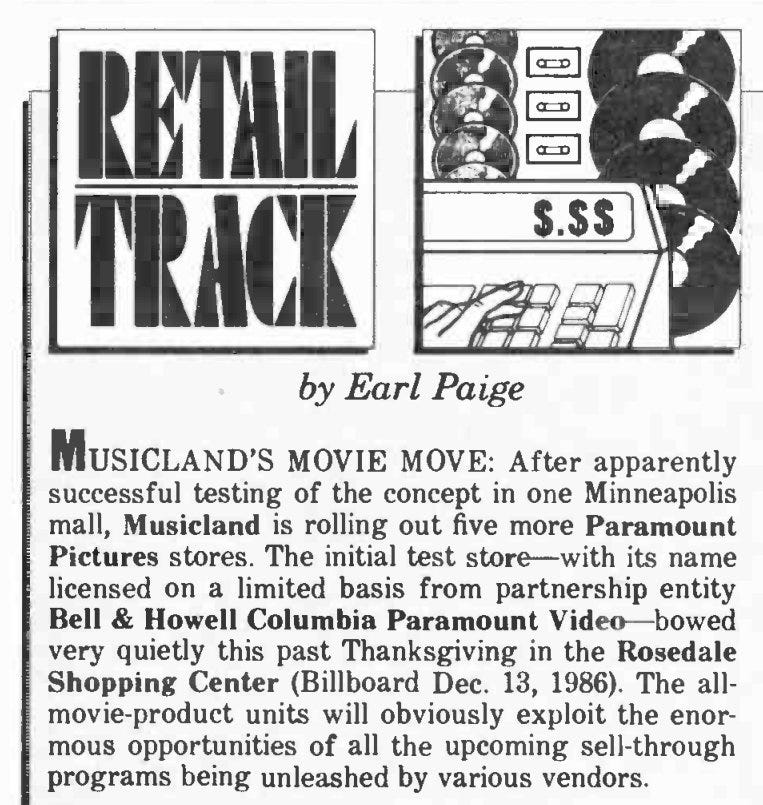
It was good timing. By the late eighties, the VCR had moved from expensive novelty to living room fixture. They were getting cheaper as were video tapes and people were getting used to the idea that a movie could be something you owned. Rental stores had already changed how people watched movies, but Suncoast leaned into the next step. I think a lot of people now think it was there to replace the local video store. While the audience overlapped, they we not always the same. Owning movies had been around for years, but it was not yet casual for everyone. Suncoast was built for the moment when buying a movie started to feel normal
The choice compared to a local video store could be overwhelming. Even early stores back in the 1980s carried between 6,500 and 7,000 titles. Early shelves were filled with movies aimed squarely at film collectors. But this wasn’t all that stores had. There were special interest videos, shirts, stuffed animals, and other movie collectibles. It was a burgeoning business and the parent company, Musicland was only going to push harder into the business in the 1990s.
A Corporate Report Minnesota piece said Musicland might open as many video stores as music stores that year, and quoted CEO Jack Eugster saying sales and profitability had exceeded company plans. The same abstract said Musicland expected overall 1990 revenue to be more than 20 percent above the previous year’s 695 million dollars.
That growth showed up in the stores. A 1994 Daily Herald item about a new Suncoast at University Mall in Orem, Utah described a location with more than 8,500 VHS titles, including new releases and classics. It said special interest videos, such as instructional, travel, and sports tapes, made up 20 percent of the selection. The same article mentioned laserdisc, soundtracks, and show tunes on compact disc and cassette.
By the mid nineties, Suncoast was more than a place to buy movies. The tapes and discs were the center of the store, but the merchandise around them was part of the business. That made it broader than a simple video shop, and probably more useful as a mall store.
Having selection was part of the appeal and a core of the business. Suncoast wanted to catch the person who came in for a title, then keep them looking at everything else connected to it. That was a real difference from the rental stores I had worked in before. Those stores were built around what someone wanted to watch that night. Suncoast was more about the deeper feeling of movie fandom and desire to own a film.
I guess this is a good spot to mention price. Suncoast was not cheap. Even with a decent employee discount. But that selection gave the store a reason to exist even when another retailer had a lower price on the biggest release of the week. You went to Suncoast because there was a chance it had the thing you were not finding anywhere else in the mall.
There were ways to get better prices at the store. Customers could reserve movies before release date and be guaranteed the store’s lowest price for that film. We were always pushing pre-orders and that got pretty ordinary as the nineties wore on, but Suncoast really stressed it and incentivized it early. It was great for who customers wanted to plan around a title before it arrived.
Working the floor, you saw that kind of customer all the time. Some people came in to browse and left with nothing. Others knew exactly what they wanted before they walked through the entrance. Those recurring customer were our bread and butter between big releases and holiday seasons. They were usually also the most fun because they loved this stuff too.
Suncoast Motion Picture Company on the Big Screen

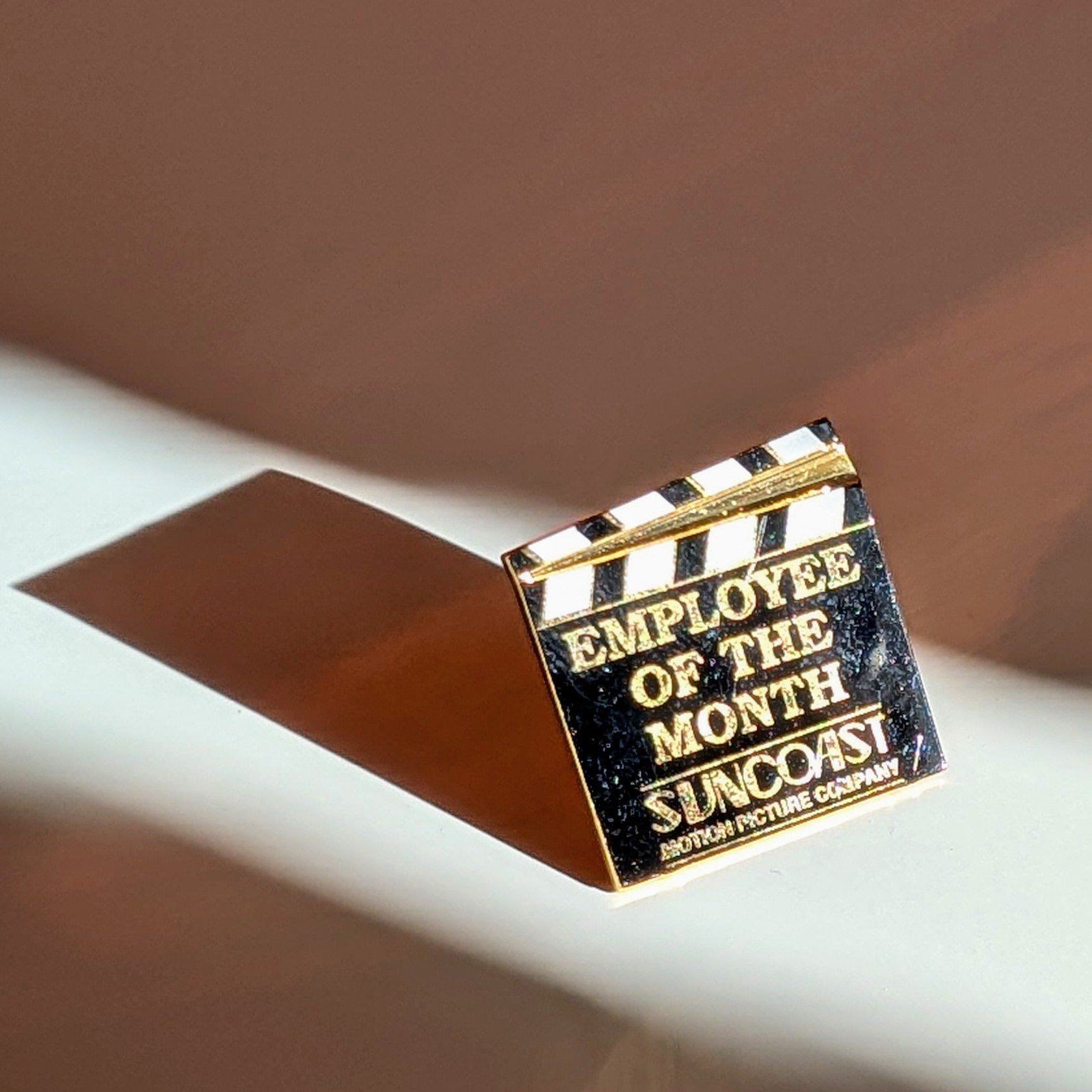
I have mentioned both here and on the podcast that I worked at Suncoast Motion Picture Company for many years. Not to brag, but I was Employee of the Month countless times, and I have pins to prove it.
Customers might not know this, but their were interesting rules around pricing. In 1996, Billboard Magazine looked at minimum advertised pricing, usually called MAP. These policies were set by the studios and limited how low a retailer could advertise a movie without risking the loss of cooperative advertising money. Specialty chains liked MAP on major new releases because it kept big box stores from advertising the same tape at a price smaller video retailers could not match.
Suncoast’s president Gary Ross wanted those protections to go further. At the time, Suncoast had 414 stores, and Ross argued that MAP helped specialty stores stay in business. He also wanted it applied to more older repriced titles, since a mass retailer could take a tape that had dropped from 19.99 to 9.99 and use it as a giveaway. Other retailers were less convinced. They supported MAP on big releases, but thought stores needed more freedom on older titles where the profit margin was already thin.
That was one of the tensions customers felt without always knowing the reason. Suncoast had selection, but Best Buy, Circuit City, and other large retailers could be cheaper on major releases. If you wanted the big title of the week, a big box store might win on price. If you wanted anime, a cult title, an older catalog release, a box set, or something that was not sitting in a discount bin, Suncoast still had a reason to exist.
The anime side of the store became one of the clearest examples of that. When people share memories of the store nowadays, anime comes up again and again. Things like Dragon Ball Z tapes, imports, and higher priced releases with only a few episodes loom large. These online comments are not hard business data, but they match the way many people remember the store. I personally remember how excited people were for the anime section. Suncoast was expensive, but for some categories it was also where people found things they could not get nearby.
If you have never seen a Suncoast storefront they were easy to recognize. They had a black mirror-like facade and a red neon sign. Later photos from remaining or recently remaining locations show how much that sign still carries the memory of the chain, even when the merchandise mix inside has changed.
The decline came through the same forces that hit a lot of entertainment retail. In December 2000, Best Buy agreed to acquire Musicland for 685 million dollars, gaining more than 1,300 stores under names including Sam Goody, Suncoast, Media Play, and On Cue. In January 2003, Best Buy closed about 110 Musicland division stores, including 90 Sam Goody stores and about 20 Suncoast stores, citing declining prerecorded music sales and slower mall traffic.
A few months later, Best Buy was already out. In June 2003, Sun Capital acquired all of Musicland’s liabilities, including lease obligations, and paid no cash consideration for the stock. That is one of those details that reads like an ending before the ending. Best Buy had paid hundreds of millions for Musicland, then moved it out of the company by having someone else take on the obligations.
Musicland filed for Chapter 11 bankruptcy in January 2006. Oak Point Partners, which later acquired remnant assets from the bankruptcy estate, says Musicland and related entities filed in the Southern District of New York on January 12, 2006. In March 2006, Trans World Entertainment completed the acquisition of substantially all of Musicland’s assets for 104.2 million dollars in cash and 18.1 million dollars in assumed liabilities. Its own press release named Sam Goody, Suncoast Motion Picture Company, On Cue, and MediaPlay.com as Musicland operations.
Suncoast did not disappear all at once. That is part of why its history can be hard to put together. Some stores closed under Best Buy, more closed during the bankruptcy period, and more were folded into or made to resemble FYE stores after Trans World took over. By the time people started taking pictures of surviving Suncoast locations as retail artifacts, the stores were already part old chain, part FYE, and part reminder of how long a mall sign can outlive the retail world that created it.
A Staten Island Advance piece from 2006 about record stores sums up the changes happening well and points to the future. It begins by noting that Tower Records was bankrupt and going out of business, then says that earlier that year Musicland, parent company of Sam Goody, had filed for Chapter 11 and closed Sam Goody and Suncoast stores. The piece frames the problem as customers moving to compact discs first, then iPods and downloads, with browsing replaced by convenience.
Video retail was not identical to record retail, but it followed a similar path. DVDs gave stores like Suncoast a strong final act by making movie collecting more mainstream. They also made the weakness of the mall store harder to ignore. Once customers knew what they wanted, online stores could offer more titles without asking anyone to drive to the mall. Downloads and streaming changed the business again. A store built around browsing physical movies had to survive in a world where more of that browsing was moving to a screen.

A few “Suncoasts” still survive, depending on how you count them. FYE’s current used media buyback page lists Suncoast Jacksonville Mall in North Carolina, while its Ohio list includes FYE Mall at Fairfield Commons in Beavercreek. The Beaumont, Texas store at Parkdale Mall was still being written about as one of the remaining full Suncoast stores in late 2023 and in later retail pieces, but current counts have shifted as locations close one at a time.
What I remember most about Suncoast is not its corporate timeline. It is the feeling of having a job that kept me close to movies after my time in rental stores, but in a different way. At Suncoast, I was not checking tapes in and out. I was helping stock a store built for people who wanted to own movies, talk about them, find them, and sometimes just stand there looking at what was new.
My Suncoast is long gone now. I don’t know what happened to the shelves, the registers, or the display pieces after the store closed. Most mall stores vanish that way. The fixtures are hauled off, the sign comes down, and the space becomes something else.
What stayed with me was the work itself. I had already been around movies in rental stores, but Suncoast was different. For a while, it was THE place built for people who wanted to own movies, talk about them, and wander the shelves longer than they probably planned. For me, that made it a good job, and one I still think about when I see the Suncoast name hanging on somewhere.
For some reason the memory that sticks out of all the times I was in Suncoast was when I walked in and prominently displayed on the front wall was a huge line of VHS tapes that presumably was a complete collection of Dark Shadows which I had never heard of up to that point.
These were great memories! We used to get our haircut at a salon in our local mall across from Suncoast. When I was in maybe fourth grade, my dad left me in the salon while he went to browse at Suncoast. He came back with a VHS copy of Grease, which my sister and I had never heard of. The movie starts with the melodramatic "Love is a Many Splendored Thing" sequence on the beach, followed by the animated title sequence. My sister and I were both so confused by what he was showing us, but by the end, we adored the movie. It was definitely not age appropriate for us, but we watched that old VHS tape hundreds of times and learned all the songs and dances. I don't remember buying anything else there- it was always expensive, but still fun to browse.
I didn't know Best Buy owned them for a time either!