

Product 19
The History of a Serious Cereal I Actually Liked as a Kid

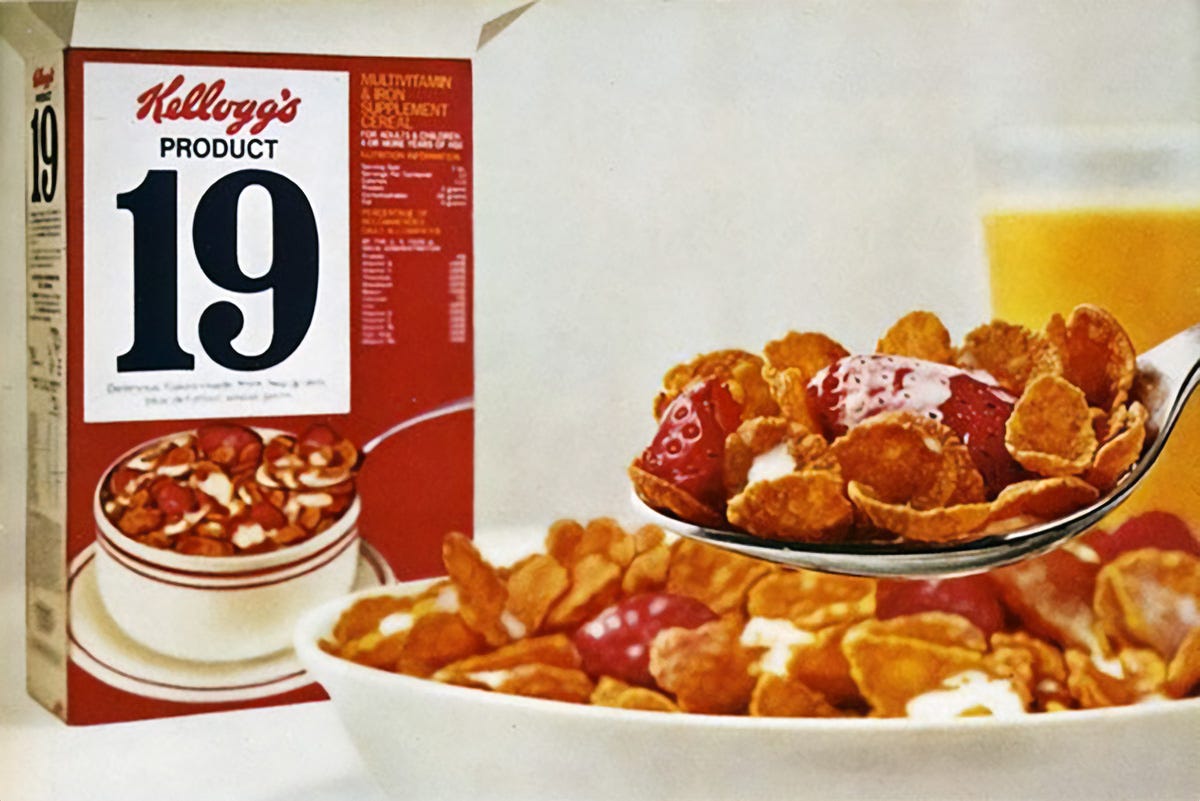
My grandmother loved Raisin Bran. That was the cereal she preferred, and if you were in her kitchen, that was the cereal she was going to offer you. But I knew there was a box of Product 19 somewhere in that kitchen, because I had seen it. I thought it tasted better than Raisin Bran and that meant breakfast usually turned into a small negotiation. How long could I hold out before she gave up on pushing the Raisin Bran and reached for the other box. Most mornings when I was with her, I won.
Why would I fight for it? Product 19 was not a fun cereal, exactly. But I liked the taste and to me it was a lot better than what I was being offered. Yes, the box looked serious, and the name made it sound more like something from a lab than something you ate for breakfast. But that may have been part of the appeal.
Kellogg’s began rolling out Product 19 in the spring of 1966, starting along the Pacific Coast. A small press item in the Tacoma News Tribune that April described it as “crisp, bubbly flakes blended from 4 nutritious grains” and said the unusual name was “selected by Kellogg’s in keeping with the uniqueness of its newest ready-to-eat cereal.”
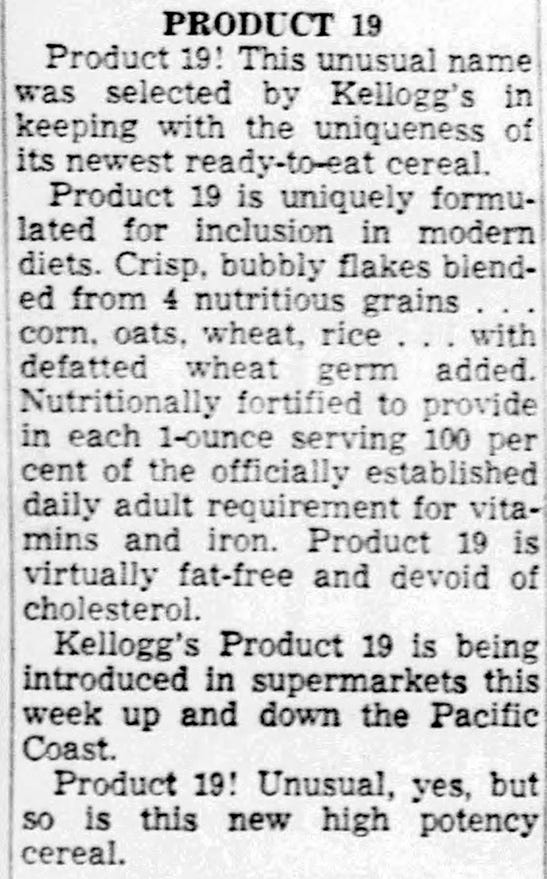
That was Kellogg’s public explanation, or at least the one that made it into newspapers, and it does not really explain much. The more familiar story is that Product 19 was the nineteenth product Kellogg’s had in development around that time. MrBreakfast gives that version, saying it was the nineteenth product Kellogg’s began developing in 1966. That date can’t be right since it was being sold early that year. Another version says it was the nineteenth formulation of the cereal itself before Kellogg’s landed on the one it wanted to sell.
I have not found Kellogg’s confirming any of those versions directly. What can be confirmed is that the company was already using the Product 19 name in commerce by March 15, 1966, and filed the trademark that May. So the name almost certainly came out of Kellogg’s development process, but the exact meaning remains a little fuzzy. For a cereal called Product 19, that seems about right. It sounded official, but somehow explained almost nothing.
What is not in dispute is why Kellogg’s built it. General Mills had launched Total in 1961, billing it as the first cereal to deliver 100% of the minimum daily vitamin requirements in a single serving. Their most famous advertising showed towers of competing cereal bowls stacked comically high, making the point that you would need an absurd number of the other guy’s product to match a single bowl of theirs.
Kellogg’s had Special K, but that was not quite the right answer to what Total was selling. So they started developing something that could go head to head with it. Product 19 was that something. Flakes made from corn, oats, wheat, and rice, fortified to deliver 100 percent of the officially established daily adult requirement for vitamins and iron in a single one ounce serving. The original slogan made the pitch very clear. “Instant Nutrition. New cereal food created especially for working mothers, otherwise busy mothers and everybody in a hurry.”
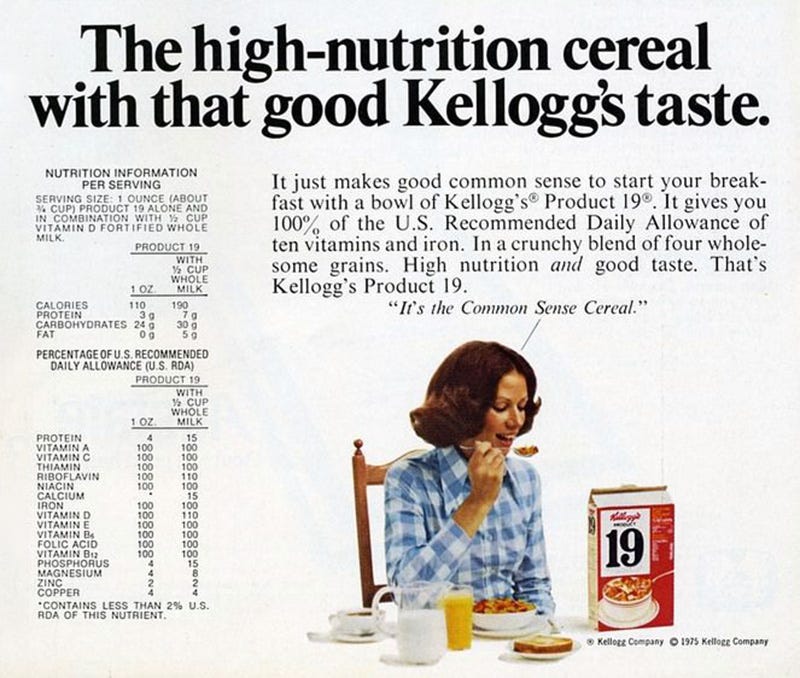
The cereal itself followed that same idea. It was not built around a cartoon animal or a prize in the box, and it was not trying very hard to make breakfast feel like a treat. Product 19 was selling usefulness. The early boxes and ads leaned into that, with charts, nutrition claims, and blocks of copy that made the whole thing feel almost medicinal. Red and white, plain, and very sure of itself. This was “the Common Sense Cereal.”
By early January 1967 you could find it at Safeway for 29 cents a box, bundled in a grocery circular alongside Lucerne milk and cottage cheese. No fanfare. Just there on the page the way sensible things are.
Then the summer of 1970 happened.
In July of that year, a consumer advocate named Robert Choate testified before the Senate Consumer Subcommittee and presented a nutritional ranking of 60 major breakfast cereals. Two thirds of the cereals he evaluated ranked below 100 on a scale that went to 700. Popular brands across the board landed in that lower tier. He told the committee that many of them “fatten but do little to prevent malnutrition.” Ranked best were General Mills’ Total and Kellogg’s Product 19.
Stores could not keep it on the shelf. In Portland, one grocery buyer told the local newspaper that Product 19 sales had jumped 50% on both 8 and 12-ounce sizes the week the story broke. He was moving 130 cases a week and could have sold more. Kellogg’s, he said, was struggling to keep up with production. He also mentioned, almost as an aside, that Product 19 “wasn’t a big seller before.” In Rochester, the Times-Union reported similar scenes. Entire store stocks gone in three hours.
It was a strange and very American moment. A cereal that had spent three or four years being overlooked became briefly famous because someone in Washington confirmed what it had been saying on the box all along. One store’s nutrition expert, quoted in the Portland coverage, offered a useful note of skepticism amid the excitement. The actual nutritional value of cereal, he said, “consists of what is put into it by the diner, such as cream, or bananas, or strawberries.” He was not wrong. But the rush was already on.
The advertising Kellogg’s ran through those years leaned on credibility rather than personality. The first commercials in 1967 featured Peter Marshall, then the host of Hollywood Squares, jogging around a large cereal box in grey sweats. Earnest and a little stiff, but it set a tone. By the early 1970s they had found a better fit in Tom Harmon. Harmon won the Heisman Trophy in 1940 at the University of Michigan, flew combat missions in World War II, and was a well-known sports broadcaster by the time Kellogg’s put him in front of a camera for Product 19. He was in his fifties during the campaign and still looked the part. He presented the cereal as part of how he stayed active, which was exactly the kind of pitch that worked on a certain kind of adult in the early 1970s.
A 1972 commercial brought in Tom’s son Mark, then quarterbacking at UCLA, for what was reportedly one of his first television appearances. Father and son, a bowl of cereal between them. Mark Harmon eventually spent twenty years on NCIS. It is one of the stranger footnotes in Product 19’s history.
By 1977 the advertising had moved toward something more suburban and lightly comic. The “Vitamins that taste too good to forget” campaign was warmer than anything involving the Harmons. By 1983, print ads running in papers across the country were calling it “the new Kellogg’s Product 19,” describing it as “flaky, bumpy, crispy, crunchy vitamins,” which is actually a pretty good description if you ever ate the stuff. The word “new” suggested a reformulation somewhere along the way, though Kellogg’s was never specific about what changed.
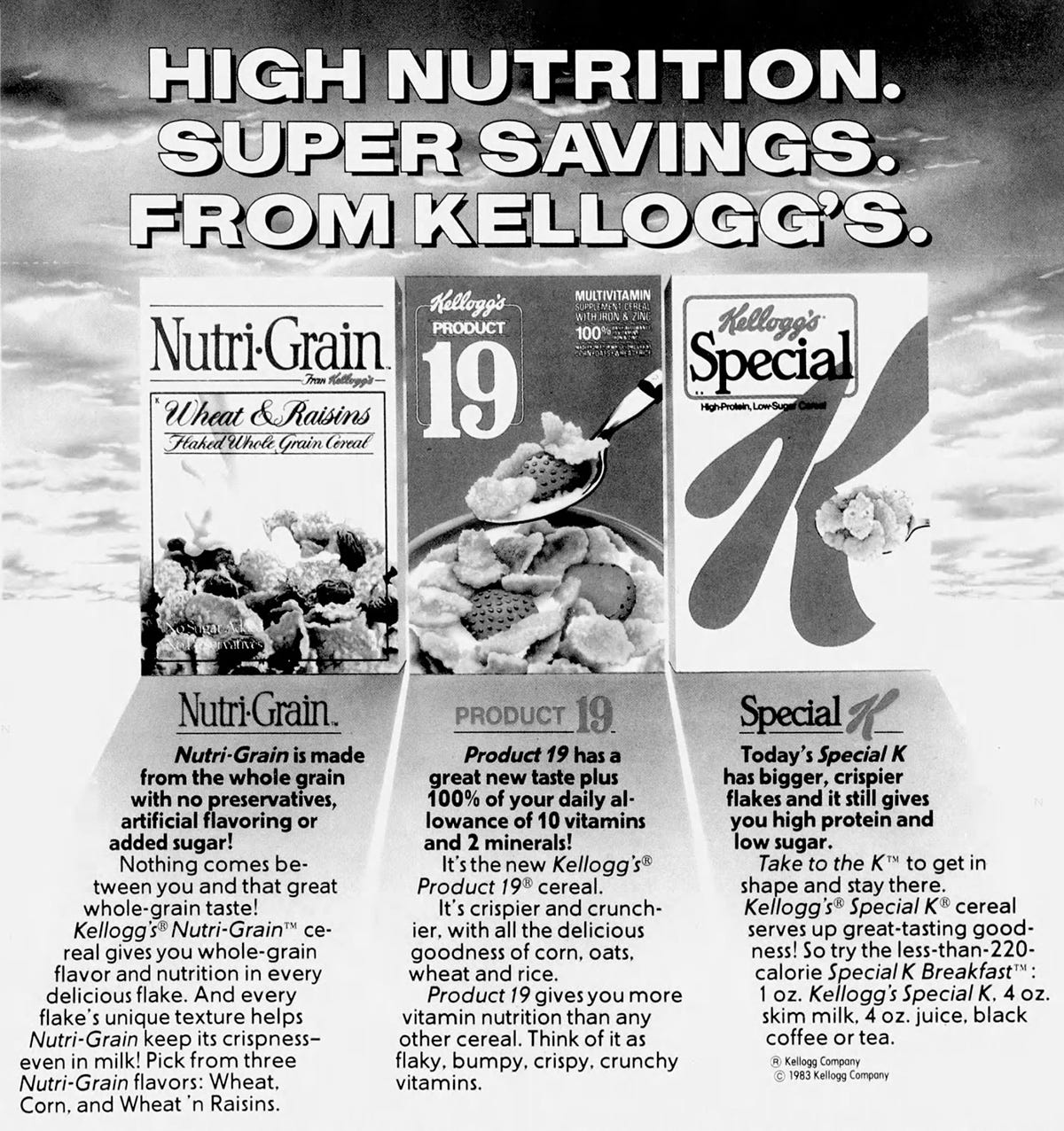
Through all of it, the box stayed red and white and Product 19 never really tried to become something else. Kellogg’s could adjust the pitch around it, but the cereal kept the same basic personality. It was plain, serious, and useful, which was not the worst place for a breakfast cereal to be. Not every cereal needed a mascot or a gimmick. Product 19 seemed perfectly fine being Product 19.
When Kellogg Canada launched Product 19 in January 1972, it did so quietly at first. A notice in The Globe and Mail reported that advertising would not begin until mid February, so the company could give stores time to get the cereal on shelves. Kellogg also had a small advantage going in. Research before the launch found that many Canadian consumers already knew the name, thanks to American advertising that had drifted north. The Canadian campaign was handled by Leo Burnett Co. of Canada, part of the same agency network long tied to Kellogg. That connection gives the launch a nice footnote. Years later, a future Kellogg CEO told the Battle Creek Enquirer that his first brand assignment at Leo Burnett had been Product 19.
The decline of the brand came slowly enough that it almost did not register as a decline. By the 2010s, Kellogg’s had quietly pulled back distribution. In 2014, a fan posted on the company’s official product forums pleading that the cereal not be pulled. A company representative responded that Product 19 had moved to limited distribution. Facebook groups with names like “Bring Back Kellogg’s Product 19” appeared around the same time. People posted photos of the last boxes they found in stores, the way you photograph something you sense you will not see again.
In November 2016, Kellogg’s made it official. The statement read in part, “We are sorry to announce that Kellogg’s Product 19 cereal has been discontinued. Unfortunately, sales of this cereal were not strong enough to support continued production.” Nearly fifty years on shelves. The comments on MrBreakfast.com filled in steadily after that. One person wrote that his mother had always called it “19s.” Another said Kellogg’s did not need twenty-five flavors of Special K. It needed Product 19. Someone else had been eating it for twenty years and had gotten their granddaughter hooked on it too.
Total, the cereal Product 19 spent nearly five decades chasing, is still on shelves.
My grandmother is gone now and Product 19 is gone too, so I suppose it makes sense that those mornings come back to me more often than I would have expected. She liked Raisin Bran and usually tried to steer me toward it. I knew there was another box in the kitchen, and most mornings, I held out for that one instead. Product 19 was not a cereal anyone was supposed to get sentimental about. It had no mascot, no prize, and not much of a personality beyond the strange name on the box. But it tasted good to me. I remember getting the bowl I wanted. I remember being happy with it in front of me.
That was one of my favorite cereals. Raisin Bran got soggy too fast.