


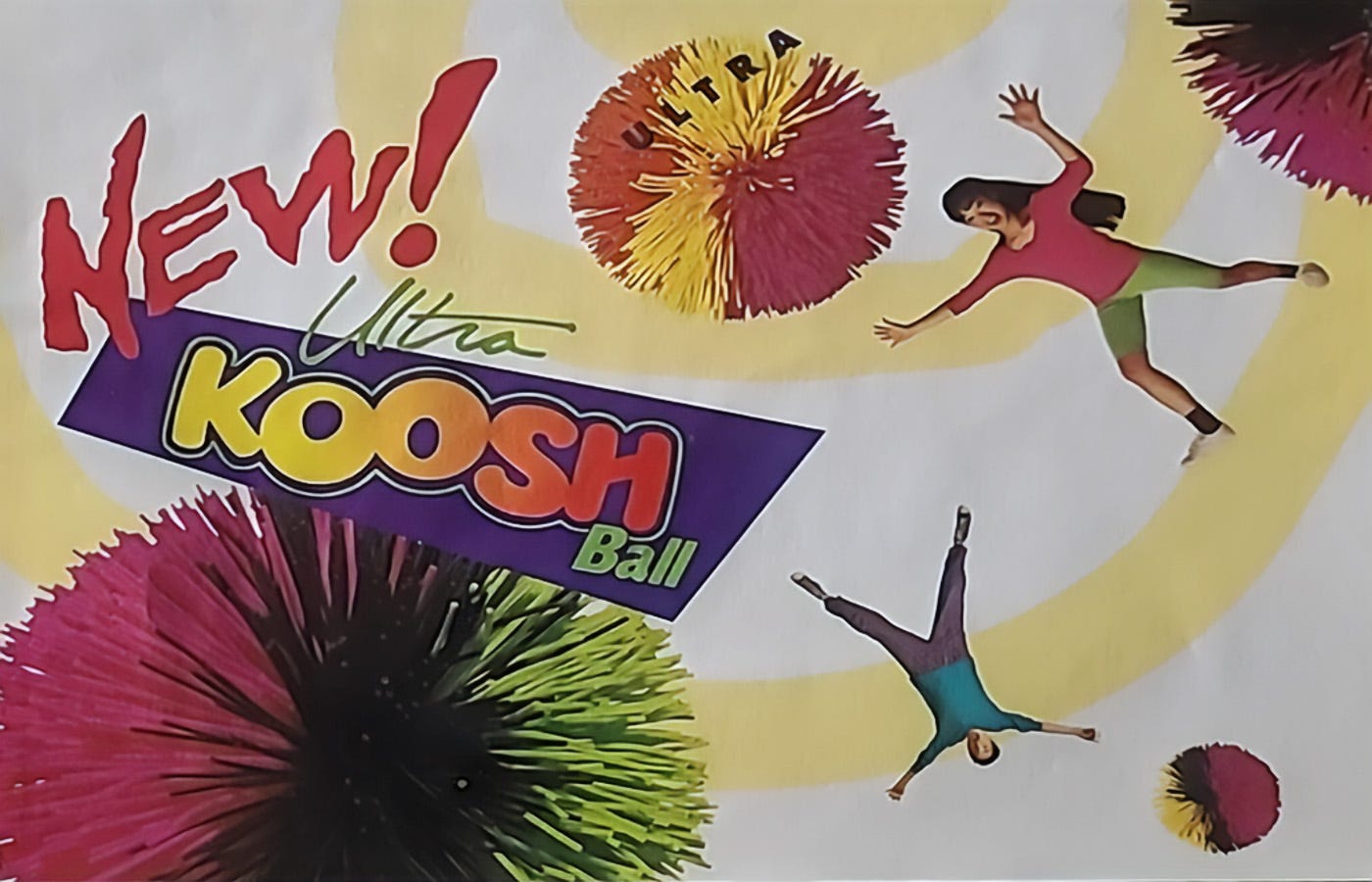
Every year after Christmas, my friends and I would visit one another to see what we had gotten. It was a fun time, but I can’t say I was ever surprised much. Sure, sometimes an amazing toy that someone didn’t expect to get would be under the tree, but rarely did a toy show up that was a complete puzzler. In December of 1987, I went over to my friend’s house to see what he had gotten. I cannot remember anything but the thing he threw at my head as soon as I entered his family’s living room, a Koosh Ball. It was weird looking and fun to play with, but it was also something that felt all new, a toy that none of us had ever seen before, but that would change very quickly.
If you haven’t seen a Koosh Ball before, let me describe it to you. It’s a peculiar and delightful toy that consists of thousands of thin, colorful rubber filaments. They are like tiny tentacles that radiate outward from a central core in every direction. The strands are soft and flexible, giving the ball a fuzzy, almost hair like appearance that makes it look like a whimsical sea creature or a pom pom. When you squeeze it, the rubbery tendrils compress easily in your hand, and when you throw it, those same filaments create air resistance that gives it an unpredictable, bouncy flight path. I remember being more confused than impressed at first, because it did not look like a toy that was supposed to work. It looked like something unfinished, like a prototype that escaped the lab.
Most importantly, when you threw the Koosh Ball at someone, it was both easy to catch and, if you hit them with it, it didn’t really hurt much. This was something my friend bragged about, and despite having many other toys to show off, we spent most of our time together that day trying to hurt each other with this brand new toy. I knew then that I needed to own one, but I was curious why I had never seen one before and neither had my friend. It turns out that this particular toy was sent to him by his aunt, who had just moved to California. I didn’t know it at the time, but its presence there and not in New Jersey made total sense.
They got their start out in the heart of Silicon Valley. There, an engineer named Scott Stillinger, who was working at a computer company, had a problem. He had two young kids and he wanted to teach them to catch, but he wanted to do it in a safe way. So, according to an article by the Scripps Howard News Service, he started to experiment. “Foam balls bounced out of your hands and bean bags were too heavy, kids were scared of being hit by them.” Exhausting the classics, he started playing around with new materials and forms and hit upon the concept of the rubber filament ball. It worked exactly as he hoped, but he also saw its potential to help other people learn to catch safely.
In an interesting twist, Stillinger’s brother in law, Mark Button, was an executive at the Mattel toy company. There he had worked on “such top selling items as Barbie and Hot Wheels.” He also saw the promise of what would come to be known as the Koosh Ball. Together, the two founded OddzOn Products to properly manufacture and distribute this creation. They did some market research and things looked good. Positive enough that, according to Stillinger, “We both quit our jobs on the same day and set out to develop it.”
In October of that year, they started selling the toy at a Los Gatos, California toy store. The results were phenomenal, with the toys flying off shelves. So they expanded to other stores. Button said at the time, “It really sells itself. If you just give people the opportunity to pick it up, they want one.” This is very true. The Koosh Ball shape is so unusual and compelling, you can’t help but want to play with it. It’s amazing that it might have been this very Los Gatos toy store that sold the toy that eventually made its way to New Jersey.
A year later, in 1988, the Koosh Ball was a nationwide smash success. It was available at over 10,000 retail locations, where it was often the best selling toy. I observed it appearing everywhere, but didn’t realize it was becoming such a massive success. The manufacturing process at the time was kept a secret (at the time), but demand had grown so much that they already had 75 employees and plans for expansion. These included new products and an international strategy that would start in 18 countries in 1989. The product list would eventually grow to include 50 other Koosh related items, including the popular Koosh Kins and their follow up, the Koosh Lings.
Koosh Kins and Koosh Lings were related but distinct attempts to turn the Koosh Ball into something more character driven. Koosh Kins came first in the early nineteen nineties and stayed close to the original toy, essentially standard Koosh Balls with faces and small hands added. They were released as a group of characters and were supported by a short Archie Comics miniseries and coloring books that gave them a shared backstory and setting. The emphasis was on world building and identity, with the toys meant to represent specific characters and extend the playability of Kooshes.
Koosh Lings arrived later in the decade and reflected a shift in how character toys were being marketed. While they still used the Koosh texture, they leaned more toward small action figures, with fuller faces, more detailed expressions, and bendable limbs that allowed for posing. They were less tied to a single narrative and more focused on variety and play patterns, often released in themed waves with different looks and personalities. Koosh Kins were about extending the original Koosh idea into a story and cast, while Koosh Lings treated the Koosh material as just one element in a broader, more conventional character toy line. The Koosh Kin remained a ball toy, while the Koosh Ling made more of a jump into figure territory. They were clearly trying to solve a problem that did not exist yet, how do you make a hit toy feel new again without breaking the thing people liked in the first place.
In the mid nineties, Koosh products started showing up as cereal premiums, which felt like a sign that they were everywhere. Honeycomb ran a promotion where you could use Honeybuck coupons from marked boxes to send away for assorted Koosh items. My favorite was from Cinnamon Toast Crunch, which offered a glow in the dark Koosh Ball. I never actually sent away for one, which is probably why I still remember it.
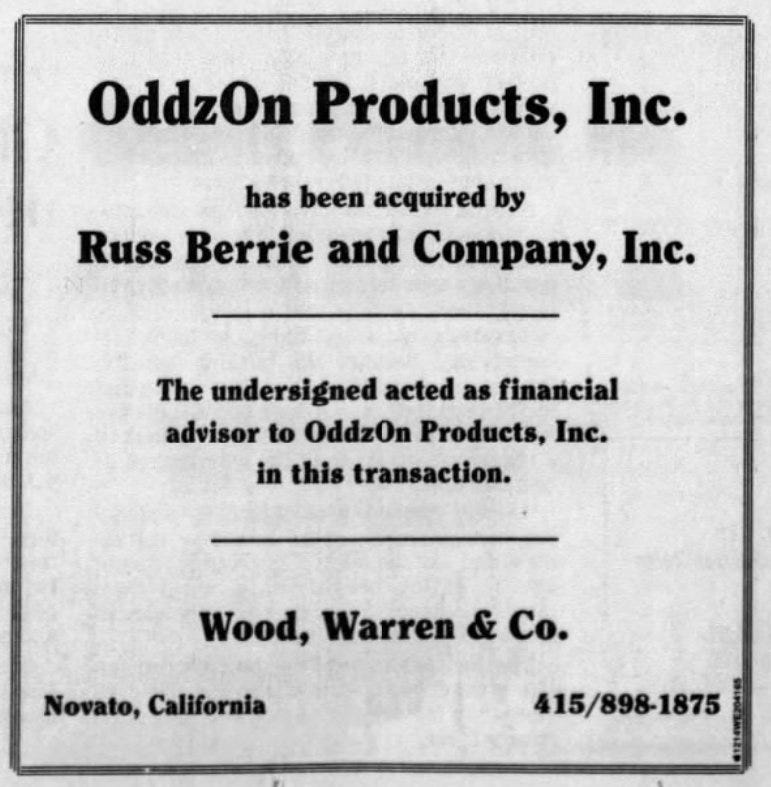
The company itself would eventually be acquired by Russ Berrie and Co. in December 1994 in an attempt to diversify their offerings. The amount paid wasn’t disclosed, but OddzOn at the time was netting about $30 million annually. As a side note, I think Russ Berrie has made some of the finest teddy bears, and I still own several. Koosh wasn’t in that company’s paws for very long because, according to a timeline published in 2003, OddzOn was sold, along with Cap Toys, to Hasbro for $166 million. This didn’t surprise me since Hasbro seems to have a hand in most every toy nowadays.
Nowadays, Koosh Balls are made by the company PlayMonster, formerly Patch, in cooperation with Hasbro. They might not have the selection of products that were available in the late eighties and early nineties, but you can still find a good number of balls and playsets if you want to relive some Koosh memories or introduce another generation to this toy.
The Koosh Ball is one of those toys that seemed to show up already knowing what it wanted to be. It wasn’t built around a character or a screen tie in, it was just a clever solution that happened to be fun. You didn’t need to read anything or figure anything out. You grabbed it and started throwing it. That straightforward design helped it move quickly from a single store in California to living rooms everywhere, including mine, where it mostly became an excuse to test how hard you could hit someone without getting in trouble. A lot of late eighties toys chased complexity, but Koosh stuck with simplicity, and that may be why it still looks inviting decades later.
I feel like these got to the point where everyone had at least one laying around the house somewhere. Hanging out with friends? Eventually someone was tossing one around. Going to your aunts house? There'd be one in the coffee table.
"..a short Archie Comics miniseries and coloring books that gave them a shared backstory and setting...."
For some reason, comic book makers and animators seemed to do this with a lot of toys at that time. And having kids hanging out with a gang of inanimate objects suddenly seemed normal...