


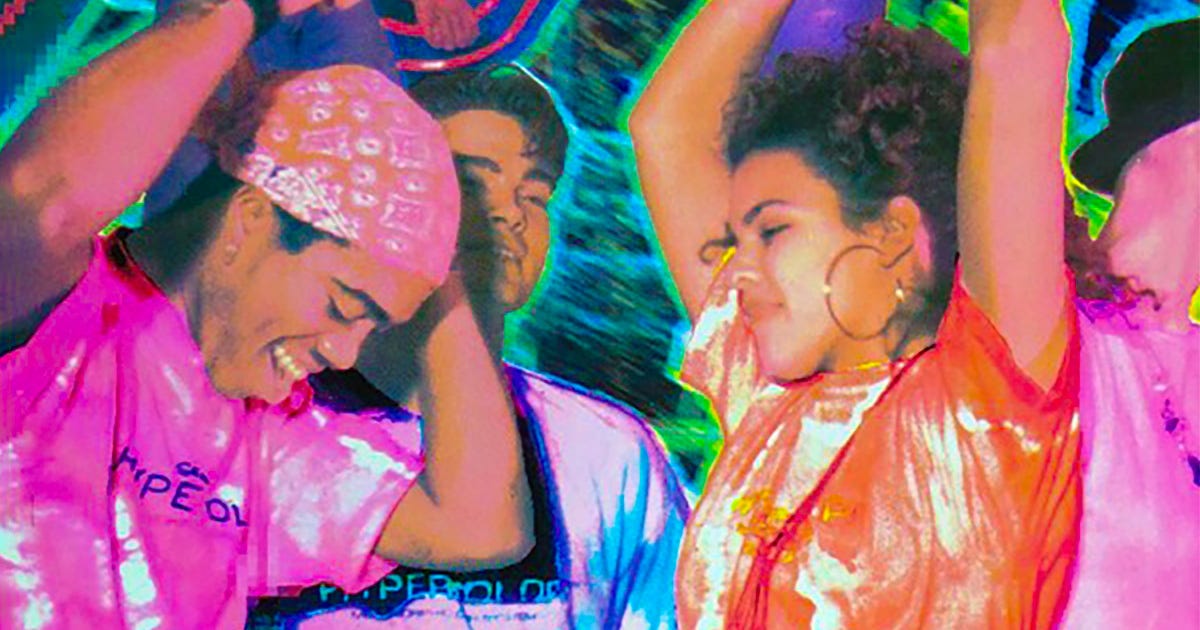
I remember seeing Hypercolor shirts down at the Jersey shore the summer they came out. Like a lot of people, I wanted one. By the time I actually got a shirt that Christmas, a few months later, the trend was already fading. I might not have been timely, but I didn’t care. Watching the color spread out under my own hand still felt like something out of the future. It turns out that I wasn’t alone in being late to the party with Hypercolor. These shirts only had about a year of shelf life in their original form. But like many other products that were short-lived, they never really disappeared. They just changed into something else.
Hypercolor got its start in Seattle at a company called Generra Sportswear. Generra was founded in 1980 by former executives from Brittania Sportswear. That company that had turned Seattle into the country’s jeans capital during the 1970s, but is hardly talked about today. Generra had that company’s expertise and grew quickly expanding rapidly in the early 80s before being sold in 1984 to a Texas company. Five years later it would be back in the hands of its original management team and looking for a breakthrough product which they found in Hypercolor.
The color changing technology behind Hypercolor came from Matsui Shikiso Chemical, a Japanese company based in Kyoto that had spent decades making inks and pigments for the textile printing industry. In the early 1980s Matsui developed a line of thermochromic paints and inks, meaning color that shifts with temperature. The technology was pretty durable. According to Miska, it worked on almost every color except darker shades like navy. The big issue was care. You couldn’t clean it in hot water, iron it (despite what you see in the commercials) or tumble it dry. All of those things could kill the effect for good.
Generra licensed the technology and began showing off a clothing dyed with the thermal sensitive pigment in January 1991. This release was backed by a marketing campaign that had already been running in MTV spots and teen magazines like Seventeen and Thrasher since late 1990.
The commercial shows how fun Hypercolor was going to be and how it worked. Anything that changed the temperature of the shirt would change its color. Which I think to most people at the time meant temporary handprints. Generra chairman Steve Miska was quoted in the press at the time saying that moms would be confused when dealing with Hypercolor. I doubt that any of this would be true, but it works as generation marketing. He said, “Kids understand, but imagine their moms. She remembers the kid’s shirt as blue, but then it comes out of the dryer and it’s white. She sets it aside and it turns blue again.”
One the ads started running, Generra couldn’t keep up with demand. They shipped 32,000 different Hypercolor garments in February of 1991. The next month they shipped another 274,000. The hype was so great that stores around the country were pre-selling the clothing. This results in them being sold out before other customers had the opportunity to get their hands on them. The company had projected that they would sell $20 million worth of clothing for the entire year. By May of 1991 they had sold $50 million with t-shirts making up 80% of sales.
While this was a runaway success, on thing Generra couldn’t escape was the cost of the dye. This was a sophisticated product compared to normal non-technical clothing. Dye alone was $16 million a year.
How much did Hypercolor clothing cost? A basic Hypercolor T shirt ran about $24, with tank tops closer to $15, jeans around $54 and shorts around $34. This sounds pretty reasonable for clothing that was extremely popular, but for clothing that was so fragile, it felt like you were paying for something that was at best temporary. It was one of the reasons my mom didn’t want me to get one. She knew how rough I was on my clothing and the idea that I would properly take care of a shirt that wasn’t super easy to wash seemed ridiculous to her. Of course, she was right.
While marketing certainly contributed to the success of the brand, they were also being featured on TV and it was hard to escape seeing them anywhere young people were. At schools, the interactive nature of the cloth made them a walking advertisement. Those first few days when someone wore them to school, everyone wanted to touch the fabric and see it in action. Some schools even banned the shirts because of this. Not because they were a distraction, but because they invited unwanted or aggressive touching. Despite that, Hypercolor sales weren’t slowing.
Generra couldn’t keep up with demand. They hired more staff and added more production capacity to try and keep up. They even set up a subsidiary Generra Production Corp just to manufacture its Hypercolor and Hypergrafix lines. Despite these changes they could only make enough clothing for about half of what retailers wanted.
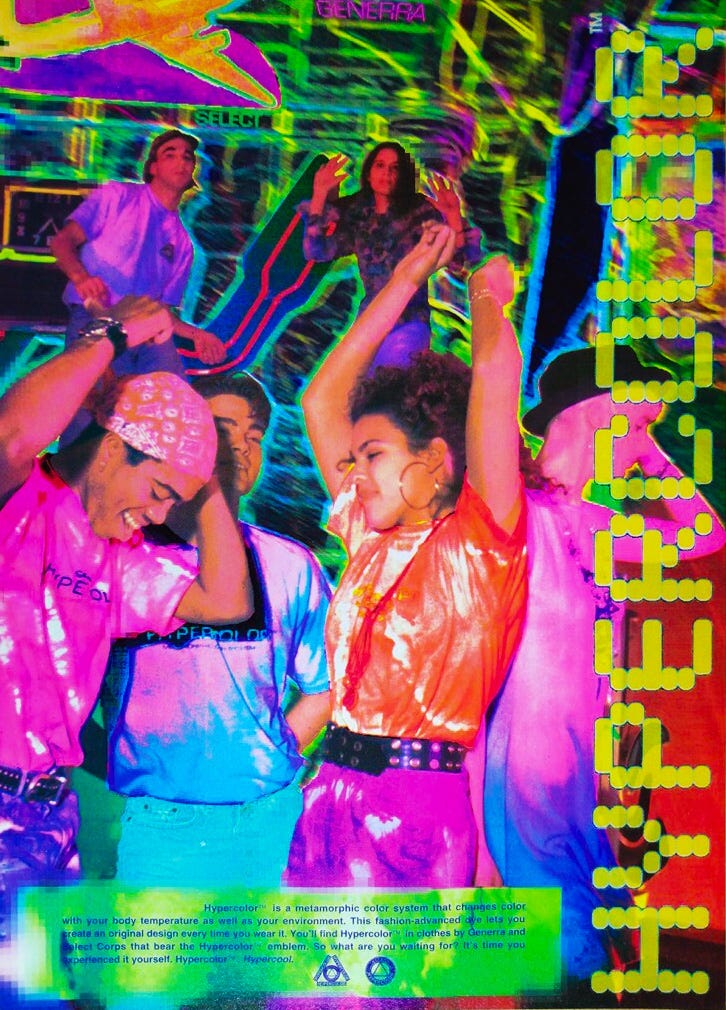
As demand raged on, Generra kept expanding, but by the 1992 the apparel industry was struggling. Licensed sports clothing was hot stuff and chains like the Gap was pushing new casual looks for young people. The companies junior and girl’s clothing line which had been doing well, crashed. It was being described as too “fashion forward” when the rest of the industry was moving towards simplicity. In July of 1992, Generra Sportswear filed for Chapter 11 bankruptcy protection. They owed more than $60 million and shut down their juniors and girls divisions. At this point they started selling undyed cloths as part of their new LOH label, which stood for leftover Hypercolor. It not that Hypercolor wasn’t selling well. The problem was, it was one of the only things that was still selling at all and it wasn’t enough.
The company started to downsize and by the mid-nineties, less than a dozen employees were left. They did this by giving up on making their own cloths and instead licensed the brand to others.
“We tried to make too much product available in too short a period of time,” Miska admitted. If he could do it over again, he said, he would have limited distribution on purpose, since he believed it “would have done a lot to prolong the life of the product.”
One brand they wouldn’t be managing domestically was Hypercolor. In 1993 they sold that part of the business to the The Seattle T-Shirt Company. They did retain the international rights which they would sell under the name Global Hypercolor. After that the company would be sold and the Generra brand still exists today, but they do not put out Hypercolor or anything else. My thought is maybe the name is being kept alive for possible future use. The trademark is currently held by Exude LLC, but nothing in the Hypercolor line has been released in years.
That doesn’t mean that color-changing clothing went away. Over in the UK, Global Hypercolor seemed have found life in the rave music scene. There, crowds of dancers provided plenty of heat to keep those colors changing. By 2008, designers including Anzevino and Florence and Henry Holland tried using it, while American Apparel sold their own version and Puma even released sneakers that changed color. The original craze may have lasted only from 1991 into 1992, but the basic idea has continued turning up in new forms ever since.
None of these new uses would ever match the mania that ran wild for a little over a year in the early nineties. My own shirt showed up a little late in the original short story of Hypercolor. Amazingly after just a few months, it was already past its cultural peak. But for a kid who wanted one all summer at the Jersey shore, it didn’t feel like a futuristic fad running out of steam. I still felt like I was getting a small piece of the future, just a few months behind schedule.