

The History of McPizza and McDonald’s Pizza
McDonald’s tried to make pizza fit the drive through and found out it wasn't so simple

I grew up in New Jersey, which means I grew up in pizza country. Every town had its place and in my town we had five, sometimes six. Every family had their spot. The idea of getting pizza from McDonald’s was not acceptable, like buying a hot dog at a French restaurant. Living in a pizza paradise, I rebelled and would try to go places like Pizza Hut or get Domino’s with my friends whenever I could. I am nut sure why. I think I just wanted to be plugged into the national pizza movement that everyone else was having. Even if the product was inferior. So when McDonald’s started testing pizza through the mid to late 1980s, I was aware of it and even wanted to try, but I never lived anywhere that had it. The nearest location was states away from me, and it stayed that way. That absence had a way of making me even more curious and decades later, I am still thinking about it.
This is the story of how the world’s largest fast food chain spent the better part of fifteen years trying to make pizza work, and why it mostly did not. By the early 1980s, McDonald’s had pretty much wrapped up the “Burger Wars” despite was advertising might make you think and was operating at a scale that is genuinely hard to comprehend. The chain controlled nearly 40 percent of the American burger market and was roughly twice the size of its nearest competitor. Chicken McNuggets had proven the company could move beyond burgers and Happy Meals were a massive success. They were even making inroads into breakfast. Wall Street analysts were bullish. But there was one persistent problem for the company, dinner.
McDonald’s customers were not coming in to eat it. Burgers were a lunch proposition, something grabbed on the go. When families sat down together at night, they wanted a table, a slower pace, something that felt like a meal rather than a pit stop. McDonald’s had solved breakfast in 1973 with the Egg McMuffin, a product critics dismissed until it became a phenomenon. The company was convinced the same logic applied to dinner. They just needed the right product.
But what product to choose? Pizza was the obvious answer. Through the 1980s, Pizza Hut and Domino’s were both growing at around 10 percent annually. Americans were eating more pizza than ever, and McDonald’s looked at those numbers and saw an opening. The company just needed to figure out how to make it work.
Some online sources claim McDonald’s experimented with pizza before its better documented tests of the late 1980s, including reports that personal pizzas were tried in Wisconsin in the late 1970s. But those details are difficult to verify, and I have not found contemporary reporting that clearly confirms them. Because of that, I would treat the story cautiously rather than as established fact (if you know of a source, please let me know). What can be said with confidence is that McDonald’s interest in pizza surfaced more clearly years later, when the idea entered a much better documented testing phase.
By 1984, trade publications were already noting that McDonald’s had developed something called a McPizza. It was being described as a pizza for one, though it had not yet reached test locations. USA Today mentioned it in October of that year alongside Chicken McNuggets as evidence that the company was serious about innovation beyond burgers.


What emerged in late summer of 1985 was something quite different from a traditional pizza. The product being quietly sold at about ten McDonald’s locations in the Philadelphia area was an oval, hand held pocket of dough, 3.5 ounces, filled with provolone and mozzarella cheese, ground beef, pepperoni, and pizza sauce. It sold for 99 cents. The Morning News in Wilmington, Delaware ran a front page item on it in September 1985, noting that the McDonald’s on Concord Pike north of Wilmington had a sign out front reading “First restaurant in country to serve McPizza,” while simultaneously being forbidden by corporate from advertising it anywhere else. The franchise owners, Les and Alan Dukart, wanted to put a billboard on the interstate. McDonald’s killed that idea immediately.
The product looked, as the Morning News put it, a bit like an egg roll. Others compared it to a cross between a calzone and a stromboli. McDonald’s own media relations head, Bob Kaiser, was careful with his language. “This is part of an operational test,” he said. “We want to make ourselves aware of our operational capabilities.” The company was not even calling it an official test product yet. They were watching to see if their kitchens could handle it.
They could, more or less. Inside sources told the Morning News that the McPizza had presented very few problems for staff and that the frozen product, fried several at a time, was not coming out greasy. The biggest customer complaint was that it was only available in one flavor. People wanted variety. The Dukarts, who owned five McDonald’s franchises in the Philadelphia area, were optimistic, and there was talk of rolling it to their other locations. Corporate wouldn’t confirm nor deny that plan.
By October 1985, the Associated Press was reporting on the pocket McPizza, confirming that McDonald’s was conducting operational tests in roughly 10 stores nationwide. The Indianapolis Star that same month was reporting that the company was trying the next level, individualized pizzas in a handful of East Coast restaurants. Corporate spokeswoman Lana Ehrsam told the paper, “People love pizza. It’s a very popular item right now.” But full consumer testing would be at least a year away.
The pocket McPizza was a first attempt, a product shaped to fit the McDonald’s system. You could eat it like an apple pie. You didn’t need a box, a table, special equipment, or the 10+ minutes it takes to bake a pizza. But as the mid 1980s became the late 1980s, it became clear that a hand held snack was not going to win dinner business away from Pizza Hut. If McDonald’s wanted to compete seriously, it needed to serve actual pizza.
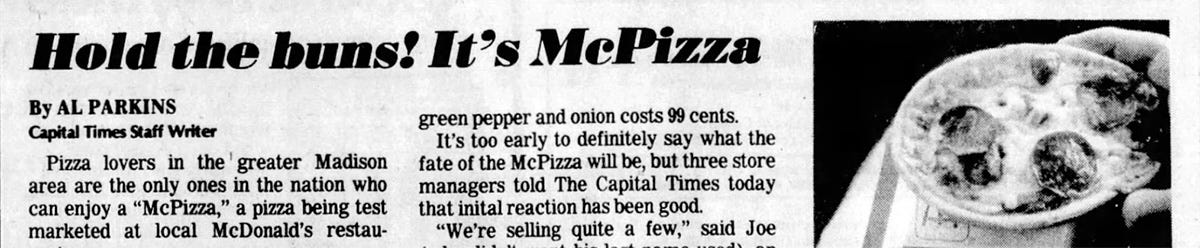
By February 1987, the Capital Times in Madison, Wisconsin reported that the chain had moved into full pizza testing at 24 locations across Madison, Wisconsin Dells, Baraboo, Sun Prairie, and Stoughton. This version was a recognizable pizza, arriving frozen at the store. A plain cheese pizza cost 89 cents. A pizza with pepperoni, sausage, green pepper, and onion cost 99 cents. Store managers were selling quite a few of them, and one manager noted the only real negative feedback was about the name. “Some people have commented that McPizza is just too cute,” he said.
That name, it turned out, would not stick much longer. By the time McDonald’s moved into its most ambitious phase of pizza development, the product, a round, 14 inch traditional pie, had been rebranded as McDonald’s Pizza.
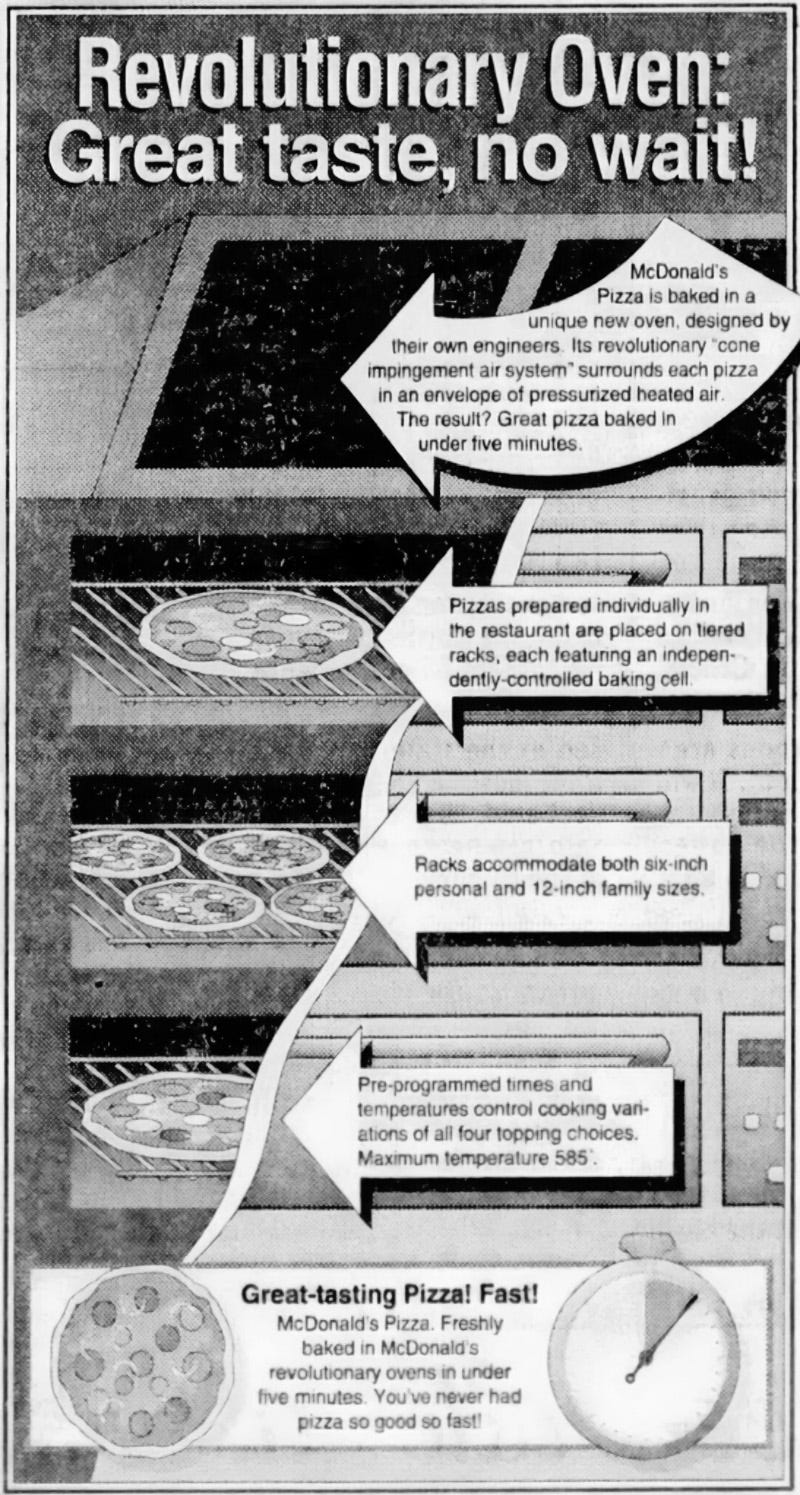
The company spent years developing a proprietary quick cook oven, which it eventually patented, capable of taking frozen dough to a finished pizza in under six minutes. The ovens worked, but they required significant kitchen renovation at each franchise. Drive through windows at many older locations were not wide enough to pass a pizza box through and had to be enlarged. McDonald’s planned to offer table service for family sized pies indoors, which meant training staff in a service model entirely unlike anything else on the menu. The whole operation was pulling against the grain of everything that had made McDonald’s successful.
A February 1988 item in The Daily Record in New Jersey, cited an analyst endorsements from the securities firm Donaldson, Lufkin and Jenrette, noting that McDonald’s was doing small scale testing pizza in Salt Lake City, Utah and Charleston, South Carolina. The goal, the piece noted, was to boost the chain’s “comparatively weak dinner sales, a part of the day McDonald’s considers its most underdeveloped.” The company had taken about seven years and sampled 145 different types of pepperoni before settling on a recipe it liked, a fact that appeared in a 1992 advertisement and said something about how seriously McDonald’s took this particular project.
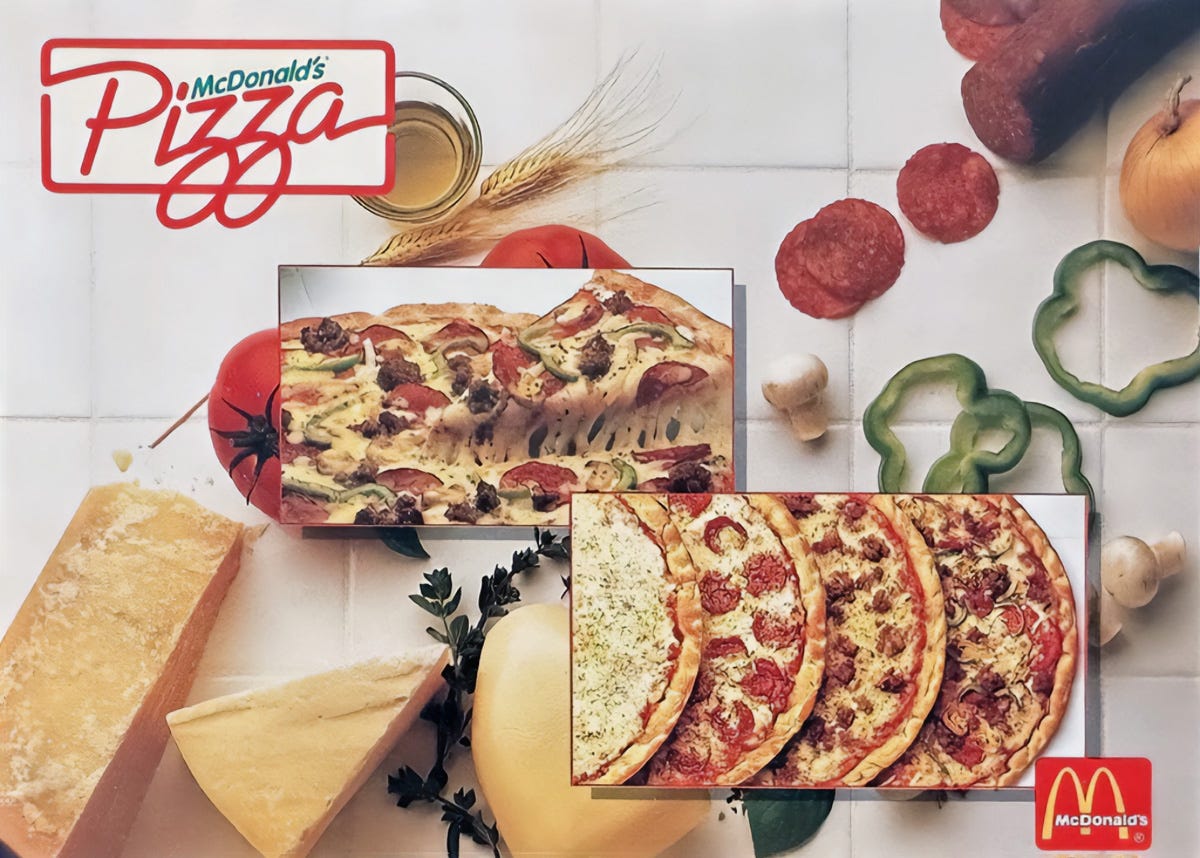
Full scale testing of the round pizza began in 1989 in and around Evansville, Indiana and Owensboro, Kentucky, with roughly 24 locations. The pizzas came in four varieties: Cheese, Pepperoni, Sausage, and Deluxe. They were made with crushed tomatoes, fresh garlic, basil, oregano, 100 percent mozzarella, and aged Romano and Parmesan. The advertising pushed hard on quality, promising pizza “made fresh and served hot from the oven.” A two for one deal was offered after 4 p.m.
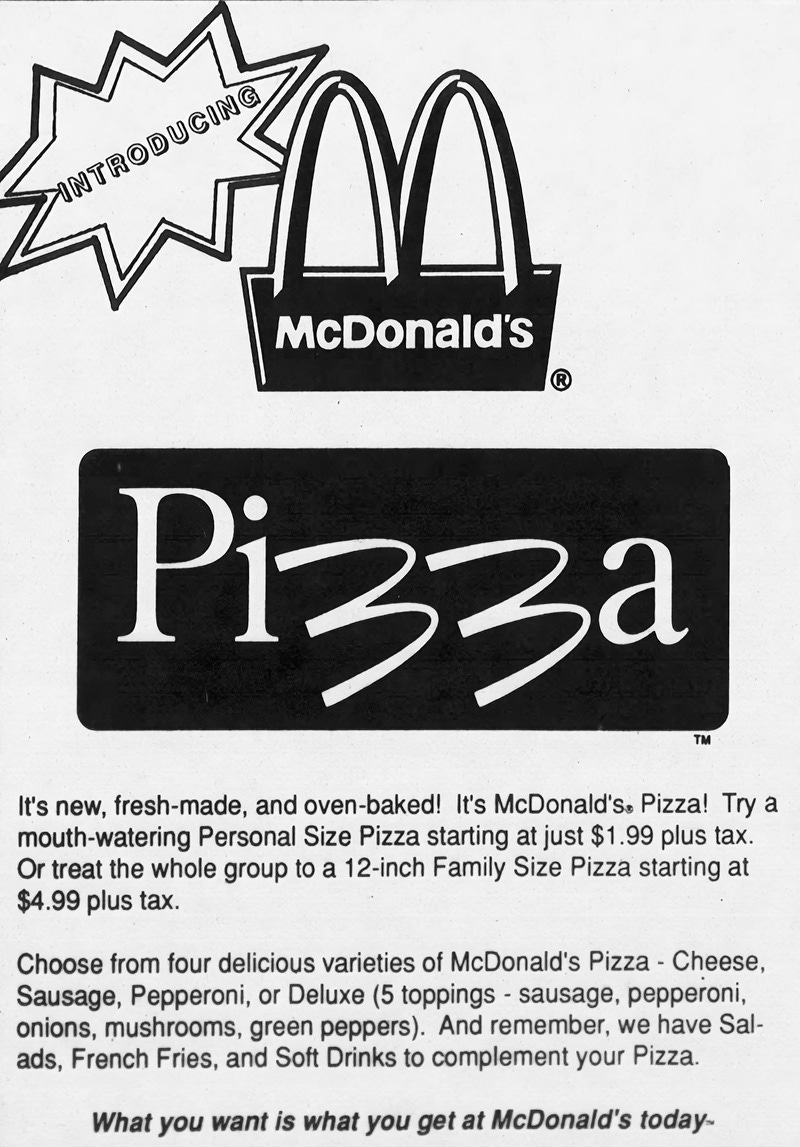
Pizza Hut did not take the threat lightly. Their response was swift and pointed. “Don’t make a McStake,” read one Pizza Hut advertisement in the Illinois market. The chain offered two for one deals and took public shots at what they called McDonald’s “McFrozen” dough. Ad man Jack Levy told the New York Times in 1989, “Every place you see a McDonald’s pizza, you’re going to see a war.”
By 1991, McDonald’s pizza had expanded to more than 500 locations across the United States. In Canada, the chain launched it around 1992, with Howie Mandel appearing in commercials. The Canadian version initially came as a full family sized pie, delivered to the table on a raised rack by a staff member, a genuinely unusual sight inside a McDonald’s. It later scaled down to personal size.
At its peak, some estimates put pizza in roughly 40 percent of American McDonald’s locations. The chain was also testing it internationally, with an 8 inch version in the United Kingdom available in cheese, pepperoni and cheese, and a deluxe variety.
For a moment, it seemed like it might actually work.
The problem was time. A pizza took roughly 11 minutes to prepare. That number became the defining fact of McDonald’s pizza’s existence, referenced in nearly every account of its rise and fall. In a restaurant built around the premise that food arrives in seconds, 11 minutes was not just slow, it was a philosophical contradiction. Customers ordering burgers would sit watching their food go cold while waiting for a friend’s pizza to finish baking. People ordering at the drive through were asked to pull forward and wait in the parking lot. The company’s own advertisements occasionally featured a customer reading a newspaper while waiting, which did not exactly help the pitch.
Speed was not the only issue. Pricing was also a problem. Pizza in the age of value meals didn’t always land well with customers who expected a more bargain-priced pizza. Their pizza wasn’t expensive, but it was more than customers had come to expect from a McDonald’s visit. It also put the chain in direct competition with dedicated pizza restaurants that had more experience, better ovens, and an established reputation.
McDonald’s Canada put it plainly in a 2012 response to a customer question posted on their website. “The preparation time was about 11 minutes, which was way too long for us. Every McDonald’s has a busy kitchen and the pizza slowed down our game. And since speed of service is a top priority and expected by our customers, we thought it best to remove this menu item.”
By the late 1990s, pizza had quietly disappeared from most American locations. Canada held on until about 1999. The experiment was over, officially if not entirely. with some exceptions.
Two McDonald’s locations kept serving pizza long after everyone else had stopped. The restaurants in Pomeroy, Ohio and Spencer, West Virginia were owned by the same franchisee, Greg Mills, and for roughly 15 years they remained the only places in the United States where you could still order a McDonald’s pizza. People drove considerable distances to do exactly that, sometimes from hundreds of miles away. One family who ate at the Pomeroy location told a local television station they came in every day, sometimes twice, because their young son refused to eat pizza anywhere else.
That ended on August 31, 2017. McDonald’s corporate issued a directive to streamline menus, and the pizza was removed. Mills posted a sign in the Pomeroy store that read in part: “Effective August 31st we will no longer be allowed to sell McPizza. This decision was made by McDonald’s Corporate office, Not your local staff. It was our Pleasure and Honor to be one of only two McDonalds in The USA to carry this Great product for the past 15 years.” The store’s last two pizzas sold to a couple who had flown in from Vancouver for the occasion. This was supposed to be the end of the story, but it’s not.
The World’s Largest McDonald’s sits on Sand Lake Road in Orlando, Florida, not far from the theme park corridor that makes Orlando one of the most visited places in the country. The building spans 19,000 square feet across multiple floors, with an arcade, a play area, and an open kitchen that contains something you will not find in any other McDonald’s in America, a wood fired pizza oven. The location, operated by franchisees Gregg and Dorothy Oerther, serves pizza year round, with multiple varieties including cheese, meat lover’s, and veggie lover’s. A reviewer from Tasting Table who visited in July 2025 described the cheese pizza’s crust as neither pan nor cracker style, a little floppy, with a fresh made sauce that carried a slight sweetness. Recent visitor accounts from early 2026 confirm the pizza is still very much available and selling well. The manager on duty told one visitor it sells in considerable volume every day.
The location draws visitors who are in town for Universal or Disney, but it also pulls in people who are specifically there for the pizza, which has developed its own category of devoted tourist. If you are going to Orlando and you have even a passing curiosity about what McDonald’s pizza tastes like, this is your only remaining opportunity to find out.
I still have not tried it. That feels like something I need to fix.
People driving hundreds of miles for McDonalds Pizza; I love it! I also love the graphic design where horizontal McDonald's Arches are used for Z's.
I remember when they launched this in Canada, and I thought, "What are they doing?" It just seemed like that generation of McDonald's executives wanted to control the entire fast food market by doing that. I wouldn't have been surprised if they had then added fried chicken to take out KFC, and/or upgraded the quality of their ice cream offerings to go after Dairy Queen (though the latter attempt would have been compromised by their notoriously malfunctioning ice cream makers).
The McDonald brothers did not serve pizza at the original McDonalds, nor did Ray Kroc insist on adding it when he franchised the chain around the world. Pizza is a "slow" food that takes time to be made well, and therefore it doesn't jell with the "fast" way McDonald's operates.
I think the company has learned since then to stay in its lane, with their major product upgrades focusing on things they were already serving and could be presented economically (e.g. coffee) and not things that would break the franchisee's banks. And thus, they remain in business, while Pizza Hut, which inspired the ill-conceived pizza venture, is no longer as popular as it once was...