

The Dune Board Game (1984)
Sandworms, spice, and one of the stranger licensed games of 1984

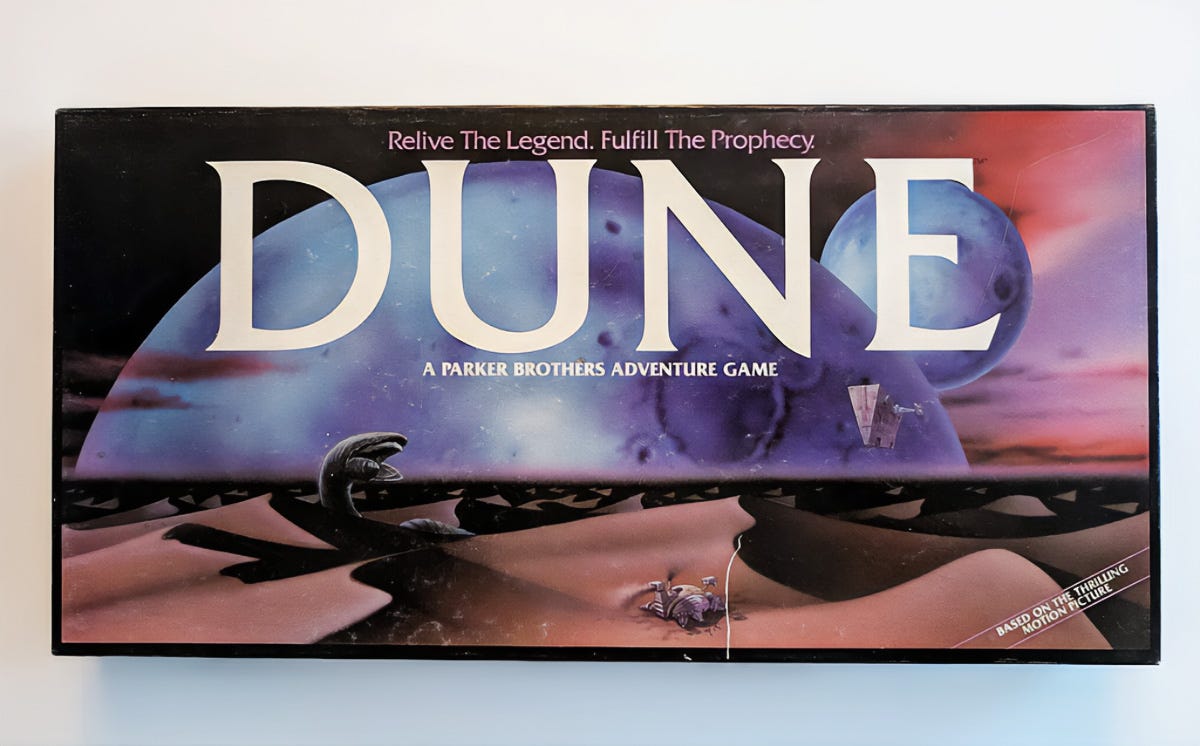
My friend got the Dune board game as a Christmas gift. He was extremely excited about it and called us all over to play. We managed to work out the rules well enough, but the game was a lot more special to him than it was for the rest of us. He had seen the movie and loved it. Most of us had not see it yet. Without that connection, the game was just a board game, and as board games go it was fine but not revelatory. I still thought about it for years afterward. Especially after having seen the movie myself on cable. So when I found a copy at a thrift store a few years ago for four dollars, I bought it.
The first thing worth knowing is that this game is frequently confused with another one. In 1979, Avalon Hill published a board game also called Dune, based on Frank Herbert’s novel. That is the one people usually mean when they call a Dune board game a classic. It was rereleased in 2019 by Gale Force Nine to considerable excitement. This is not that game. This game came out in 1984 from Parker Brothers, designed by Brad Stock, and it is tied entirely to David Lynch’s film adaptation. They share a name and a universe, and that is more or less where the overlap ends. The confusion persists across forums and comment sections to this day.
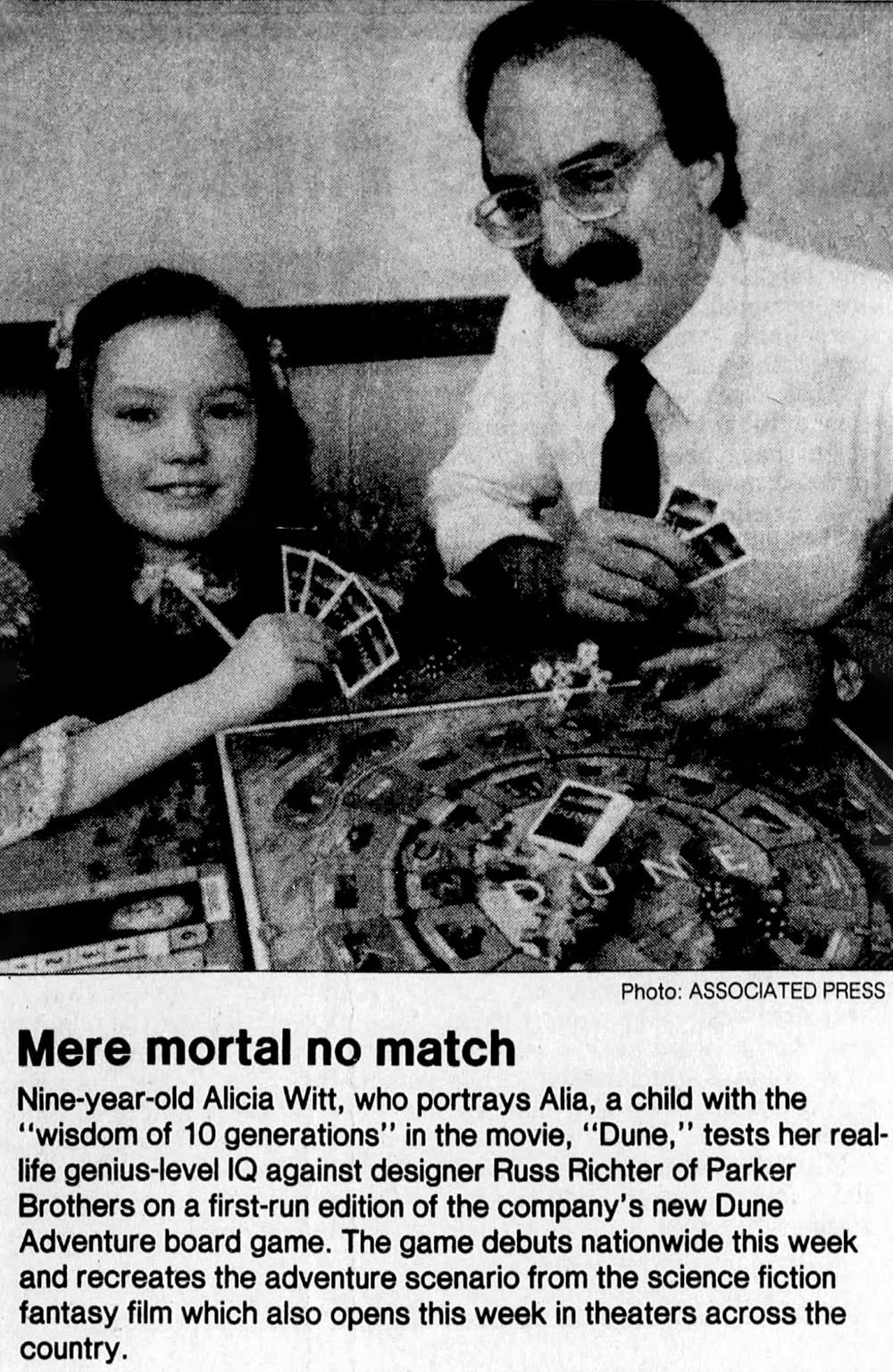
The film opened in December 1984 to mixed reviews. Made on a budget of over forty million dollars, it earned just over six million dollars in its opening weekend and was pulled from theaters after five weeks, with a total domestic gross of about twenty-seven million dollars. It premiered during the holiday season in direct competition with Beverly Hills Cop. Lynch has since said that not securing final cut was his biggest professional regret. The film eventually developed a cult following, but at the time, Dune merchandise was a bet on a movie the studio suspected was in trouble before it even opened.
What makes that merchandising bet stranger in retrospect is how aggressively Dune was positioned as a children’s property. LJN gave the film the full toy treatment, producing coloring books, bed sheets, and a line of action figures with battle-matic action features. There was a motorized Spice Scout vehicle and a poseable vinyl sandworm large enough to interact with the figures. The movie wasn’t exactly kid-friendly, and a lot Dune merchandise ended up in the clearance aisle.
Dune is a novel about things like political assassination, ecological devastation, and the danger of messianic mythology. It is not an obvious toy property. But 1984 was post-Star Wars, and any science fiction film with a cast that included Sting and giant worm monsters was going to get the full licensed merchandise treatment regardless of content.
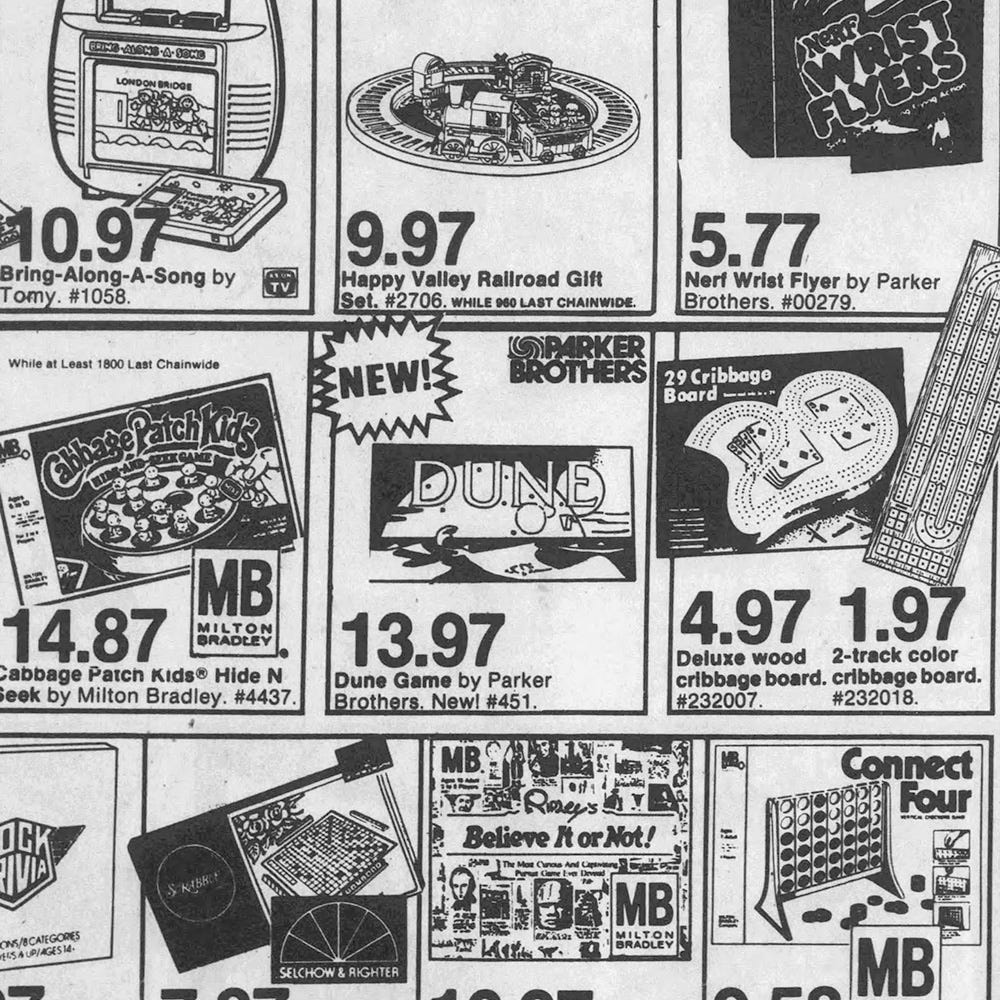
The Parker Brothers board game was part of that same wave. A Meijer store circular from December 10, 1984 shows it priced at $13.97, flagged as “New!” and sitting alongside other great games based on popular IP, like the Cabbage Patch Kids. Parker Brothers positioned the Dune game as holiday competition alongside some of the most sought-after children’s toy of the year.
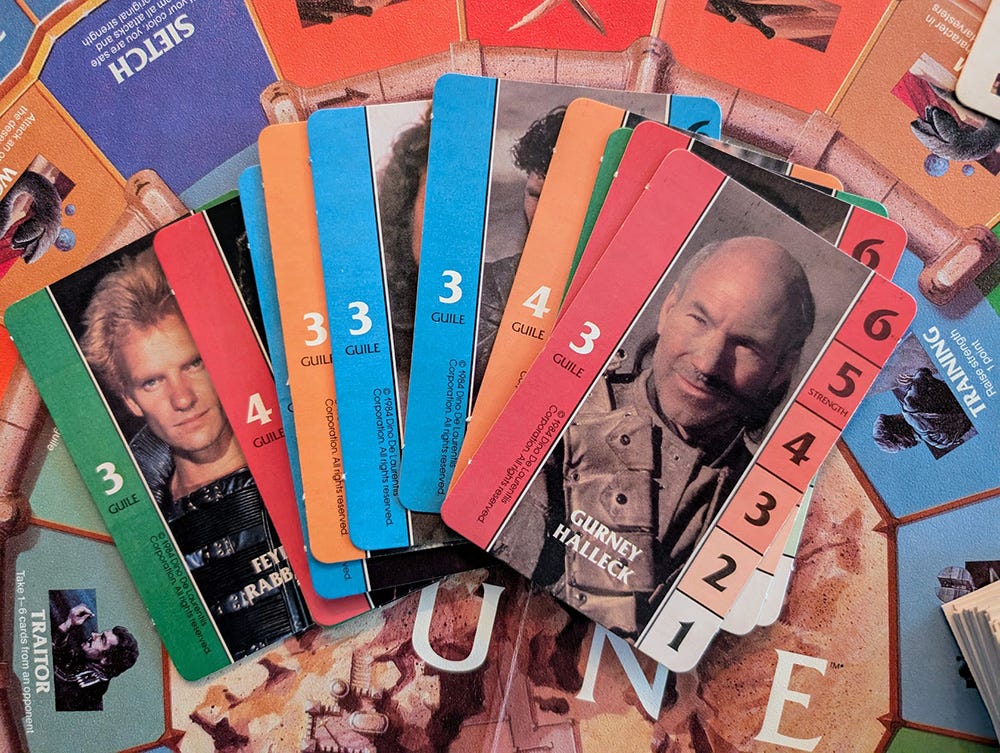
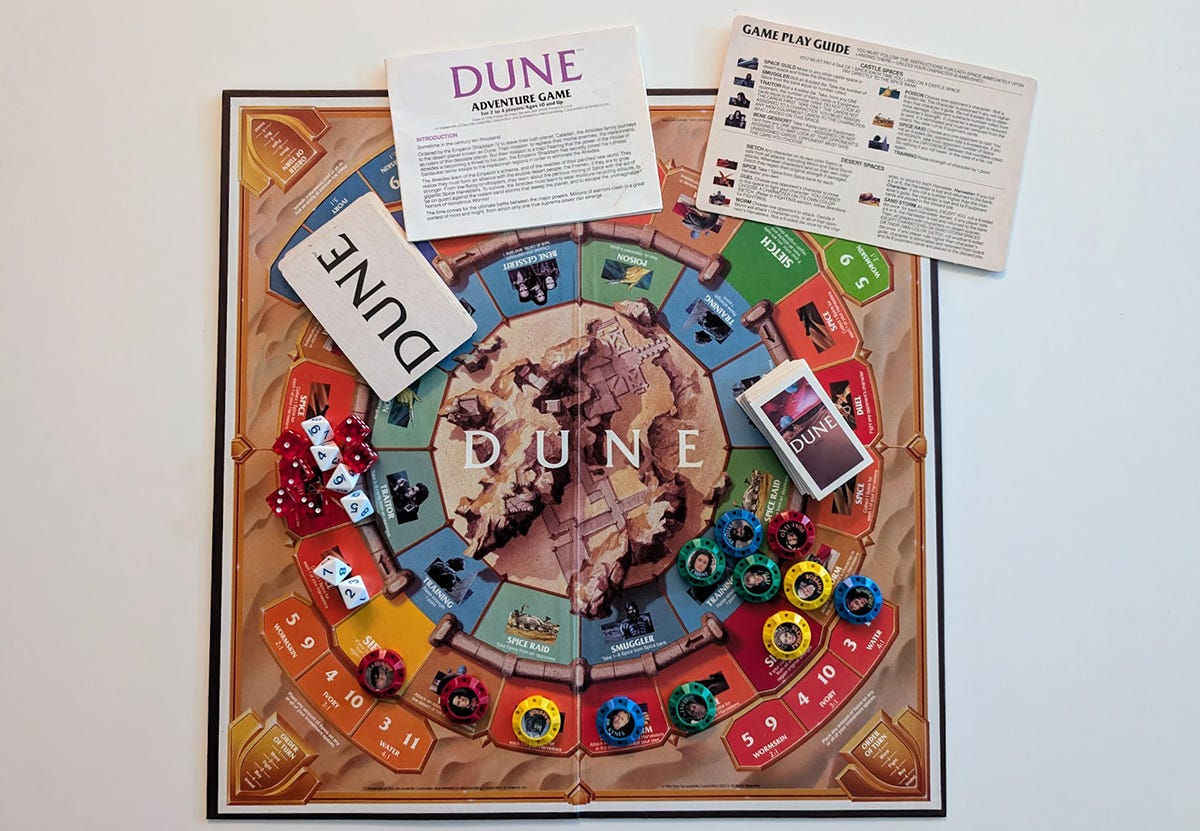
The game calls for two to four players, ages ten and up, and runs about ninety minutes. Each player controls a team of three characters drawn from the film. The four teams are the Atreides (Paul, Duke Leto, Gurney Halleck), the Fremen (Dr. Kynes, Stilgar, Chani), the Emperor’s faction (Shaddam IV, Princess Irulan, a Sardaukar Warrior), and the Harkonnen (Baron Harkonnen, Feyd-Rautha, Beast Rabban). Each character card carries a photograph of the actor who played the role in the film, and each character has individual strength and guile values tracked with a small clip that slides along the card. The goal is simple and blunt, eliminate everyone else’s team.
The board consists of two concentric rings. The outer represents the desert, with spaces for sandworms, duels, spice harvesting, sandstorms, and home bases. The inner represents the castle, where characters build strength and access different card resources. Players move between rings. On each turn, a player rolls two dice and decides how to distribute the result between characters, or apply the total to one. The decision of how to split a roll between characters who may be in very different positions on the board produces more options than the roll-and-move format suggests. A reviewer on BoardGameGeek noted that the board has 37 spaces, and that with reasonable positioning, players can often access a third of them on a given turn. You have to make pretty bad choices to run out of useful moves.
The component list includes 52 Kanly and Equipment cards, 70 red spice tokens (the same plastic pieces used in Risk, a fact noted plainly in the game’s own component documentation), 24 grey harvester tokens, and two sets of dice in different sizes and colors. Equipment cards include Swords, Shields, Poison, Lasgun, Stillsuit, Ornithopter, and Gom Jabbar. Kanly cards let you raid other players’ harvesters, dispatch a Hunter-Seeker, or plunder a Secret Silo. Players can also invest spice in a craps-like commodity market printed on the board that pays out when certain dice totals come up. It is a odd mechanic, and it gives the game flavor most licensed titles of the era completely lack.
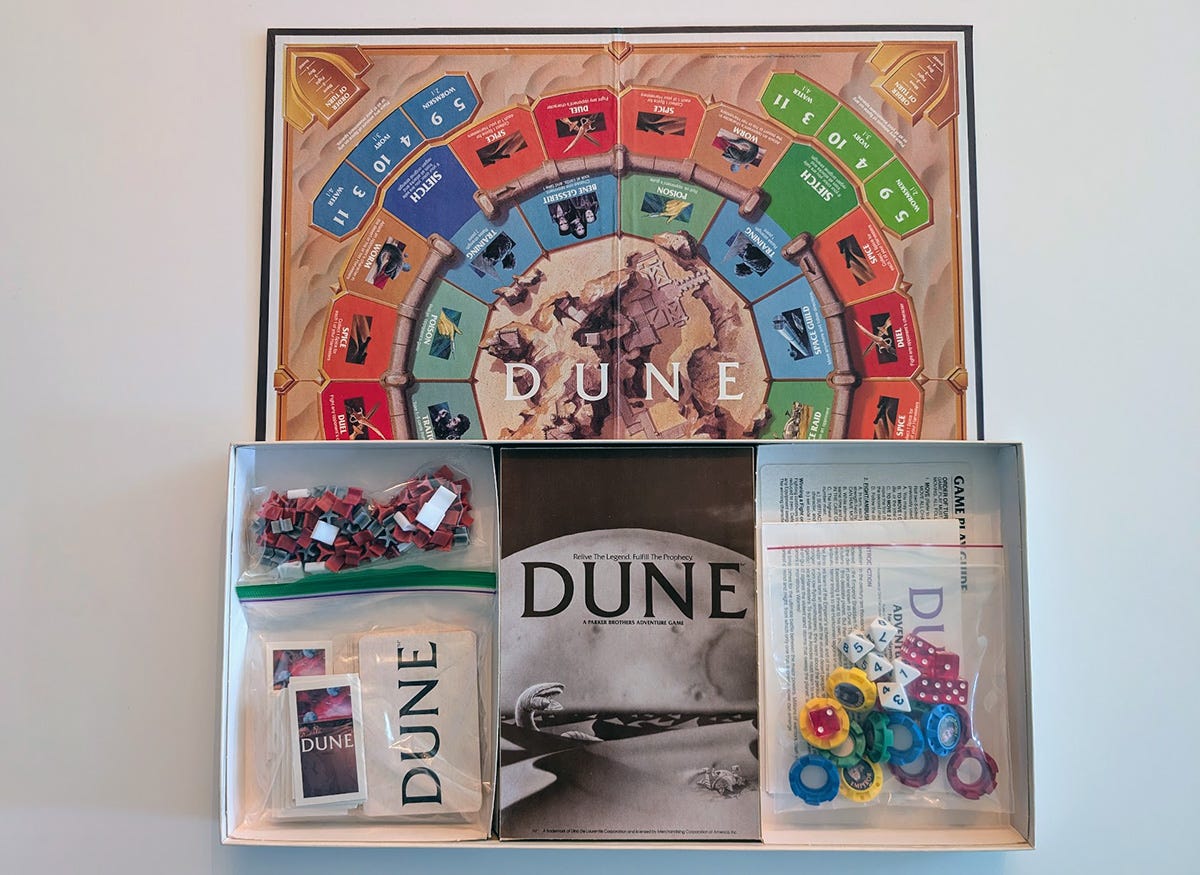
What the game does that was unusual for a mass market release of its time is give each player a team of three distinct characters with individual stats, rather than a single pawn. That is closer to wargame design than to Monopoly. Experienced players quickly discover that the game rewards knowing the fiction. A character in the desert without a Stillsuit card is vulnerable to sandstorm and worm attacks that a protected character shrugs off. Poison cards can eliminate someone from across the board. Novice players can run into trouble, so I suggest that if you are introducing people to the game, you walk them through gameplay carefully.
The game catches consistent criticism for dice-heavy combat and for the player elimination mechanic that can leave someone watching the endgame from the sidelines. These are both true. It is also a game that plays brutal and fast. With four players who know the cards, it can get genuinely mean pretty quickly.
On BoardGameGeek, the game holds a community rating of 5.7 from 372 ratings. The most-read review, posted in 2015, describes it as something resembling Murder Monopoly, which is probably the most accurate summary available. Someone in the same thread called it “Little Dune” to distinguish it from the Avalon Hill version and mentioned running both versions in the same session. The consensus is that it rewards players who engage with the material and has little patience for those who do not.
That was part of what made our session as kids slightly flat. My friend was deeply sold on Dune. The rest of us were not, and the game leaned hard on the film for its atmosphere. The character photographs, the spice terminology, the sandworm threat, the kanly mechanics are all things that are helpful to know. Without that, you have a functional if unexceptional roll-and-move game with some interesting wrinkles. With it, you have something that feels like a genuine attempt to put Lynch’s version of Arrakis on a tabletop.
The game was published in the United States by Parker Brothers and in Europe under the Clipper label in a Dutch edition, with a German Parker Brothers edition as well. Copies have sold on the secondary market in the thirty to forty dollar range for complete used copies in good condition, with sealed examples reaching considerably higher. It has remained a modestly active trade item on BoardGameGeek, with several dozen users flagging interest in acquiring one.
The Polygon essential Dune games list includes it, describing it as a misunderstood relic, much like the Lynch film itself. That comparison is pretty good. Both the movie and the game arrived at the wrong moment, aimed at an audience that was not quite there, and built around a property that resisted the commercial form it was being pushed into. The film eventually found its people. The game found fewer, but it does appear to have found them.
I got mine for four dollars at a thrift store, which feels about right to me. The toys from the film have become collector pieces, especially the sandworm and the Spice Scout vehicle, but the board game has never quite made the same leap. Maybe that is because it was made to be opened, punched out, and played, not kept on a shelf. But that is also what makes it interesting. It survived the movie’s rough first life, survived the long years when 1984 Dune was treated like a punchline, and it is still out there waiting to be played. For a licensed game from a box office disappointment, that is not a bad legacy.
Still have mine. Always liked the movie so I've always enjoyed playing it. Managed to get my kids to play it on family game night. They were not fans.
Saw one of those in the charity shop but walked by - it was full of worms.